How and when to interpret with the couple

Journal title INTERAZIONI
Author/s Daniela Lucarelli
Publishing Year 2025 Issue 2025/2
Language Italian Pages 12 P. 43-54 File size 78 KB
DOI 10.3280/INT2025-002005
DOI is like a bar code for intellectual property: to have more infomation click here

Below, you can see the article first page

If you want to buy this article in PDF format, you can do it, following the instructions to buy download credits
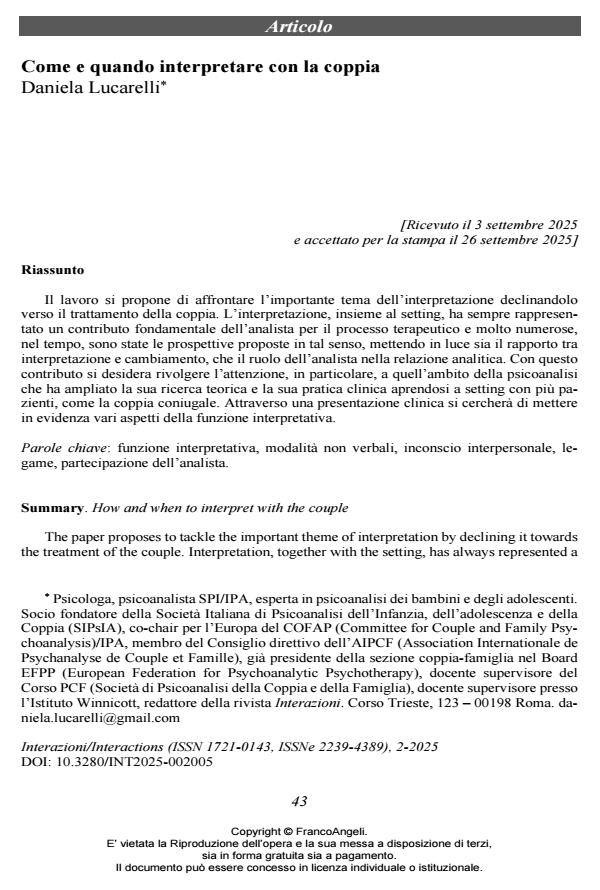
Article preview

FrancoAngeli is member of Publishers International Linking Association, Inc (PILA), a not-for-profit association which run the CrossRef service enabling links to and from online scholarly content.

The paper proposes to tackle the important theme of interpretation by declining it towards the treatment of the couple. Interpretation, together with the setting, has always represented a fundamental contribution of the analyst to the therapeutic process and many perspectives have been proposed in this sense over time, highlighting both the relationship between interpretation and change and the analyst’s role in the analytical relationship. With this contribution we wish to turn our attention, in particular, to that area of psychoanalysis that has expanded its theoretical research and clinical practice by opening up to multi-patient settings, such as the marital couple. Through a clinical presentation, an attempt will be made to highlight various aspects of the interpretative role.

Keywords: interpretative role, non-verbal communication, interpersonal unconscious, link, analyst involvement.

  1. Anzieu D. (1986). Scène de ménage et espace imaginaire du couple. Nouvelle Revue de Psychanalyse, 33: 75-79 (tr. it. Introduzione allo studio delle funzioni dell’Io pelle di coppia. Interazioni, 14, 2, 1999: 7-11).
  2. Balint A., Balint M. (1939). On transference and countertransference. The International Journal of Psychoanalysis, 20: 223.
  3. Bion W.R. (1980). Discussioni con W.R. Bion. Loescher: Torino, 1984.
  4. Dicks H. (1967). Marital Tensions. London: Routledge (tr. it. Tensioni coniugali. Roma: Borla, 1992).
  5. Freud S. (1913). L’interesse per la psicoanalisi. OSF, vol. 7. Torino: Bollati Boringhieri, 1975.
  6. Morgan M. (2019). Interpretation on couple and family psychoanalysis. Cross-cultural perspectives. NY: Routledge.
  7. Nicolò A.M. (2003). Utilità e limiti dell’interpretazione. In Fabozzi P., Forme dell’interpretare. Milano: FrancoAngeli.
  8. Nicolò A.M. (2005). Nuove forme di genitorialità. Riflessioni a partire da un caso di procreazione assistita. Interazioni, 1, 23: 43-52.
  9. Pichon Rivière E. (1979). Teoria del vinculo. Buenos Aires: Nueva Vision.
  10. Racker H. (1968). Studi sulla tecnica psicoanalitica. Roma: Armando, 1970.
  11. Sami-Ali M. (1984). Le visuel et le tactile. Paris: Dunod.
  12. Winnicott D.W. (1947). L’odio nel controtransfert. In Winnicott D.W., Dalla pediatria alla psicoanalisi. Martinelli: Firenze, 1975.
  13. Winnicott D.W. (1965). La famiglia e la maturità emotiva. In Winnicott D.W., La famiglia e lo sviluppo dell’individuo. Roma: Armando, 1968.
  14. Winnicott D.W. (1968). L’interpretazione in psicoanalisi. In Winnicott D.W., Esplorazioni psicoanalitiche. Milano: Cortina, 1995.

Daniela Lucarelli, Come e quando interpretare con la coppia in "INTERAZIONI" 2/2025, pp 43-54, DOI: 10.3280/INT2025-002005