Don Quixote of La Mancha: The emblem of the refusal to grow up and the impossibility of dreaming
Journal title PSICOANALISI
Author/s Marinella Linardos
Publishing Year 2026 Issue 2025/2
Language Italian Pages 13 P. 35-47 File size 84 KB
DOI 10.3280/PSI2025-002004
DOI is like a bar code for intellectual property: to have more infomation
click here
Below, you can see the article first page
If you want to buy this article in PDF format, you can do it, following the instructions to buy download credits
FrancoAngeli is member of Publishers International Linking Association, Inc (PILA), a not-for-profit association which run the CrossRef service enabling links to and from online scholarly content.
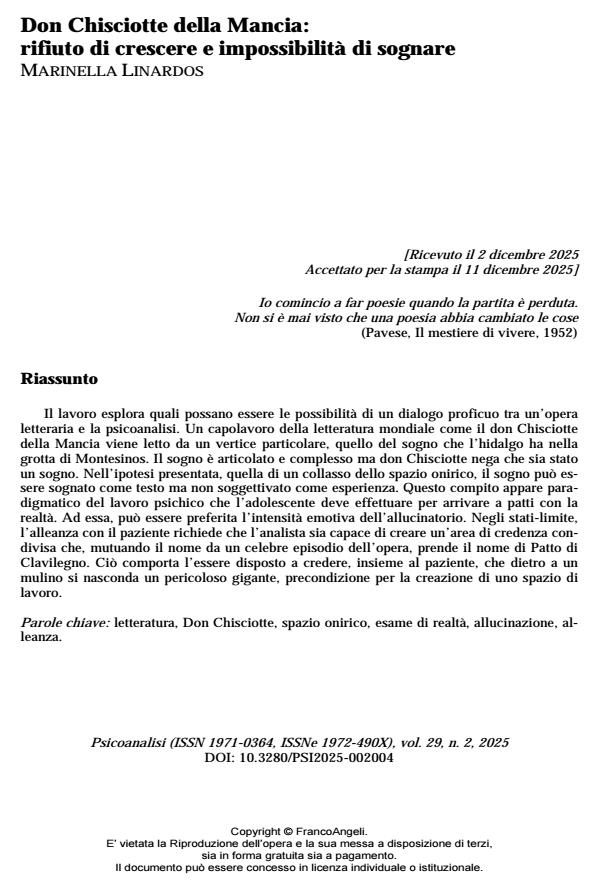
This paper explores the possibilities for a fruitful dialogue between literary work and psychoanalysis. A masterpiece of world literature like Don Quixote de la Mancha is interpreted from a particular angle: the dream the hidalgo has in the cave of Montesinos. The dream is detailed and complex, but Don Quixote denies it was a dream. In the hypothesis presented, that of a collapse of the dream space, the dream can be dreamed as a text but not subjectivized as an experience. This task appears paradigmatic of the psychic work the adolescent must undertake to come to terms with reality. The emotional intensity of the hallucinatory may be preferred to it. In borderline states, the alliance with the patient requires the analyst to be capable of creating a shared belief system, which, borrowing its name from a famous episode in the work, is called the Clavilegno Pact. This involves being willing to believe, along with the patient, that a dangerous giant lurks behind a mill, a prerequisite for creating a workspace.
Keywords: literature, Don Quixote, dream space, reality testing, hallucination, alliance, adolescence.
- Agamben G. (2005). Profanazioni. Roma: Nottetempo.
- Bion A. (1972). Apprendere dall’esperienza. Roma: Armando.
- Bion A. (1970). Attenzione e interpretazione. Roma: Armando.
- Botella C. Botella S. (2004). La raffigurabilità psichica. Roma: Borla.
- Bufalino G. (1982). Dizionario dei personaggi di romanzo. Milano: il Saggiatore
- Canna M. (2007). La cueva de Montesinos como microcosmo del Quijote. Artifara, 7: 3.
- Cervantes M. (1605, 1615). Don Quixote. Trans. Grossman. E. (2005). London: Vintage Books.
- Civitarese G., Ferro A. (2020). Vitalità e gioco in psicoanalisi. Milano: Cortina.
- Foucault M. (1966). Le mots et le choses. Paris: Gallimard.
- Freud S. (1923). Letter to Señtor Luis Lopez-Ballesteros Y De Torres. In: S.E., vol. 19, London: Hogart Press, p. 289.
- Freud S. [1899 (1900)]. L’interpretazione dei sogni. In: OSF, vol. 3, Torino: Boringhieri, p. 1968.
- Grotstein S.J. (2007). Un raggio di intensa oscurità, Milano: Cortina, 2010.
- Kafka F. (1998). Tutti i racconti. Roma: Mondadori
- Khan M (1979). Lo spazio privato del Sé. Torino: Bollati Boringhieri 1979.
- Laplanche J., Pontalis J.B. (1967). Enciclopedia della Psicoanalisi. (trad. it. G. B. Contri, Bari: Laterza, 1968).
- Lukacs G. (1920). La teoria del romanzo. Milano: SE, 1999.
- Ogden T. (2019). Ontological Psychoanalysis or “What Do You Want to Be When You Grow Up?”. The Psychoanalytic Quarterly, 88: 4, 2019.
- Pavese C. (1952). Il mestiere di vivere. Torino: Einaudi.
- Percas de Ponseti H. (1975). Cervantes e il suo concetto di arte. Madrid: Gredos.
- Pontalis B.J. (1977). Tra sogno e dolore. Roma: Borla, 1988.
- Roussillon R. (2015). An introduction to the work on primary symbolization. The International journal of psycho-analysis. 96: 583-94. DOI: 10.1111/1745-8315.12347
- Smirgel Chasseguet J. (1975). L’ideale dell’Io. Milano: Raffaello Cortina, 1991.
- Steiner J. (2020). Learning from Don Quixote. International Journal of Psychoanalysis 101, 1: 1-12.
Marinella Linardos, Don Chisciotte della Mancia: rifiuto di crescere e impossibilità di sognare in "PSICOANALISI" 2/2025, pp 35-47, DOI: 10.3280/PSI2025-002004