The social determinants of psychoanalytic therapy
Journal title PSICOTERAPIA E SCIENZE UMANE
Author/s Erich Fromm
Publishing Year 2026 Issue 2026/1
Language Italian Pages 25 P. 13-42 File size 404 KB
DOI 10.3280/PU2026-001002
DOI is like a bar code for intellectual property: to have more infomation
click here
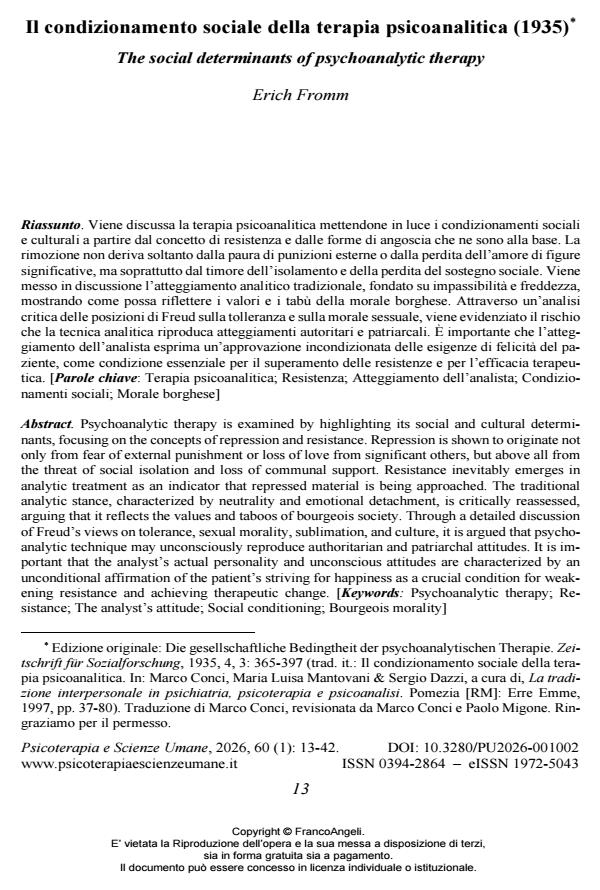
Below, you can see the article first page
If you want to buy this article in PDF format, you can do it, following the instructions to buy download credits
FrancoAngeli is member of Publishers International Linking Association, Inc (PILA), a not-for-profit association which run the CrossRef service enabling links to and from online scholarly content.
Psychoanalytic therapy is examined by highlighting its social and cultural determinants, focusing on the concepts of repression and resistance. Repression is shown to originate not only from fear of external punishment or loss of love from significant others, but above all from the threat of social isolation and loss of communal support. Resistance inevitably emerges in analytic treatment as an indicator that repressed material is being approached. The traditional analytic stance, characterized by neutrality and emotional detachment, is critically reassessed, arguing that it reflects the values and taboos of bourgeois society. Through a detailed discussion of Freud’s views on tolerance, sexual morality, sublimation, and culture, it is argued that psychoanalytic technique may unconsciously reproduce authoritarian and patriarchal attitudes. It is important that the analyst’s actual personality and unconscious attitudes are characterized by an unconditional affirmation of the patient’s striving for happiness as a crucial condition for weakening resistance and achieving therapeutic change.
Keywords: Psychoanalytic therapy; Resistance; The analyst’s attitude; Social conditioning; Bourgeois morality
Erich Fromm, Il condizionamento sociale della terapia psicoanalitica (1935) in "PSICOTERAPIA E SCIENZE UMANE" 1/2026, pp 13-42, DOI: 10.3280/PU2026-001002