Psychoanalytic therapies are effective
Journal title PSICOTERAPIA E SCIENZE UMANE
Author/s Thomas Rabeyron
Publishing Year 2026 Issue 2026/1
Language Italian Pages 5 P. 101-105 File size 236 KB
DOI 10.3280/PU2026-001006
DOI is like a bar code for intellectual property: to have more infomation
click here
Below, you can see the article first page
If you want to buy this article in PDF format, you can do it, following the instructions to buy download credits
FrancoAngeli is member of Publishers International Linking Association, Inc (PILA), a not-for-profit association which run the CrossRef service enabling links to and from online scholarly content.
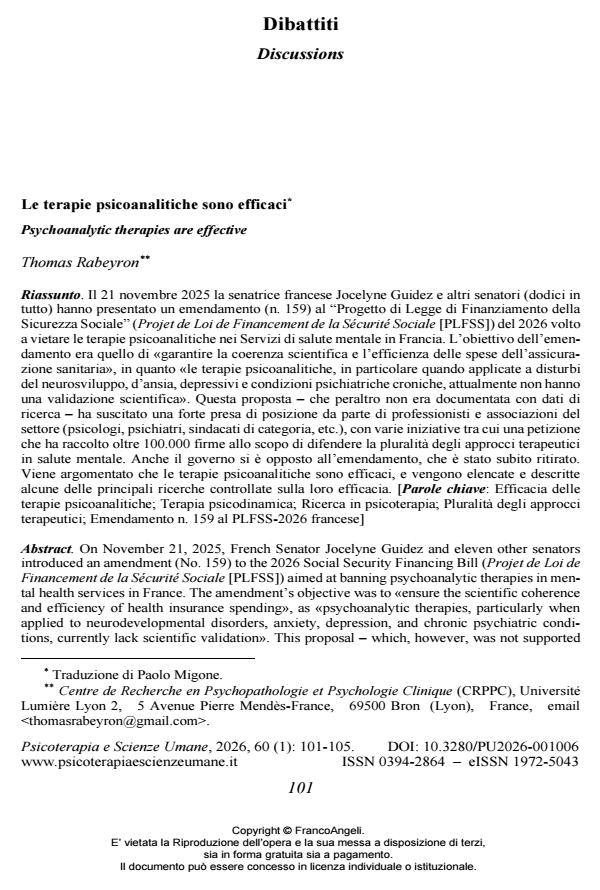
On November 21, 2025, French Senator Jocelyne Guidez and eleven other senators introduced an amendment (No. 159) to the 2026 Social Security Financing Bill (Projet de Loi de Financement de la Sécurité Sociale [PLFSS]) aimed at banning psychoanalytic therapies in mental health services in France. The amendment’s objective was to «ensure the scientific coherence and efficiency of health insurance spending», as «psychoanalytic therapies, particularly when applied to neurodevelopmental disorders, anxiety, depression, and chronic psychiatric conditions, currently lack scientific validation». This proposal – which, however, was not supported by research data – caused great concern among clinicians and the academic community (psychologists, psychiatrists, professional organizations, etc.), with various initiatives, including a petition that collected over 100,000 signatures to defend the diversity of therapeutic approaches in mental health. The government also opposed the amendment, which was quickly withdrawn. It is argued that psychoanalytic therapies are effective, and some of the main controlled studies on the effectiveness of psychoanalytic therapies are listed and described.
Keywords: Efficacy of psychoanalytic therapies; Psychodynamic therapy; Psychotherapy research; Plurality of psychotherapeutic approaches; Amendment no. 159 to the 2026 PLFSS of France
Thomas Rabeyron, Le terapie psicoanalitiche sono efficaci in "PSICOTERAPIA E SCIENZE UMANE" 1/2026, pp 101-105, DOI: 10.3280/PU2026-001006