Some reflections on the analytic third: Postmodernism, psychoanalysis, and psychopathology

Journal title PSICOTERAPIA E SCIENZE UMANE
Author/s Mark L. Ruffalo
Publishing Year 2026 Issue 2026/1
Language Italian Pages 11 P. 108-118 File size 275 KB
DOI 10.3280/PU2026-001008
DOI is like a bar code for intellectual property: to have more infomation click here

Below, you can see the article first page

If you want to buy this article in PDF format, you can do it, following the instructions to buy download credits
Article preview

FrancoAngeli is member of Publishers International Linking Association, Inc (PILA), a not-for-profit association which run the CrossRef service enabling links to and from online scholarly content.

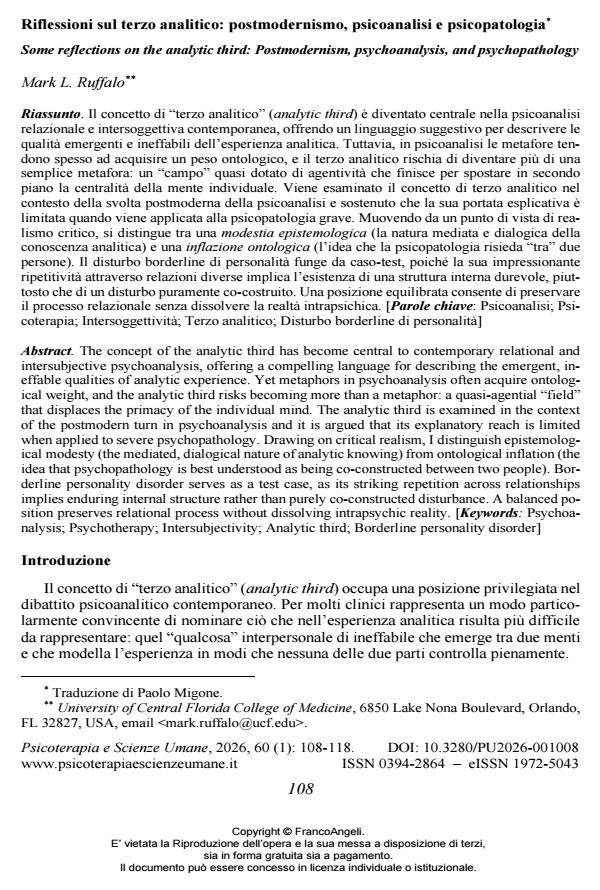
The concept of the analytic third has become central to contemporary relational and intersubjective psychoanalysis, offering a compelling language for describing the emergent, ineffable qualities of analytic experience. Yet metaphors in psychoanalysis often acquire ontological weight, and the analytic third risks becoming more than a metaphor: a quasi-agential “field” that displaces the primacy of the individual mind. The analytic third is examined in the context of the postmodern turn in psychoanalysis and it is argued that its explanatory reach is limited when applied to severe psychopathology. Drawing on critical realism, I distinguish epistemological modesty (the mediated, dialogical nature of analytic knowing) from ontological inflation (the idea that psychopathology is best understood as being co-constructed between two people). Borderline personality disorder serves as a test case, as its striking repetition across relationships implies enduring internal structure rather than purely co-constructed disturbance. A balanced position preserves relational process without dissolving intrapsychic reality.

Keywords: Psychoanalysis; Psychotherapy; Intersubjectivity; Analytic third; Borderline personality disorder

  1. Adler G. (1985). Borderline Psychopathology and Its Treatment. New York: Aronson.
  2. Adler G. (1989). Uses and limitations of Kohut’s self psychology in the treatment of borderline patients. Journal of the American Psychoanalytic Association, 37, 3: 761-785. DOI: 10.1177/000306518903700309
  3. Adler G. & Buie D. (1979). Aloneness and borderline psychopathology: The possible relevance of child development issues. International Journal of Psychoanalysis, 60, 1: 83-96.
  4. Barnes J. (2025). The myth of the isolated mind. Introducing relational psychology or how relationships shape mental health. Psychology Today, July 25, 2025: www.psychologytoday.com/us/blog/the-between-us/202507/the-myth-of-the-isolated-mind.
  5. Bhaskar R. (1975). A Realist Theory of Science. Leeds, UK: Leeds Books.
  6. Brandchaft B. & Stolorow R.D. (1984). The borderline concept: Pathological character or iatrogenic myth? In: Lichtenberg J., Bornstein M. & Silver D., editors, Empathy II. Hillsdale, NJ: Analytic Press, 1984, pp. 333-358.
  7. Burnham D.L., Gladstone A.I. & Gibson R.W. (1969). Schizophrenia and the Need-Fear Dilemma. New York: International Universities Press.
  8. Eagle M.N. (2000). La svolta post-moderna in psicoanalisi. Psicoterapia e Scienze Umane, 34, 4: 5-44 (Edizione su Internet: http://priory.com/ital/riviste/psicouman/eaglepost.htm) (trad. inglese: The postmodern turn in psychoanalysis: A critique. Psychoanalytic Psychology, 2003, 20, 3: 411-424. DOI: 10.1037/0736-9735.20.3.411).
  9. Eagle M.N., Wolitzky D.L. & Wakefield J.C. (2001). The analyst’s knowledge and authority: A critique of the “new view” in psychoanalysis. Journal of the American Psychoanalytic Association, 49, 2: 457-489. DOI: 10.1177/00030651010490020301.
  10. Giovacchini P. (2005). Subjectivity and the ephemeral mind. In: Mills J., editor, Relational and Intersubjective Perspectives in Psychoanalysis: A Critique. Lanham, MD: Aronson, 2005, cap. 4.
  11. Gunderson J.G. (1984). Borderline Personality Disorder. Washington, D.C.: American Psychiatric Association.
  12. Gunderson J.G. & Lyons-Ruth K. (2008). BPD’s interpersonal hypersensitivity phenotype: A gene-environment-developmental model. Journal of Personality Disorders, 22, 1: 22-41.
  13. Kernberg O.F. (1975). Borderline Conditions and Pathological Narcissism. New York: Aron-son (trad. it.: Sindromi marginali e narcisismo patologico. Torino: Boringhieri, 1978).
  14. Masterson J.F. (1981). The Narcissistic and Borderline Disorders: An integrated developmental approach. New York: Brunner/Mazel.
  15. Mills J. (2005). A critique of relational psychoanalysis. Psychoanalytic Psychology, 22, 2: 155-188. DOI: 10.1037/0736-9735.22.2.155
  16. Mills J. (2012). Conundrums: A critique of contemporary psychoanalysis. London: Routledge.
  17. Muskin P.R. (2025). Doctor I would like to die. Please help. Psychodynamic Psychiatry, 53, 1: 18-21.
  18. Ruffalo M.L. (2025a). Toward a critical realist understanding of psychoanalytic interpretation. psychotherapy.net, October 29, 2025: www.psychotherapy.net/blog/title/toward-a-critical-realist-understanding-of-psychoanalytic-interpretation.
  19. Ruffalo M.L. (2025b). Heads I win, tails you lose: Interpersonal aspects of borderline personality disorder. Bulletin of the Menninger Clinic, 89, 1: 52-69.
  20. Ruffalo M.L. (2025c). Some reflections on the “analytic third”. What happens to psychoanalysis when the individual mind disappears? Psychology Today, November 12, 2025: www.psychologytoday.com/sg/blog/from-freud-to-fluoxetine/202511/some-problems-with-the-analytic-third.
  21. Ruffalo M.L. (2026). Fundamental problems in borderline personality disorder. Psychoanalytic Review, 113, in press.
  22. Ogden T.H. (1994). The analytic third. Working with intersubjective clinical facts. International Journal of Psychoanalysis, 75, 1: 3-19 (trad. it.: Il terzo analitico. Lavorando con fatti clinici intersoggettivi. Psicoterapia Psicoanalitica, 1997, IV, 2: 48-75. Anche in: Soggetti dell’analisi. Milano: Masson, 1999, cap. 5; Roma: Astrolabio, 2024, cap. 5).
  23. Ogden T.H. (1995). Analyzing forms of aliveness and deadness of the transference-countertransference. International Journal of Psychoanalysis, 76, 4: 695-709.

Mark L. Ruffalo, Riflessioni sul terzo analitico: postmodernismo, psicoanalisi e psicopatologia in "PSICOTERAPIA E SCIENZE UMANE" 1/2026, pp 108-118, DOI: 10.3280/PU2026-001008