From curri-culum design to teaching practice: misalignments and fracture points in shared mediation

Journal title CADMO
Author/s Laura Parigi, Maria Elisabetta Cigognini, Sonia Sorgato
Publishing Year 2026 Issue 2025/2
Language Italian Pages 14 P. 115-128 File size 190 KB
DOI 10.3280/CAD2025-002007
DOI is like a bar code for intellectual property: to have more infomation click here

Below, you can see the article first page

If you want to buy this article in PDF format, you can do it, following the instructions to buy download credits
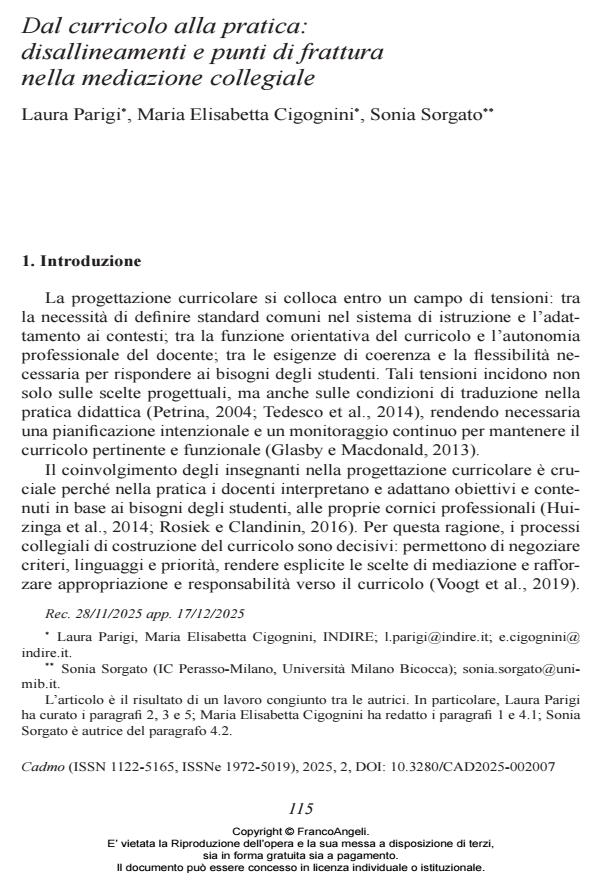
Article preview

FrancoAngeli is member of Publishers International Linking Association, Inc (PILA), a not-for-profit association which run the CrossRef service enabling links to and from online scholarly content.

Curriculum design constitutes a crucial juncture for the quality of edu-cational systems and is situated at the center of structural tensions between standardization and contextualization, normative prescription and professio-nal autonomy. Within this framework, misalignments between the intended, planned, enacted, and assessed curriculum cannot be understood merely as technical discrepancies, but rather as indicators of the mediations that shape design processes and of their criticalities, particularly at the collegial level. This contribution presents preliminary findings from a qualitative study conducted on a non-representative sample of 34 primary school teachers, aimed at investigating the “fracture points” between the school-level cur-riculum and individual planning. The analysis highlights recurring misali-gnments related to the formulation of learning objectives, their adequacy with respect to time constraints, contexts, and students’ learning levels, as well as their translatability into assessment practices. The adaptations enacted by teachers are predominantly individual and are rarely renegotia-ted in collegial settings, producing systemic effects such as the coexistence of parallel curricula within schools. The findings outline an initial map of critical points, which may support more conscious, shared, and reflective processes of curriculum alignment.

Keywords: curriculum design; curriculum alignment

  1. Agrusti, G., Guerzoni, G., Matteucci, M. C. (2018), I nodi della ricerca formazione. In La ricerca formazione: temi, esperienze, prospettive. Milano: FrancoAngeli, pp. 170-179.
  2. Alvunger, D. (2024), “Curriculum making across sites of activity in upper secondary school vocational education and training: A review of the research in Sweden”, International Journal for Research in Vocational Education and Training, 11 (3), pp. 303-333.
  3. Anderson, L. W. (2002), “Curricular alignment: A re-examination”, Theory into Practice, 41 (4), pp. 255-260.
  4. Blumberg, P. (2009), “Maximizing Learning through Course Alignment and Expe-rience with Different Types of Knowledge”, Innovative Higher Education, 34, pp. 93-103,
  5. Blumer, H. (1969), Symbolic interactionism: Perspective and method. Englewood Cliffs: Prentice-Hall.
  6. Bonnat, C., Marzin, P., Luengo, V., Trgalová, J., Chaachoua, H., Bessot, A. (2020), “Proposition d’un modèle pour la compréhension des décisions didactiques d’un enseignant”, Éducation et didactique, 14 (3), pp. 69-90.
  7. Bowen, G. A. (2020), Sensitizing concepts. London: SAGE.
  8. Cardarello, R. (2018), Dimensioni metodologiche nella ricerca-formazione. In Asquini, G. (a cura di), La ricerca-formazione. Temi, esperienze, prospettive. Milano: FrancoAngeli, pp. 42-51.
  9. Case, B., Zucker, S. (2005), Horizontal and vertical alignment. London: Pearson Education.
  10. Charmaz, K. (2006), Constructing grounded theory: A practical guide through qua-litative analysis. London: SAGE.
  11. Colton, A. B., Sparks-Langer, G. M. (1993), “A conceptual framework to guide the development of teacher reflection and decision making”, Journal of Teacher Education, 44 (1), pp. 45-54.
  12. De Almeida, S., Viana, J. (2023), “Teachers as curriculum designers: What knowled-ge is needed?”, The Curriculum Journal, 34 (3), pp. 357-374.
  13. Finnanger, T., Prøitz, T. (2024), “Teachers as national curriculum makers: does in-volvement equal influence?”, Journal of Curriculum Studies, 56, pp. 220-234, DOI: 10.1080/00220272.2024.2307450
  14. Frost, D., Ackrill, R. (2025), “The multiple dimensions of curriculum mapping: de-signing a comprehensive outcomes-based framework”, London Review of Edu-cation, 23 (1), 17,
  15. Glasby, T., Macdonald, D. (2013), Negotiating the curriculum: Challenging the so-cial relationships in teaching. In Critical inquiry and problem solving in physical education. London: Routledge, pp. 133-144.
  16. Glaser, B. G., Strauss, A. L. (2017), The discovery of grounded theory: Strategies for qualitative research. New York: Routledge.
  17. Goodlad, J. I. (1991), Curriculum making as a sociopolitical process. In The politics of curriculum decision-making. New York: State University of New York Press, pp. 9-23.
  18. Harden, R. M. (2001), “AMEE Guide No. 21: Curriculum mapping: a tool for transpa-rent and authentic teaching and learning”, Medical Teacher, 23 (2), pp. 123-137.
  19. Harrison, J. M., Williams, V. R. (2023), A guide to curriculum mapping: Creating a collaborative, transformative, and learner-centered curriculum. New York: Routledge.
  20. Huizinga, T., Handelzalts, A., Nieveen, N., Voogt, J. (2014), “Teacher involvement in curriculum design: need for support to enhance teachers’ design expertise”, Journal of Curriculum Studies, 46, pp. 33-57, DOI: 10.1080/00220272.2013.834077
  21. Khan, H. F., Qayyum, S., Beenish, H., Khan, R. A., Iltaf, S., Faysal, L. R. (2025), “Determining the alignment of assessment items with curriculum goals through document analysis by addressing identified item flaws”, BMC Medical Educa-tion, 25 (1), 200.
  22. Kuckartz, U., Rädiker, S. (2023), Qualitative content analysis: Methods, practice and software. London, SAGE, 2nd ed., DOI: 10.4135/9781036212940
  23. Martineau, J., Paek, P., Keene, J., Hirsch, T. (2007), “Integrated, comprehensive alignment as a foundation for measuring student progress”, Educational Mea-surement: Issues and Practice, 26, pp28-35, https://doi. org/10.1111/j.1745-3992.2007.00086.x.
  24. Martone, A., Sireci, S. G. (2009), “Evaluating alignment between curriculum, asses-sment, and instruction”, Review of Educational Research, 79 (4), pp. 1332-1361. Mayring, P. (2014), Qualitative content analysis: Theoretical background and proce-dures. In Approaches to qualitative research in mathematics education: Exam-ples of methodology and methods. Dordrecht: Springer Netherlands, pp. 365-380.
  25. Nigris, E., Cardarello, R., Losito, B., Vannini, I. (2020), “Ricerca-formazione e mi-glioramento della scuola. Il punto di vista del CRESPI”, RicercAzione, 12 (2), pp. 225-237.
  26. Petrina, S. (2004), “The politics of curriculum and instructional design/theory/form: Critical problems, projects, units, and modules”, Interchange, 35 (1), pp. 81-126. Pontecorvo, C., Ligorio, M. (2010), La scuola come contesto. Roma: Carocci.
  27. Priestley, M., Biesta, G. J., Philippou, S., Robinson, S. (2015), The teacher and the curriculum: Exploring teacher agency. In The SAGE Handbook of Curriculum, Pedagogy and Assessment. London: SAGE, vol. 2, pp. 187-201.
  28. Roach, A., Niebling, B., Kurz, A. (2008), “Evaluating the alignment among curriculum, instruction, and assessments: Implications and applications for research and practi-ce”, Psychology in the Schools, 45, pp. 158-176,
  29. Tedesco, J. C., Operti, R., Amadio, M. (2014), “The curriculum debate: Why it is important today”, Prospects, 44 (4), pp. 527-546.
  30. Tekir, S. (2021), “Alignment of the intended, enacted, received and assessed curricu-lum in EFL pre-service measurement and evaluation education”, Education and Science, 46 (208), pp. 157-188.
  31. Voogt, J., Westbroek, H., Handelzalts, A., Walraven, A., McKenney, S., Pieters, J., De Vries, B. (2011), “Teacher learning in collaborative curriculum design”, Tea-ching and Teacher Education, 27 (8), pp. 1235-1244.
  32. Wenger, E. (1998), Comunità di pratica. Milano: Raffaello Cortina.
  33. Wijngaards-de Meij, L., Merx, S. (2018), “Improving curriculum alignment and achieving learning goals by making the curriculum visible”, International Jour-nal for Academic Development, 23 (3), pp. 219-231.
  34. Zucchermaglio, C., Alby, F. (2006), Psicologia culturale delle organizzazioni. Roma: Carocci.

Laura Parigi, Maria Elisabetta Cigognini, Sonia Sorgato, Dal curricolo alla pratica: disallineamenti e punti di frattura nella mediazione collegiale in "CADMO" 2/2025, pp 115-128, DOI: 10.3280/CAD2025-002007