Vulnerabilità abitativa e salute in età anziana: associazioni e diseguaglianze

Journal title SALUTE E SOCIETÀ
Author/s Marco Arlotti, Mariateresa Ciommi, Luigi Bernardi
Publishing Year 2026 Issue 2026/1
Language Italian Pages 17 P. 28-44 File size 489 KB
DOI 10.3280/SES2026-001003
DOI is like a bar code for intellectual property: to have more infomation click here

Below, you can see the article first page

If you want to buy this article in PDF format, you can do it, following the instructions to buy download credits
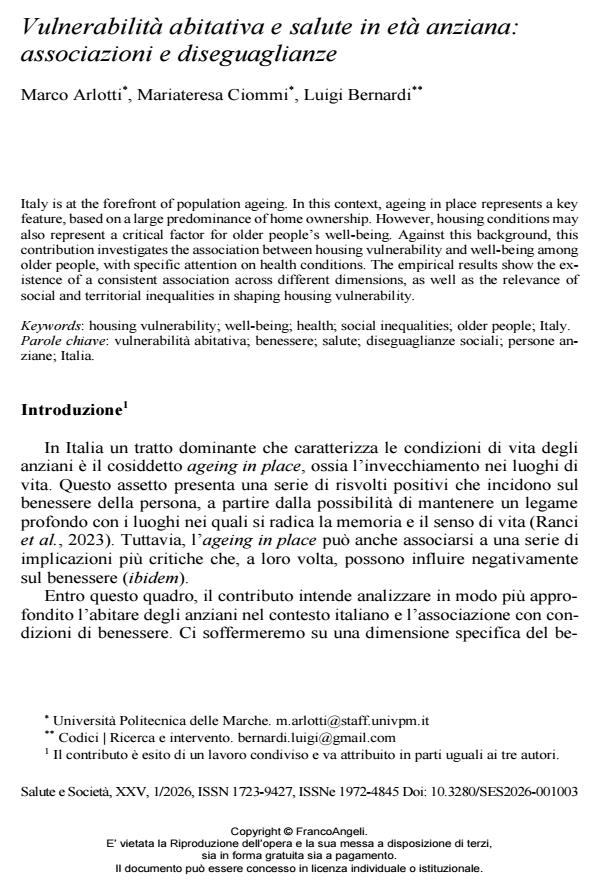
Article preview

FrancoAngeli is member of Publishers International Linking Association, Inc (PILA), a not-for-profit association which run the CrossRef service enabling links to and from online scholarly content.

Italy is at the forefront of population ageing. In this context, ageing in place represents a key feature, based on a large predominance of home ownership. However, housing conditions may also represent a critical factor for older people’s well-being. Against this background, this contribution investigates the association between housing vulnerability and well-being among older people, with specific attention on health conditions. The empirical results show the existence of a consistent association across different dimensions, as well as the relevance of social and territorial inequalities in shaping housing vulnerability.

Keywords: housing vulnerability; well-being; health; social inequalities; older people; Italy.

  1. Alkire S., Foster J. (2011). Counting and multidimensional poverty measurement. Journal of public economics, 95(7-8): 476-487.
  2. Arlotti M. (2024). Anziani, povertà e diseguaglianze sociali. Una prospettiva multidimensionale. Bologna: Il Mulino.
  3. Arlotti M., Bettin G., Ciommi M., Ermini B., Mariani F., Recchioni M.C., Spina E., Alici A., Espinosa E. (2024). Rapporto di revisione interdisciplinare della letteratura. WP1, progetto VAI - Vulnerabilità abitativa e di salute degli Anziani in Italia. Università Politecnica delle Marche. Testo disponibile al sito: https://vai.econ.univpm.it/files/WP1-D-1.1-D-1.2-Revisione_della_letteratura_interdisciplinare_finale.pdf (25/11/2025).
  4. Balestra C., Sultan, J. (2013). Home Sweet Home: the Determinants of Residential Satisfaction and its Relation with Well-being. OECD Statistics Working Papers, No. 2013/05. Paris: OECD Publishing.
  5. De Rosa D. (2022). Are Italians getting multidimensionally poorer? Evidence on the lack of equitable and sustainable well-being. Italian Economic Journal, 8(1): 145-174.
  6. Eurostat (2025). Glossary: Under-occupied dwelling. Testo disponibile al sito: https://ec.europa.eu/eurostat/statistics-explained/index.php?title=Glossary:Under-occupied_dwelling (25/11/2025).
  7. Golant S.M. (2008). Commentary: Irrational Exuberance for the Aging in Place of Vulnerable Low-Income Older Homeowners. Journal of Aging & Social Policy, 20(4): 379-397. DOI: 10.1080/0895942080213143
  8. Howden-Chapman P., Bennett J., Edwards R., Jacobs D., Nathan K., Ormandy D. (2023). Review of the Impact of Housing Quality on Inequalities in Health and Well-Being. Annual Review of Public Health, 44: 233-54.
  9. ISTAT (2025). Rapporto Annuale 2025. La situazione del Paese. Roma: Istituto Nazionale di Statistica. Testo disponibile al sito: https://www.istat.it/produzione-editoriale/rapporto-annuale-2025-la-situazione-del-paese-il-volume/ (25/11/2025).
  10. Matel A., Marcinkiewicz J. (2021). Did the Elderly Suffer More from Housing Deprivation? Evidence from Poland. International Journal of Social Economics, 48(1): 105-119. DOI: 10.1108/IJSE-06-2020-036
  11. Nolan B., Winston N. (2011). Dimensions of Housing Deprivation for Older People in Ireland. Social Indicators Research, 104: 369-385.
  12. OECD (2023a). Measuring Population Mental Health. Paris: OECD Publishing.
  13. OECD (2023b). Health at a Glance 2023: OECD Indicators. Paris: OECD Publishing.
  14. Oswald F., Wahl H.W. (2004). Housing and Health in Later Life. Reviews on Environmental Health, 19(3-4): 223-252.
  15. Polinesi G., Ciommi M., Mariani F. (2025). Unveiling multidimensional poverty across Italian Provinces using small area estimation and penalized power means. Ann Oper Res.
  16. Ranci C., Arlotti M., Lamura G, Martinelli F., a cura di (2023). La solitudine dei numeri ultimi. Bologna: Il Mulino.
  17. Schr?der-Butterfill E., Marianti R. (2006). A framework for understanding old-age vulnerabilities. Ageing & Society, 26(1): 9-35. DOI: 10.1017/S0144686X0500442
  18. Simcock N.K., Jenkins E.H., Lacey-Barnacle M., Martiskainen M., Mattioli G., Hopkins D. (2021). Identifying double energy vulnerability: A systematic and narrative review of groups at-risk of energy and transport poverty in the global north, Energy Research & Social Science, 82: 102351,
  19. Stone W., Sharam A., Goodall Z., Reynolds M., Sinclair S., Faulkner D., James A., Zhang T. (2024). Gendered Housing Matters: Toward Gender-Responsive Data and Policy Making. AHURI Final Report No. 415. Melbourne: Australian Housing and Urban Research Institute Limited.
  20. Van der Meer M.J., Droogleever Fortuijn J., Thissen F. (2008). Vulnerability and environmental stress of older adults in deprived neighbourhoods in The Netherlands. Tijdschrift voor Economische en Sociale Geografie, 99(1): 53-64.
  21. Vasquez C., Fernandez A., Borrell, C. (2022). Gender-Based Inequalities in the Effects of Housing on Health: A Critical Review. SSM - Population Health, 17, 101068: 1-13.
  22. WHO (2018). Housing and health guidelines. Geneva: World Health Organization.
  23. Windle G.S., Burholt V., Edwards R.T. (2006). Housing related difficulties, housing tenure and variations in health status: evidence from older people in Wales. Health & Place, 12: 267-278.

Marco Arlotti, Mariateresa Ciommi, Luigi Bernardi, Vulnerabilità abitativa e salute in età anziana: associazioni e diseguaglianze in "SALUTE E SOCIETÀ" 1/2026, pp 28-44, DOI: 10.3280/SES2026-001003