Crisi economica e benessere degli anziani in Italia: l’impatto di lungo periodo della Grande Recessione

Journal title SALUTE E SOCIETÀ
Author/s Eleonora Vlach, Paolo Pasetti, Loris Vergolini
Publishing Year 2026 Issue 2026/1
Language Italian Pages 14 P. 45-58 File size 631 KB
DOI 10.3280/SES2026-001004
DOI is like a bar code for intellectual property: to have more infomation click here

Below, you can see the article first page

If you want to buy this article in PDF format, you can do it, following the instructions to buy download credits
Article preview

FrancoAngeli is member of Publishers International Linking Association, Inc (PILA), a not-for-profit association which run the CrossRef service enabling links to and from online scholarly content.

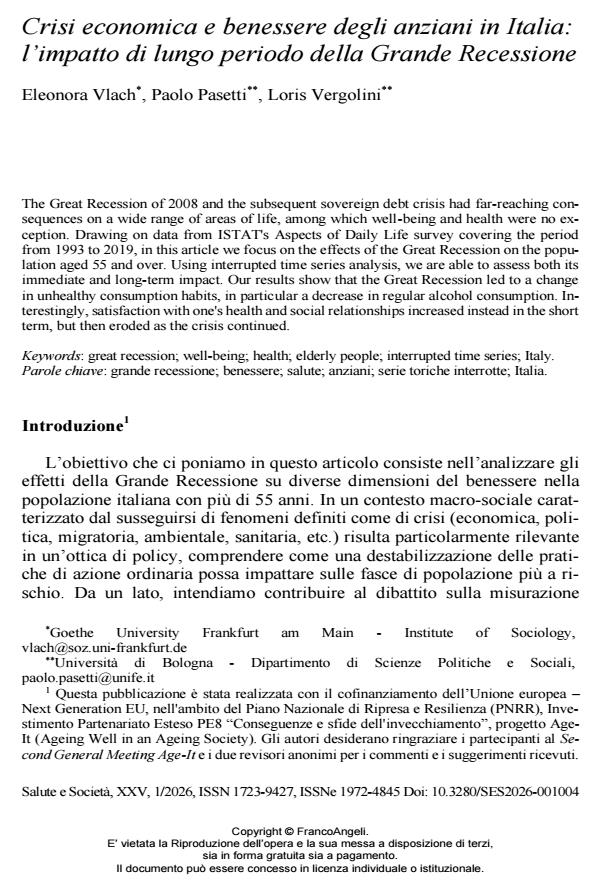
The Great Recession of 2008 and the subsequent sovereign debt crisis had far-reaching consequences on a wide range of areas of life, among which well-being and health were no exception. Drawing on data from ISTAT's Aspects of Daily Life survey covering the period from 1993 to 2019, in this article we focus on the effects of the Great Recession on the population aged 55 and over. Using interrupted time series analysis, we are able to assess both its immediate and long-term impact. Our results show that the Great Recession led to a change in unhealthy consumption habits, in particular a decrease in regular alcohol consumption. Interestingly, satisfaction with one's health and social relationships increased instead in the short term, but then eroded as the crisis continued.

Keywords: great recession; well-being; health; elderly people; interrupted time series; Italy.

  1. Avramov D., Maskova M. (2003). Active Ageing in Europe. Population studies. Strasbourg: Council of Europe Publishing.
  2. Benvenga L. (2025). Anziani e processi di autonomia. Lo stato dell’arte della letteratura sull’invecchiamento attivo. Salute e Società, 2: 9-19. DOI: 10.3280/SES2025-00200
  3. Bister L., Janssen F.,Vogt T. (2025). Do parents suffer too? Children’s unemployment and their parents’ mental health in 12 European countries. European Sociological Review, online first.
  4. Burgard S.A., Kalousova L. (2015). Effects of the Great Recession: Health and Well-Being. Annual Review of Sociology, 41: 181-201.
  5. Catalano R., Goldman-Mellor S., Saxton K., et al. (2011) The health effect of economic decline. Annual Review of Public Health, 32: 431-450.
  6. Davis M.E., Laden F., Hart J.E., et al. (2010). Economic activity and trends in ambient air pollution. Environmental Health Perspectives, 118: 614-619.
  7. Egidi V., Demuru E. (2018). Impatto delle grandi crisi economiche su salute e mortalità: il caso italiano. In: ISTAT, a cura di, La società italiana e le grandi crisi economiche 1929-2016. Roma: Annali di Statistica.
  8. Geven K., Skopek J., Triventi M. (2018). How to increase PhD completion rates? An impact evaluation of two reforms in a selective graduate school, 1976–2012. Research in higher education, 59: 529-552.
  9. Istat (2024). Il benessere equo e sostenibile in Italia. Roma: Istituto Nazionale di Statistica.
  10. Linden A. (2015). Conducting interrupted time-series analysis for single-and multiple-group comparisons. The Stata Journal, 15: 480-500. DOI: 10.1177/1536867X150150020
  11. Manzoni A., Gebel M. (2024). Young adults’ labour market transitions and intergenerational support in Germany. European Sociological Review, 40: 99-115.
  12. Meyer V., Werding M. (2010). Ageing and the welfare state: securing sustainability. Oxford Review of Economic Policy, 26: 655-673.
  13. Principi A., Di Rosa M., Domínguez-Rodríguez A., et al. (2023). The active ageing index and policy making in Italy. Ageing & Society, 43: 2554-2579. DOI: 10.1017/S0144686X2100183
  14. Ruhm C.J. (2005). Healthy living in hard times. Journal of Health Economics, 24: 341-363.
  15. Sollis K., Biddle N., Maulana H., et al. (2024). Measuring wellbeing across culture and context – are we getting it right? Evaluating the variation in wellbeing conceptualisations throughout the world. Social Indicators Research, 174: 123-155.
  16. van den Berg G.J., Ulf-G. Gerdtham, von Hinke S., et al. (2017). Mortality and the business cycle: Evidence from individual and aggregated data. Journal of Health Economics, 56: 61-70.

Eleonora Vlach, Paolo Pasetti, Loris Vergolini, Crisi economica e benessere degli anziani in Italia: l’impatto di lungo periodo della Grande Recessione in "SALUTE E SOCIETÀ" 1/2026, pp 45-58, DOI: 10.3280/SES2026-001004