Sperimentare le tecnologie digitali per il benessere degli anziani fragili: risultati e prospettive per la formazione

Journal title SALUTE E SOCIETÀ
Author/s Lara Toccafondi, Massimo Campedelli
Publishing Year 2026 Issue 2026/1
Language Italian Pages 15 P. 114-128 File size 311 KB
DOI 10.3280/SES2026-001008
DOI is like a bar code for intellectual property: to have more infomation click here

Below, you can see the article first page

If you want to buy this article in PDF format, you can do it, following the instructions to buy download credits
Article preview

FrancoAngeli is member of Publishers International Linking Association, Inc (PILA), a not-for-profit association which run the CrossRef service enabling links to and from online scholarly content.

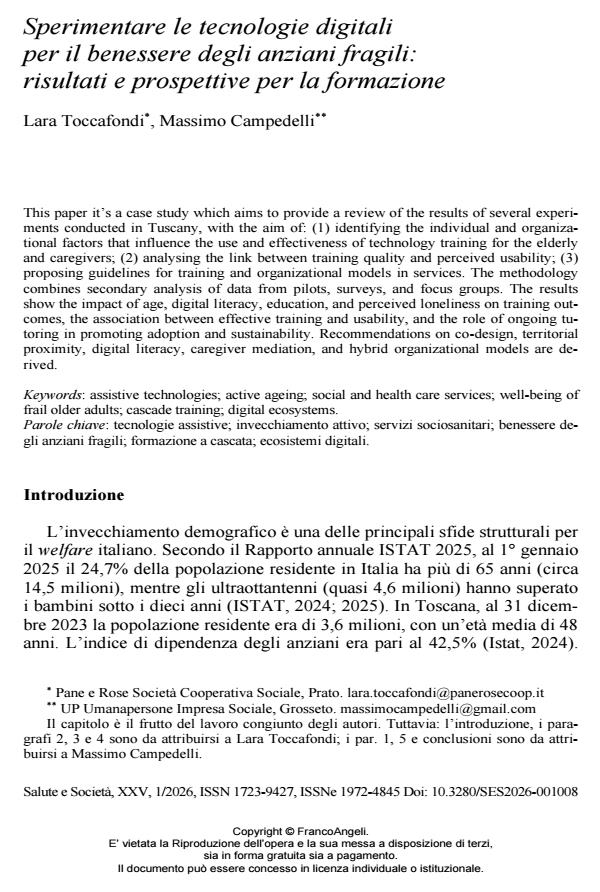
This paper it’s a case study which aims to provide a review of the results of several experiments conducted in Tuscany, with the aim of: (1) identifying the individual and organizational factors that influence the use and effectiveness of technology training for the elderly and caregivers; (2) analysing the link between training quality and perceived usability; (3) proposing guidelines for training and organizational models in services. The methodology combines secondary analysis of data from pilots, surveys, and focus groups. The results show the impact of age, digital literacy, education, and perceived loneliness on training outcomes, the association between effective training and usability, and the role of ongoing tutoring in promoting adoption and sustainability. Recommendations on co-design, territorial proximity, digital literacy, caregiver mediation, and hybrid organizational models are derived.

Keywords: assistive technologies; active ageing; social and health care services; well-being of frail older adults; cascade training; digital ecosystems.

  1. Bylykbashi A. (2023). Methods and models for the redesign of home care services enabled by the introduction of assistive technologies. Tesi di Laurea Magistrale in Ingegneria Gestionale. Università degli Studi di Firenze.
  2. Campedelli M. (2022). Welfare digitale, servizio sociale e gap formativo. Testo disponibile al sito: https://welforum.it/il-punto/welfare-digitale-servizio-sociale-e-gap-formativo/ (30/10/2025).
  3. Campedelli M., Toccafondi L., Vignani G. (2021). Professioni sociali e competenze digitali. Una proposta per adeguare i percorsi formativi. Testo disponibile al sito: https://welforum.it/professioni-sociali-e-competenze-digitali/ (30/10/2025)
  4. Campedelli M., Vesan P., a cura di (2023). Welfare digitalizzato, welfare digitale e i nuovi rischi sociali digitali: prospettive per la ricerca. Politiche Sociali/Social Policies, 10(2).
  5. Fiorini et al. (2020). Multidimensional evaluation of telepresence robot: results from a field trial. 2020 29th IEEE International Conference on Robot and Human Interactive Communication (RO-MAN), Naples, Italy, pp. 1211-1216.
  6. Fiorini L. et al. (2022a). Personalized Integrated Care for Frail Seniors Within the Pharaon Project: The Italian Pilot Site. In: Bettelli, A., Monteriù, A., Gamberini, L., eds., Ambient Assisted Living. ForItAAL 2020. Lecture Notes in Electrical Engineering, vol 884. Springer, Cham.
  7. Fiorini L., Pani J., Rovini E., Bueno Delgado M.V., Pérez-Martos S. et al. (2025). Investigating the Impact of Sociodemographic Factors on Training Efficacy and its Correlation with Technology Usability in Older Adults: Lessons Learned in Italian and Murcian Pilots. International Journal of Medical Informatics, 105973.
  8. Fiorini L., Rovini E., Russo S., Toccafondi L., D’Onofrio G. et al. (2022b). On the Use of Assistive Technology during the COVID-19 Outbreak: Results and Lessons Learned from Pilot Studies. Sensors, 22(6631).
  9. IRPET (2023). Rapporto 2022-2023. Le tre transizioni della Toscana. Firenze
  10. ISTAT (2024). Censimento permanente della popolazione e delle abitazioni 2023 – Toscana, Roma.
  11. ISTAT (2025). Rapporto annuale 2025. La situazione del Paese. Roma.
  12. Pani J., Fiorini L., Rovini E., Giuliani F., Russo S. et al. (2025). Twelve-Month Pilot Study on Wearables to Enhance Health and Quality of Life in Older Adults. Health and Technology, 1-10.
  13. Rockwood K., Song X., MacKnight C., Bergman H., Hogan D.B., McDowell I., Mitnitski A. (2005). A global clinical measure of fitness and frailty in elderly people. CMAJ, 173(5): 489-95.
  14. Rogers E. (2003). Diffusion of Innovation. New York: Free Press.
  15. Toccafondi L. (2021). Pronto Badante - Relazione finale interna UP. (Documento interno non pubblicato).
  16. Toccafondi L. (2023). Inside Out - Relazione finale interna UP. (Documento interno non pubblicato).
  17. Toccafondi L., Vignani G. (2022). Innovazione tecnologica e servizi sociosanitari e assistenziali. Prospettive Sociali e Sanitarie, 2: 15-19.
  18. Vignani G. (2023). Formazione e digitalizzazione. Riflessioni a partire dall’esperienza del “cascade training method”. Prospettive Sociali e Sanitarie, 1: 4-6.

Lara Toccafondi, Massimo Campedelli, Sperimentare le tecnologie digitali per il benessere degli anziani fragili: risultati e prospettive per la formazione in "SALUTE E SOCIETÀ" 1/2026, pp 114-128, DOI: 10.3280/SES2026-001008