Health and safety at work: the situation of immigrants in the platform economy

Journal title GIORNALE DI DIRITTO DEL LAVORO E DI RELAZIONI INDUSTRIALI
Author/s Nicola Costalunga, Luigi di Cataldo
Publishing Year 2026 Issue 2025/188
Language Italian Pages 24 P. 714-737 File size 279 KB
DOI 10.3280/GDL2025-188008
DOI is like a bar code for intellectual property: to have more infomation click here

Below, you can see the article first page

If you want to buy this article in PDF format, you can do it, following the instructions to buy download credits
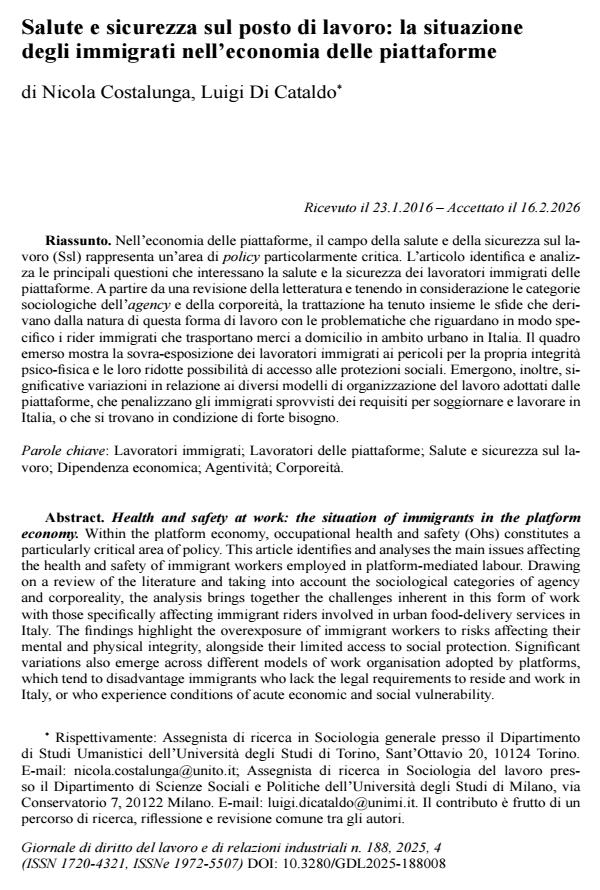
Article preview

FrancoAngeli is member of Publishers International Linking Association, Inc (PILA), a not-for-profit association which run the CrossRef service enabling links to and from online scholarly content.

Within the platform economy, occupational health and safety (Ohs) constitutes a particularly critical area of policy. This article identifies and analyses the main issues affecting the health and safety of immigrant workers employed in platformmediated labour. Drawing on a review of the literature and taking into account the sociological categories of agency and corporeality, the analysis brings together the challenges inherent in this form of work with those specifically affecting immigrant riders involved in urban fooddelivery services in Italy. The findings highlight the overexposure of immigrant workers to risks affecting their mental and physical integrity, alongside their limited access to social protection. Significant variations also emerge across different models of work organisation adopted by platforms, which tend to disadvantage immigrants who lack the legal requirements to reside and work in Italy, or who experience conditions of acute economic and social vulnerability.

Keywords: Immigrant labour; Platform work; Occupational safety and health; Economic dependence; Agency; Corporeality.

  1. Behrendt C., Nguyen Q.A., Rani U. (2019). Social protection systems and the future of work: Ensuring social security for digital platform workers. ISSR, 72: 17 ss.
  2. Bérastégui P. (2023). Exposure to psychosocial risk factors in the gig economy. A systematic review Brussels: Etui, The European Trade Union Institute. Disponibile su: www. etui.org/publications/exposurepsychosocialriskfactorsgigeconomy (consultato il 09.11.2025).
  3. Bergamante F., Della Ratta F., De Minicis M., Mandrone E. (2022). Lavoro virtuale nel mondo reale: i dati dell’indagine INAPPPlus sui lavoratori delle piattaforme in Italia. Roma: Inapp Policy Brief, 25. Disponibile su: oa.inapp.gov.it/handle/20.500.12916/3406 (consultato il 07.11.2025).
  4. Bertolini A., Dukes R. (2021). Trade Unions and Platform Workers in the UK: Worker Representation in the Shadow of the Law. ILJ, 50: 662 ss.
  5. Bertolini S., Fullin G., Pacetti V. (2022). Il lavoro da remoto tra terziarizzazione, digitalizzazione e trasformazioni delle relazioni di impiego. Meridiana, 104: 9 ss.
  6. Bond E. (2018). Writing migration through the body. London: Palgrave.
  7. Boniardi L., Campo L., Prudenzi S., Fasano L., Natale P., Consonni D., Carugno M., Pesatori A.C., Fustinoni S. (2024). Occupational Safety and Health of Riders Working for Digital Food Delivery Platforms in the City of Milan, Italy. ML: 115.
  8. Bonifacio F., Marcolin A. (2024). Unpacking the role of workers’ heterogeneity in the representation and regulation of platform work. A focus of the case of the Just Eat Takeaway agreement in Italy. CRL, 42: 25 ss.
  9. Booth A.L., Francesconi M., Frank J. (2002). Temporary jobs: stepping stones or dead ends? EJ, 112: 189 ss.
  10. Bourdieu P. (2015). Forme di capitale (a cura di M. Santoro). Roma: Armando.
  11. Cabras F., Di Cataldo L., Massari M. (2024). Corpi migranti al lavoro. Forme di sfruttamento e processi di (in)visibilizzazione dalle campagne siciliane alle piattaforme digitali. W&E: 27 ss.
  12. Caxaj C.S., Cohen A. (2019). I Will Not Leave My Body Here: Migrant Farmworkers’ Health and Safety Amidst a Climate of Coercion. IJERPH, 16: 2643 ss.
  13. CEPS (2021). Digital labour platforms in the EU: Mapping and business models – Final report. Luxembourg: Publications Office of the European Union.
  14. Christie N., Ward H. (2019). The health and safety risks for people who drive for work in the gig economy. JTH, 13: 115 ss.
  15. Comune di Trento (2023). Indagine sul fenomeno del food delivery. Disponibile su: www.integrazionemigranti.gov.it/AnteprimaPDF.aspx?id=5945 (consultato il 06.04.2025).
  16. Costalunga N., Di Cataldo L. (2024). Immigrazione, lavoro e segregazione al tempo della gig economy. ESR, XLII(1): 41 ss.
  17. Costalunga N., Di Cataldo L. (2025). Inequalities in the platform labour market: a study on stratifications in the Italian food delivery sector. Inequalities, 2: 71 ss.
  18. Crain T.L., Brossoit R.M., RoblesSainz F., Tran M. (2020). Fighting fatigue: A conceptual model of driver sleep in the gig economy. SH, 6: 358 ss.
  19. Cregan K. (2006). The sociology of the body. Mapping the abstraction of the embodiment. London: Sage.
  20. de GraafZijl M., van den Berg G.J., Heyma A. (2011). Stepping stones for the unemployed: the effect of temporary jobs on the duration until (regular) work. JPE, 24: 107 ss.
  21. Della Puppa F. (2015). Corpi al lavoro, lavoro sui corpi. Lavoro salariato e ricongiungimento familiare nella diaspora bangladese in Italia. In: Casellato A., Zazzara G. (a cura di), Corpi al lavoro. Ricerche di storia e scienze sociali. Atti del quarto seminario “Ascoltare il lavoro”. Venezia: Edizioni Ca’ Foscari, 77 ss.
  22. Della Puppa F. (2019). Bodies at Work, Work on Bodies: Migrant Bodies, Wage Labour, and Family Reunification in Italy. JIMI, 20: 963 ss.
  23. Dennerlein J.T., Meeker J.D. (2002). Occupational injuries among Boston bicycle messengers. AJIM, 42: 519 ss.
  24. Di Cataldo L. (2021). Cycling through the pandemic. La protezione dei riders dal Covid 19. LLI, 7: 149 ss.
  25. Di Cataldo L. (2021). Il mercato del food delivery nella città di Catania. Un caso di studio interdisciplinare: dalla composizione della categoria al rapporto di lavoro. PS, 1: 36 ss.
  26. Di Cataldo L. (2023). Connettività, tempo e retribuzione. Verso un metodo per la determinazione del compenso minimo nel platform work. E&L, 2: 101 ss.
  27. Di Cataldo L., Cabras F. (2025). Life is (Not) a Game: Racial Platform Capitalism, Exploitation Practices and Forms of Rider Mobilization in Milan. Cambio, 5(30).
  28. EuOsha (2021). Digital platform work and occupational safety and health: a review. Luxembourg: Publications Office of the European Union. Disponibile su: osha.europa. eu/sites/default/files/202111/Osh_policies_online_platform_economy.pdf (consultato il 07.12.2025).
  29. EuOsha (2022a). Digital platform work: occupational safety and health policy and practice for risk prevention and management. Policy brief. Disponibile su: osha.europa.eu/sites/ default/files/Digital_platform work_EN.pdf (consultato il 07.12.2025).
  30. EuOsha (2022b). Digital platform work and occupational safety and health: overview of regulation, policies, practices and research. Report. Disponibile su: osha.europa.eu/sites/ default/files/202203/Digital_platform_work_Osh_policies_report_0.pdf (consultato il 07.12.2025).
  31. EuOsha (2024). Digital platform work: implications for occupational safety and health. Disponibile su: osha.europa.eu/en/publications/digitalplatformworkimplicationsoccupationalsafetyandhealth (consultato il 07.12.2025).
  32. European Commission (2021). Impact assessment report. Accompanying the document: Proposal for a Directive of the European Parliament and of the Council On improving working conditions in platform work. Commission Staff Working Document. SWD 396 final. Disponibile su: eurlex.europa.eu/legalcontent/EN/ALL/?uri=SWD:2021:396:FIN (consultato il 7.12.2025).
  33. Fairwork (2024). Locationbased platform work principles. Disponibile su: fair.work/en/fw/ principles/fairworkprincipleslocationbasedwork/ (consultato il 12.12.2025).
  34. GarciaMuñoz A. (2021). Spain. In: Waas B., Hießl C. (a cura di), Collective Bargaining for SelfEmployed Workers in Europe: Approaches to Reconcile Competition Law and Labour Rights. Alphen aan den Rijn: Wolters Kluwers, 229 ss.
  35. Giddens A. (1993). Problems of Action and Structure. In: Cassell P. (eds.), The Giddens Readers. Stanford: Stanford University Press, 88 ss.
  36. Gil Garcia J. (2017). Inequalities, limits and possibilities for the transformation of capital in the sharing economy. Redes.com, 15: 32 ss.
  37. Giorgiantonio C., Rizzica L. (2018). Il lavoro nella gig economy. Evidenze dal mercato del food delivery in Italia. QEF (Occasional Papers), 472. Disponibile su: www.bancaditalia. it/pubblicazioni/qef/20180472/QEF_472_18.pdf (consultato il 07.11.2025).
  38. GombergMuñoz R. (2010). Willing to Work: Agency and Vulnerability in an Undocumented Immigrant Network. AA, 112: 205 ss.
  39. Gramano E. (2021). Italy. In: Waas B., Hießl C. (a cura di), Collective Bargaining for SelfEmployed Workers in Europe: Approaches to Reconcile Competition Law and Labour Rights. Alphen aan den Rijn: Wolters Kluwers, 153 ss.
  40. Griesbach K., Reich A., ElliottNegri L., Milkman R. (2019). Algorithmic Control in Platform Food Delivery Work. Socius, 5.
  41. Haidar J., Keune M. (2021). Introduction. In: Haidar J., Keune M. (a cura di), Work and Labour Relations in Global Platform Capitalism. Cheltenham: Edward Elgar, 1 ss.
  42. Heyer J.H., Sethi M., Wall S.P., AyoungChee P., Slaughter D., Jacko S., DiMaggio C.J., Frangos S.G. (2015). Drawing the Curtain Back on Injured Commercial Bicyclists. AJPH, 105: 2131 ss.
  43. Hießl C. (2021). Austria. In: Waas B., Hießl C. (a cura di), Collective Bargaining for SelfEmployed Workers in Europe: Approaches to Reconcile Competition Law and Labour Rights. Alphen aan den Rijn: Wolters Kluwers, 53 ss.
  44. Hießl C. (2022). The legal status of platform workers: regulatory approaches and prospects of a European solution. ILLeJ, 15: 13 ss.
  45. Holmes S.M. (2013). Fresh fruit, broken bodies. Migrant farmworkers in the United States.
  46. BerkeleyLos Angeles: University of California Press.
  47. ISSA (2024). Social security for the selfemployed in Europe: Progress and developments. International Social Security Association. Disponibile su: www.issa.int/analysis/socialsecurityselfemployedeuropeprogressanddevelopments (consultato il 07.12.2025).
  48. Korpi T., Levin H. (2001). Precarious footing: temporary employment as a stepping stone out of unemployment in Sweden. WES, 15: 127 ss.
  49. Kresal B. (2021). Slovenia. In: Waas B., Hießl C. (a cura di), Collective Bargaining for SelfEmployed Workers in Europe: Approaches to Reconcile Competition Law and Labour Rights. Alphen aan den Rijn: Wolters Kluwers, 215 ss.
  50. Krzywdzinski M., Gerber C. (2021). Between automation and gamification: forms of labour control on crowdwork platforms. WGE, 1: 161 ss.
  51. Lachapelle U., CarpentierLaberge D., Cloutier M., Ranger L. (2021). A framework for analyzing collisions, near misses and injuries of commercial cyclists. JTG, 90.
  52. Lam L., Triandafyllidou A. (2021). An unlikely stepping stone? Exploring how platform work shapes newcomer migrant integration. TJTM, 5: 11 ss.
  53. Li Z., Bo X., Qian C., Chen M., Shao Y., Peng Y., Cai R., Huang X., Wei L., Zhao J., Shi J. (2022). Risk factors for musculoskeletal disorders among takeaway riders: Uptodate evidence in Shanghai, China. FPH, 10: 988724 ss.
  54. Lipsitz G. (2005). Foreword. In Mangos, Chiles and Truckers: The Business of Transnationalism. Minneapolis: University of Minnesota Press.
  55. Marx K. (1977). Capital, vol. 1, traduzione di B. Fowkes. New York: Vintage Books.
  56. Mbare B. (2023). Psychosocial work environment and mental wellbeing of food delivery platform workers in Helsinki, Finland: A qualitative study. IJQHW, 18.
  57. McKinlay A., Mitchell G., Bertenshaw C. (2022). Review article: DINED (Deliveryrelated INjuries in the Emergency Department) part 1: A scoping review of risk factors and injuries affecting food delivery riders. EMA, 34: 150 ss.
  58. Mendonça P., Clark I., Kougiannou N. (2023). I’m always delivering food while hungry’: how undocumented migrants find work as substitute couriers in the UK. The Conversation. Disponibile su: theconversation.com/imalwaysdeliveringfoodwhilehungryhowundocumentedmigrantfindworkassubstitutecouriersintheuk201695 (consultato il 12.12.25).
  59. Ortner S. (2006). Anthropology and Social Theory: Culture, Power, and the Acting Subject. Durham: Duke University Press.
  60. Perocco F., Antunes R., Basso P. (2021). Il lavoro digitale, i suoi significati e i suoi effetti, nel quadro del capitalismo pandemico”. Socioscapes, 2: 7 ss.
  61. Piasna A., Zwysen W., Drahokoupil J. (2022). The platform economy in Europe: Results from the second Etui Internet and Platform Work Survey. Etui Working Paper, 5. Brussels: Etui – The European Trade Union Institute. Disponibile su: www.etui.org/sites/default/files/202202/The platform economy in Europe_2022.pdf (consultato il 12.12.2025).
  62. Pirina G., Della Puppa F., Perocco F. (2024). Lavoratori immigrati e lavoro digitale di piattaforma. Percorsi teorici, lavorativi e urbani. ESR, XLII(1): 27 ss.
  63. PPMI (2021). Study to support the impact assessment of an EU initiative to improve the working conditions in platform work – Final report. Luxembourg: Publications Office of the European Union.
  64. Prassl J. (2018). Collective voice in the platform economy: challenges, opportunities, solutions. Report to the ETUC. Disponibile su: www.etuc.org/en/publication/collectivevoiceplatformeconomychallengesopportunitiessolutions (consultato il 12.01.2026).
  65. Pulignano V., Agnieszka P., Domecka M., Muszynski K., Vermeerbergen L. (2021). Does it pay to work? Unpaid labour in the platform economy. Etui Policy Briefs, 15. Disponibile su: www.etui.org/sites/default/files/202111/Does%20it%20pay%20to%20work.%20 Unpaid%20labour%20in%20the%20platform%20economy_2021.pdf (consultato il 12.12.2025).
  66. Pulignano V., Grimshaw D., Domecka M., Vermeerbergen L. (2024). Why does unpaid labour vary among digital labour platforms? Exploring sociotechnical platform regimes of worker autonomy. HR, 77: 1243 ss.
  67. Renau Cano M., Espelt R., Fuster Morell M. (2021). Flexibility and freedom for whom? Precarity, freedom and flexibility in ondemand food delivery. WOLG, 15: 46 ss.
  68. Rocchini E., Ferrigni N. (2022). Tra trasformazioni normative e ricadute sociali: la figura del rider in Italia. DLRI, 175: 405 ss.
  69. Rummel J. (2021). Germany. In: Waas B., Hießl C. (a cura di), Collective Bargaining for SelfEmployed Workers in Europe: Approaches to Reconcile Competition Law and Labour Rights. Alphen aan den Rijn: Wolters Kluwers, 121 ss.
  70. Salmon P.M., Kc B., Irwin B.G., Brennan C.J., Read G.J.B. (2023). What Influences Gig Economy Delivery Rider Behavior and Safety? A Systems Analysis. SS, 166.
  71. Sartori D.M. (2022). Lo sfruttamento dei rider del food delivery. Caporalato, lavoro straniero e piattaforme digitali. Lecce: Elison Publishing.
  72. Sassen S. (1988). The Mobility of Labor and Capital: A Study in International Investment and Labor Flow. Cambridge: Cambridge University Press.
  73. SassenKoob S. (1981). Towards a Conceptualization of Immigrant Labor. SP, 29: 65 ss. Schor J.B. (2020). After the Gig: How the Sharing Economy Got Hijacked and How to Win It Back. San Francisco: University of California Press.
  74. Schor J.B., AttwoodCharles W., Cansoy M., Ladegaard I., Wengronowitz R. (2020). Dependence and precarity in the platform economy. TS, 49: 833 ss.
  75. Sewell W.H. (1992). A Theory of Structure: Duality, Agency, and Transformation. AJS, 98: 1 ss.
  76. Shilling C. (1993). The body and Social Theory. London: SAGE Publications Ltd.
  77. Sieker F. (2022). Platform work and access to social protection across major European countries. JICSP, 38: 193 ss.
  78. Turin School of Regulation (2019). Il lavoro nelle piattaforme. Un focus su rider e food delivery nel capoluogo Piemontese. Disponibile su: www.turinschool.eu (consultato il 06.04.2025).
  79. van Doorn N., Ferrari F., Graham M. (2023). Migration and migrant labour in the gig economy: An intervention. WES, 37: 1099 ss.
  80. van Doorn N., Vijay D. (2021). Gig work as migrant work: The platformization of migration infrastructure. EPA, 56: 1129 ss.
  81. Wacquant L. (2002). Anima e corpo: La fabbrica dei pugili nel ghetto nero americano. Roma: DeriveApprodi.
  82. Wacquant L. (2007). Body & Soul: notebooks of an apprentice boxer. Oxford: Oxford University Press.
  83. Zwysen W., Piasna A. (2024). Digital labour platforms and migrant workers. Analysing migrants’ working conditions and (over)representation in platform work in Europe. Brussels: Etui, The European Trade Union Institute, Etui Working paper, 6. Disponibile su: shorturl. at/J0Glz (consultato il 12.01.2026).

Nicola Costalunga, Luigi di Cataldo, Salute e sicurezza sul posto di lavoro: la situazione degli immigrati nell’economia delle piattaforme in "GIORNALE DI DIRITTO DEL LAVORO E DI RELAZIONI INDUSTRIALI " 188/2025, pp 714-737, DOI: 10.3280/GDL2025-188008