La risemantizzazione dell’amore e del suo fallimento
Journal title SOCIETÀ DEGLI INDIVIDUI (LA)
Author/s Laura Gherardi, Gianluca Maestri
Publishing Year 2026 Issue 2025/84
Language Italian Pages 12 P. 21-32 File size 157 KB
DOI 10.3280/LAS2025-084003
DOI is like a bar code for intellectual property: to have more infomation
click here
Below, you can see the article first page
If you want to buy this article in PDF format, you can do it, following the instructions to buy download credits
FrancoAngeli is member of Publishers International Linking Association, Inc (PILA), a not-for-profit association which run the CrossRef service enabling links to and from online scholarly content.
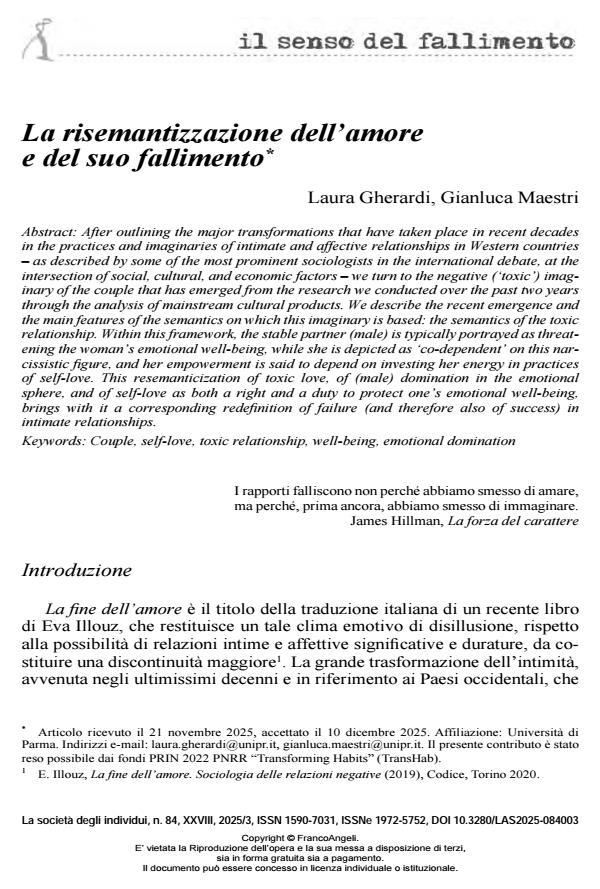
After outlining the major transformations that have taken place in recent decades in the practices and imaginaries of intimate and affective relationships in Western countries – as described by some of the most prominent sociologists in the international debate, at the intersection of social, cultural, and economic factors – we turn to the negative (‘toxic’) imaginary of the couple that has emerged from the research we conducted over the past two years through the analysis of mainstream cultural products. We describe the recent emergence and the main features of the semantics on which this imaginary is based: the semantics of the toxic relationship. Within this framework, the stable partner (male) is typically portrayed as threatening the woman’s emotional well-being, while she is depicted as ‘co-dependent’ on this narcissistic figure, and her empowerment is said to depend on investing her energy in practices of self-love. This resemanticization of toxic love, of (male) domination in the emotional sphere, and of self-love as both a right and a duty to protect one’s emotional well-being, brings with it a corresponding redefinition of failure (and therefore also of success) in intimate relationships.
Keywords: Couple, self-love, toxic relationship, well-being, emotional domination
Laura Gherardi, Gianluca Maestri, La risemantizzazione dell’amore e del suo fallimento in "SOCIETÀ DEGLI INDIVIDUI (LA)" 84/2025, pp 21-32, DOI: 10.3280/LAS2025-084003