A Strange Encounter: Shiroto no Ran Shops, the Kitanaka Shopping Street Association and a Case of shotengai Revitalization in Koenji
Journal title STORIA URBANA
Author/s Filippo Dornetti
Publishing Year 2026 Issue 2025/181
Language Italian Pages 18 P. 138-155 File size 190 KB
DOI 10.3280/SU2025-181008
DOI is like a bar code for intellectual property: to have more infomation
click here
Below, you can see the article first page
If you want to buy this article in PDF format, you can do it, following the instructions to buy download credits
FrancoAngeli is member of Publishers International Linking Association, Inc (PILA), a not-for-profit association which run the CrossRef service enabling links to and from online scholarly content.
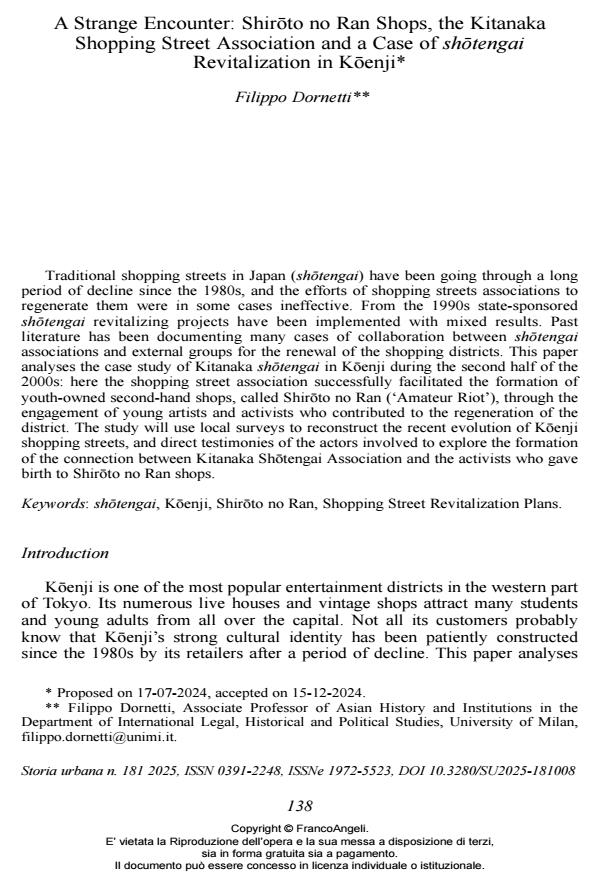
Traditional shopping streets in Japan (shotengai) have been going through a long period of decline since the 1980s, and the efforts of shopping streets associations to regenerate them were in some cases ineffective. From the 1990s state-sponsored shotengai revitalizing projects have been implemented with mixed results. Past literature has been documenting many cases of collaboration between shotengai associations and external groups for the renewal of the shopping districts. This paper analyses the case study of Kitanaka shotengai in Koenji during the second half of the 2000s: here the shopping street association successfully facilitated the formation of youth-owned second-hand shops, called Shiroto no Ran (‘Amateur Riot’), through the engagement of young artists and activists who contributed to the regeneration of the district. The study will use local surveys to reconstruct the recent evolution of Koenji shopping streets, and direct testimonies of the actors involved to explore the formation of the connection between Kitanaka Shotengai Association and the activists who gave birth to Shiroto no Ran shops.
A partire dagli anni Ottanta, le tradizionali strade commerciali giapponesi (shōten-gai) hanno attraversato un lungo periodo di declino, e gli interventi promossi dalle as-sociazioni di quartiere per la loro rigenerazione si sono rivelati in alcuni casi poco ef-ficaci. Dagli anni Novanta sono stati avviati progetti statali di rivitalizzazione degli shōtengai, con risultati disomogenei. La letteratura ha documentato numerosi esempi di collaborazione tra le associazioni di shōtengai e gruppi esterni finalizzati al rinnova-mento dei distretti commerciali. Questo contributo analizza il caso dello shōtengai della via Kitanaka, nel quartiere di Kōenji, nella seconda metà degli anni Duemila. In questo contesto, l’associazione commerciale riuscì a favorire la formazione di una rete di negozi dell’usato gestiti da giovani, noti come Shirōto no Ran (“Rivolta dei dilettanti”), attraverso il coinvolgi-mento di artisti e attivisti che contribuirono in modo significativo alla rigenerazione dell’area. Lo studio si basa su indagini locali per ricostruire l’evoluzione recente degli shōtengai di Kōenji e su testimonianze dirette degli attori coinvolti, al fine di analizza-re la genesi del rapporto tra l’Associazione dei commercianti di via Kitanaka e il grup-po di attivisti che diedero vita ai negozi Shirōto no Ran. Li
Keywords: shōtengai, Kōenji, Shirōto no Ran, Shopping Street Revitalization Plans.
Filippo Dornetti, A Strange Encounter: Shiroto no Ran Shops, the Kitanaka Shopping Street Association and a Case of shotengai Revitalization in Koenji in "STORIA URBANA " 181/2025, pp 138-155, DOI: 10.3280/SU2025-181008