When the Story Is Untold: A Clinical Case
Journal title PSICOTERAPIA PSICOANALITICA
Author/s Giulia Russo
Publishing Year 2026 Issue 2026/1
Language Italian Pages 9 P. 125-133 File size 59 KB
DOI 10.3280/PSP2026-001008
DOI is like a bar code for intellectual property: to have more infomation
click here
Below, you can see the article first page
If you want to buy this article in PDF format, you can do it, following the instructions to buy download credits
FrancoAngeli is member of Publishers International Linking Association, Inc (PILA), a not-for-profit association which run the CrossRef service enabling links to and from online scholarly content.
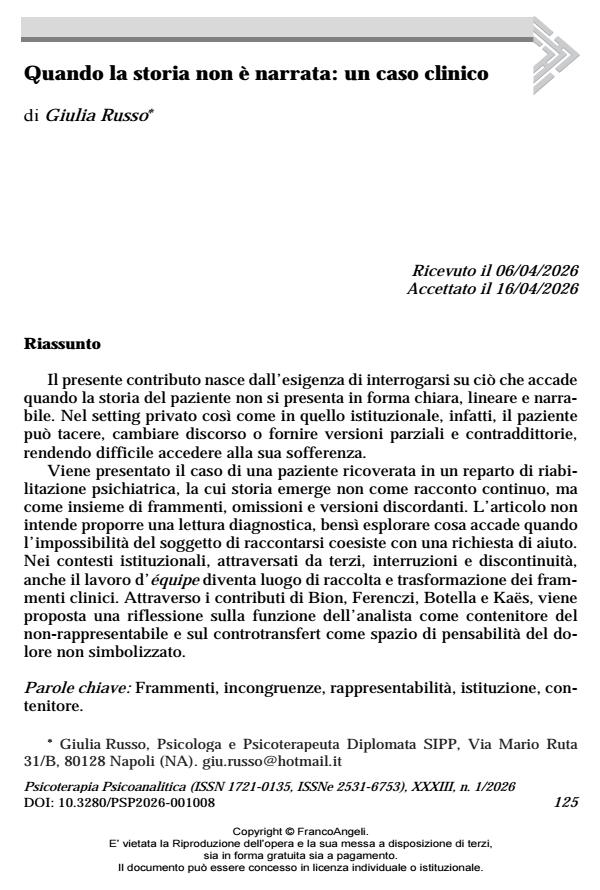
This paper arises from the need to explore what happens when a patient’s history does not present itself in a clear, linear, and narratable form. In both private and institutional settings, patients may remain silent, shift the subject, or provide partial and contradictory accounts, making it difficult to access their suffering. The paper presents the case of a patient admitted to a psychiatric rehabilitation unit, whose history emerges not as a continuous narrative but as a constellation of fragments, omissions, and discordant versions. The article does not aim to provide a diagnostic formulation, but rather to explore what happens when the subject’s inability to narrate themselves coexists with a request for help. In institutional settings, marked by the presence of third parties, interruptions, and discontinuities, team-based clinical work also becomes a space for collecting and transforming clinical fragments. Drawing on the contributions of Bion, Ferenczi, Botella, and Kaës, the paper reflects on the analyst’s function as a container for the unrepresentable and on countertransference as a space in which non-symbolized suffering may begin to become thinkable.
Keywords: Fragments, incongruences, representability, institution, container.
Giulia Russo, Quando la storia non è narrata: un caso clinico in "PSICOTERAPIA PSICOANALITICA" 1/2026, pp 125-133, DOI: 10.3280/PSP2026-001008