Benessere Soggettivo e Salute Percepita degli anziani in Europa

Titolo Rivista SALUTE E SOCIETÀ
Autori/Curatori Gessica Vella, Manuela Stranges
Anno di pubblicazione 2026 Fascicolo 2026/1
Lingua Italiano Numero pagine 17 P. 11-27 Dimensione file 545 KB
DOI 10.3280/SES2026-001002
Il DOI è il codice a barre della proprietà intellettuale: per saperne di più clicca qui

Qui sotto puoi vedere in anteprima la prima pagina di questo articolo.

Se questo articolo ti interessa, lo puoi acquistare (e scaricare in formato pdf) seguendo le facili indicazioni per acquistare il download credit. Acquista Download Credits per scaricare questo Articolo in formato PDF
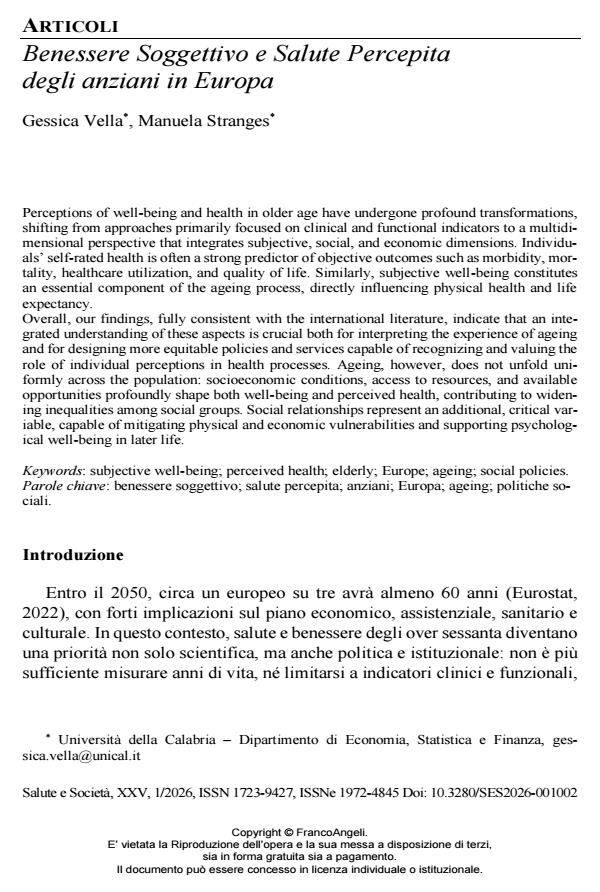
Anteprima articolo

FrancoAngeli è membro della Publishers International Linking Association, Inc (PILA), associazione indipendente e non profit per facilitare (attraverso i servizi tecnologici implementati da CrossRef.org) l’accesso degli studiosi ai contenuti digitali nelle pubblicazioni professionali e scientifiche.

Perceptions of well-being and health in older age have undergone profound transformations, shifting from approaches primarily focused on clinical and functional indicators to a multidimensional perspective that integrates subjective, social, and economic dimensions. Individuals’ self-rated health is often a strong predictor of objective outcomes such as morbidity, mortality, healthcare utilization, and quality of life. Similarly, subjective well-being constitutes an essential component of the ageing process, directly influencing physical health and life expectancy. Overall, our findings, fully consistent with the international literature, indicate that an integrated understanding of these aspects is crucial both for interpreting the experience of ageing and for designing more equitable policies and services capable of recognizing and valuing the role of individual perceptions in health processes. Ageing, however, does not unfold uniformly across the population: socioeconomic conditions, access to resources, and available opportunities profoundly shape both well-being and perceived health, contributing to widening inequalities among social groups. Social relationships represent an additional, critical variable, capable of mitigating physical and economic vulnerabilities and supporting psychological well-being in later life.

Parole chiave:benessere soggettivo; salute percepita; anziani; Europa; ageing; politiche sociali.

  1. Akaeda N. (2022). Social trust and well-being inequality according to social stratification. Research in Social Stratification and Mobility, 82: 100733.
  2. Arber S., Ginn J. (1993). Gender and inequalities in health in later life. Social Science & Medicine, 36: 33-46. DOI: 10.1016/0277-9536(93)90303-
  3. Arpino B., de Valk H. (2018) ‘Comparing life satisfaction of migrants and natives across Europe: the role of social contacts’, Social Indicators Research, 137: 1163-1184.
  4. Billari F.C., Stranges M., Vella G. (2024). Diventare anziane, diventare anziani: i doppi standard. Il Mulino, Rivista trimestrale di cultura e di politica, 4: 41-50
  5. Blanchflower D.G., Oswald A.J. (2008). Is well-being U-shaped over the life cycle? Social Science & Medicine, 66: 1733–1749.
  6. Blendon R.J., Buhr T., Cassidy E.F., et al. (2007). Disparities in health: perspectives of a multi-ethnic, multi-racial America. Health Affairs, 26:1437-1447.
  7. Calasanti T.M., Slevin K.F. (2001). Gender, social inequalities, and aging. Londra: Bloomsbury Publishing PLC.
  8. Case A., Paxson C. (2005). Sex differences in morbidity and mortality. Demography, 42: 189–214.
  9. Chung S., Park S.J. (2008). Successful ageing among low-income older people in South Korea. Ageing & Society, 28: 1061-1074. DOI: 10.1017/S0144686X0800739
  10. Dahlgren G., Whitehead M. (2007). European strategies for tackling social inequities in health: Levelling up Part 2. World Health Organization. Copenhagen: WHO Regional Office for Europe.
  11. Davidov E., Meuleman B., Cieciuch J., et al. (2014). Measurement equivalence in cross-national research. Annual Review of Sociology, 40: 55–75.
  12. Diener E., Suh E., Lucas R.E., Smith H.L. (1999). Subjective well-being: Three decades of progress. Psychological Bulletin, 125: 276–302. DOI: 10.1037/0033-2909.125.2.27
  13. Ehsan A., Klaas H.S., Bastianen A., Spini D. (2019). Social capital and health: A systematic review of systematic reviews. Social Science & Medicine.
  14. Eurostat (2022). Projected population by broad age group, EU,1 January 2022-2100; https://ec.europa.eu/eurostat/statistics-explained/images/d/df/EUROPOP2023_Figure_2_Projected_population_by_broad_age_group%2C_EU%2C_1_January_2022-2100.png
  15. Glatz C., Eder A. (2020). Patterns of Trust and Subjective Well-Being Across Europe: New Insights from Repeated Cross-Sectional Analyses Based on the European Social Survey 2002–2016. Social Indicator Research, 148: 417–439.
  16. Harkness J.A., Braun M., Edwards B., et al. (2010). Survey methods in multicultural, multinational, and multiregional contexts. Hoboken: Wiley.
  17. Hendriks M., Burger M.J. (2019). ‘Unsuccessful subjective well–being assimilation among immigrants: the role of faltering perceptions of the host society’, Journal of Happiness Studies.
  18. Hess T.M., O'Brien E.L., Voss P., et al. (2017). Context influences on the relationship between views of aging and subjective age: The moderating role of culture and domain of functioning. Psychology and Aging, 32: 419-431.
  19. Heyman R.E., Baucom K.J.W., Giresi J., et al. (2020). Patient experience and expression of unpleasant emotions during health care encounters. Journal of Patient Experience, 7: 1481–1488. DOI: 10.1177/237437352097886
  20. Hubley A.M., Russell L.B. (2009). Prediction of subjective age, desired age, and age satisfaction in older adults: Do some health dimensions contribute more than others?. International Journal of Behavioral Development, 33: 12-21. DOI: 10.1177/016502540809948
  21. Huppert F.A. (2009). Psychological well-being: Evidence regarding its causes and consequences. Applied Psychology: Health and Well-Being, 1: 137–164.
  22. Idler E.L., Benyamini Y. (1997). Self-rated health and mortality: A review of twenty-seven community studies. Journal of Health and Social Behavior, 38: 21–37. DOI: 10.2307/295535
  23. Litwin H., Shiovitz-Ezra S. (2006). The association between activity and wellbeing in later life: What really matters? Ageing & Society, 26: 225–242. DOI: 10.1017/S0144686X0500453
  24. Liu Y., Kong Q., Yuan S., van de Klundert J. (2019). What are the risk factors of negative patient experience? A cross-sectional study in Chinese public hospitals. Health Services Research and Managerial Epidemiology, 6: 2333392819843614. DOI: 10.1177/004695801984786
  25. López-Otín C., Blasco M.n.A., Partridge L., et al. (2013). The hallmarks of aging. Cell, 153: 1194-1217.
  26. Marina L., Ionas L. (2012). Active ageing and successful ageing as explicative models of positive evolutions to elderly people. Scientific Annals of the “Alexandru Ioan Cuza” University, Iasi. New Series SOCIOLOGY AND SOCIAL WORK Section, 5(1).
  27. Marmot M. (2015). The health gap: The challenge of an unequal world. Londra: Bloomsbury.
  28. McDaniel S.A. (2013). Family demography and postmodern society. In: Scott R., Kosslyn S., eds., Emerging trends in the social and behavioral sciences. Hoboken, Wiley.
  29. McGinnis J.M., Olsen L., Goolsby W.A., Grossmann C., eds. (2011). Engineering a learning healthcare system: A look at the future: Workshop summary. Washington, D.C: National Academies Press.
  30. Murayama H., Fujiwara Y., Kawachi I. (2012). Social capital and health: A review of prospective multilevel studies. Social Science & Medicine, 75: 785–792.
  31. Oksuzyan A., Brønnum-Hansen H., Jeune B., Christensen, K. (2008). Men: good health and high mortality. Sex differences in health and aging. Aging Clinical and Experimental Research, 20: 91–102. DOI: 10.1007/BF0332475
  32. Putnam R.D. (2000). Bowling alone: The collapse and revival of American community. New York: Simon & Schuster.
  33. Safi M. (2010). Immigrants’ life satisfaction in Europe: Between assimilation and discrimination. European Sociological Review, 26: 159–176.
  34. Schwei R.J., Del Pozo S., Agger-Gupta N., et al. (2016). Changes in research on language barriers in health care since 2003: A cross-sectional review study. International journal of nursing studies, 54: 36-44.
  35. Soons J.P.M., Kalmijn M. (2009). Is marriage more than cohabitation? Well-being differences in 30 European countries. Journal of Marriage and Family, 71: 1141–1157.
  36. Steptoe A., Deaton A., Stone A.A. (2014). Psychological wellbeing, health and ageing. The Lancet, 385: 640-648.
  37. Steptoe, A., Deaton, A., & Stone, A. A. (2015). Subjective wellbeing, health, and ageing. The lancet, 385(9968), 640-648. DOI: 10.1016/S0140-6736(13)61489-
  38. Stranges M. (2022). The Intergenerational Transmission of Female Labour Force Participation by Gender among Native and Immigrant Europeans: A Focus on Religion, Journal of Family and Economic Issues, 43: 774-798.
  39. Stranges M., Vignoli D., Venturini A. (2021). Migrants’ subjective well-being in Europe: does relative income matter?. European Societies, 23: 255-284. DOI: 10.1080/14616696.2020.183223
  40. Terracciano A., Stephan Y., Aschwanden D., et al. (2021). Changes in subjective age during COVID-19. The Gerontologist, 61: 13-22.
  41. Van Doorslaer E., Masseria C., Koolman X. (2006). Inequalities in access to medical care by income in developed countries. Cmaj, 174: 177-183.
  42. Westerhof G.J., Whitbourne S.K., Freeman G.P. (2012). The aging self in a cultural context: The relation of conceptions of aging to identity processes and self-esteem in the United States and the Netherlands. Journals of Gerontology Series B: Psychological Sciences and Social Sciences, 67: 52-60.

Gessica Vella, Manuela Stranges, Benessere Soggettivo e Salute Percepita degli anziani in Europa in "SALUTE E SOCIETÀ" 1/2026, pp 11-27, DOI: 10.3280/SES2026-001002