L’emergere e la costruzione delle identità nell’interazione medico-paziente in contesti multiculturali
Titolo Rivista SALUTE E SOCIETÀ
Autori/Curatori Franca Orletti
Anno di pubblicazione 2013 Fascicolo 2013/1
Lingua Italiano Numero pagine 15 P. 61-75 Dimensione file 119 KB
DOI 10.3280/SES2013-001006
Il DOI è il codice a barre della proprietà intellettuale: per saperne di più
clicca qui
Qui sotto puoi vedere in anteprima la prima pagina di questo articolo.
Se questo articolo ti interessa, lo puoi acquistare (e scaricare in formato pdf) seguendo le facili indicazioni per acquistare il download credit. Acquista Download Credits per scaricare questo Articolo in formato PDF
FrancoAngeli è membro della Publishers International Linking Association, Inc (PILA), associazione indipendente e non profit per facilitare (attraverso i servizi tecnologici implementati da CrossRef.org) l’accesso degli studiosi ai contenuti digitali nelle pubblicazioni professionali e scientifiche.
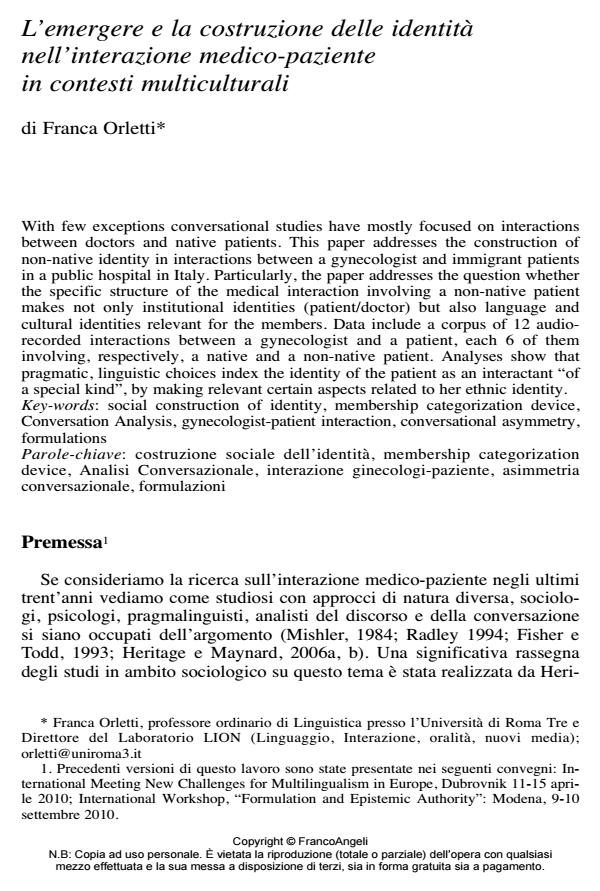
With few exceptions conversational studies have mostly focused on interactions between doctors and native patients. This paper addresses the construction of non-native identity in interactions between a gynecologist and immigrant patients in a public hospital in Italy. Particularly, the paper addresses the question whether the specific structure of the medical interaction involving a non-native patient makes not only institutional identities (patient/doctor) but also language and cultural identities relevant for the members. Data include a corpus of 12 audiorecorded interactions between a gynecologist and a patient, each 6 of them involving, respectively, a native and a non-native patient. Analyses show that pragmatic, linguistic choices index the identity of the patient as an interactant "of a special kind", by making relevant certain aspects related to her ethnic identity.
Parole chiave:Costruzione sociale dell’identità, membership categorization device, Analisi Conversazionale, interazione ginecologi-paziente, asimmetria conversazionale, formulazioni
- van Dijk T. (2000). Ideologies, racism, discourse: Debates on immigration and ethnic issues. In: Wal ter J., Verkuyten M., editors, Comparative perspectives on racism. Aldershot: Ashgate, 91-116
- Zimmerman E. (2007). Constructing Korean and Japanese interculturality in talk: Ethnic membership categorization among users of Japanese. Pragmatics, 17, 1: 71-94
- Orletti F. (2010). Formulating identities in multicultural therapeutic contexts. Invited lecture at the International Workshop “Formulation and Epistemic Authority”, Modena, 9-10 settembre 2010
- Orletti F., Fatigante M. (2010). Constructing institutional identities at the thresholds of different cultural contexts: analyses of medical interactions with nonnative patients. Paper presented at the International Meeting New Challenges for Multilingualism in Europe, Dubrovnik 11-15 aprile 2010
- Parsons T. (1951). The Social System. New York: Free Press
- Perakyla A. (1998). Authority and accountability: the delivery of diagnosis in primary health care. Social Psychology Quarterly, 61, 4: 301-20
- Perakyla A. (2002). Agency and authority: extended responses to diagnostic statements in primary care encounters. Research on Language and Social Interaction, 35, 2: 219-47
- Pilnick A., Hindmarsh J., Gill Teas V. (2009). Beyond ‘doctor and patient’ developments in the study of healthcare interactions. Sociology of Health and Illness, 31, 6: 787-802
- Psathas G. (1999). Studying the organization in action: Membership categorization and interaction analysis. Human Studies, 22, 2-4: 139-162
- Radley A. (1994). Making sense of illness: the social psychology of health and disease. London: Sage Publications
- Ragan S.L. (2000). Sociable talk in women’s health care contexts: two forms of non-medical talk. In: Coupland J., editor, Small talk. London: Longman, 269-287
- Robinson J.D. (2003). An interactional structure of medical activities during acute visits and its implications for patients’ participation. Health Communication, 15: 27-59
- Sacks H. (1972). An initial investigation of the usability of conversational data for doing sociology. In: Sudnow D., editor, Studies in social interaction. New York: Free Press, 31-74
- Sacks H. (1992). Lectures on Conversation. Volumes I and II. Edited by G. Jefferson with Introduction by E.A. Schegloff. Oxford: Blackwell
- Sacks H., Garfinkel H. (1970). On formal structures of practical action. In: McKinney J.C., Tiryakian, E.A., editors, Theoretical Sociology. New York: Appleton- Century-Crofts, 338-366
- Sacks H., Schegloff E.A., Jefferson G. (1974). A simplest systematics for the organization of turn-taking for conversation. Language, 50: 696-735
- Sarangi S. (2001). On demarcating the space between `lay expertise’ and `expert laity’. Text 21, 1-2: 3-12
- Schegloff E.A. (1991). Reflections on talk and social structure. In Boden D., Zimmerman D., editors, Talk and Social Structure. Cambridge: Polity Press, 44-70
- Schegloff E.A. (1992). In another context. In: Duranti A., Goodwin C. editors, Rethinking context. Language as an interactive phenomenon, Cambridge, 191- 228
- Stivers T. (2005a). Non-antibiotic treatment recommendations:delivery formats and implications for parent resistance. Social Science and Medicine, 60: 949- 64
- Stivers T. (2005b). Parent resistance to physicians’ treatment recommendations: one resource for initiating a negotiation of the treatment decision. Health Communication, 18, 1: 41-74
- Stivers T., Majid A. (2007). Questioning children: Interactional evidence of implicit bias in medical interviews. Social Psychology Quarterly, 70, 4: 424-441
- ten Have P. (1991). Talk and institution: a reconsideration of the ‘asymmetry’ of doctor-patient interaction. In: Boden D., Zimmerman D., editors, Talk and social structure: studies in ethnomethodology and conversation analysis. Cambridge: Polity Press, 138-63
- Gavioli L., a cura di (2009). La mediazione linguistico-culturale: una prospettiva interazionista. Perugia: Guerra
- Garfinkel H., Sacks H. (1970) On formal structures of practical action. In: McKinney J.C. and Tiryakian E.A., editors, Theoretical Sociology. New York: Appleton- Century-Crofts, 338-366
- Giglioli P.P., Cavicchioli S., Fele G. (1997). Rituali di degradazione. Anatomia del processo Cusani. Bologna: Il Mulino
- Gill Teas V. (1998). Doing attributions in medical interaction: patients’ explanations for illness and doctors’ responses. Social Psychology Quarterly, 61: 322-360
- Gill Teas V., Maynard D.W. (1995). On ‘labeling’ in actual interaction: Delivering and receiving diagnoses of developmental disabilities. Social Problems, 42: 11-37
- Gill Teas V., Maynard D.W. (2006). Explaining illness: patients’ proposals and physicians’ responses. In: Heritage J., Maynard D.W., editors, Communication in Medical Care: Interaction Between Primary Care Physicians and Patients. Cambridge: Cambridge University Press, 115-50
- Goffman E. (1981). Forms of talk. Philadelphia: University of Pennsylvania (trad. it. Orletti F., a cura di, Le forme del parlare. Bologna: Il Mulino, 1987)
- Heath C. (1992). Diagnosis and assessment in the medical consultation. In: Drew P., Heritage J., editors, Talk at work: interaction in institutional settings. Cambridge: Cambridge University Press, 235-67
- Heritage J. (2004). Conversation analysis and institutional talk: analysing data. In: Silverman D., editor, Qualitative research: theory, method and practice. 2nd edition. Thousand Oaks, CA: Sage, 222-245
- Heritage J. (2010). Questioning in Medicine. In: Freed A., Ehrlich S., editors, “Why Do You Ask?”: The Function of Questions in Institutional Discourse. New York: Oxford University Press, 42-68
- Heritage J., Maynard D.W. (2006a). Problems and Prospects in the Study of Physician- Patient Interaction: Thirty Years of Research. Annual Review of Sociology, 32: 351-74
- Heritage J., Maynard D.W., editors (2006b). Communication in medical care: Interaction between primary care physicians and patients. Cambridge: Cambridge University Press
- Heritage J., Watson R. (1980). Aspects of the Properties of Formulations. Semiotica, 30: 245-262
- Linell P., Adelswärd V., Bredmar M., Lindstedt U. and Sachs L. (2002). Expert talk in medical contexts: Explicit and implicit orientations to risks. Research on Language and Social Interaction, 35: 195-218
- McCarthy M. (2000). Mutually captive audiences: small talk and the genre of close-contact service encounters. In Coupland J., editor, Small talk. London: Longman, 84-109
- McKenzie P. (2010). Informing relationships: small talk, informing and relationship building in midwife-woman interaction. IR Information research 15, 1
- Mishler E.G. (1984). The discourse of medicine: dialectics of medical interviews. Norwood: Ablex Publishing
- Montanari M. (2006). Il cibo come cultura. Bari: Laterza
- Mori J. (2007). Reconstructing the participants’ treatment of “interculturality”: Variations in data methodologies. Pragmatics, 17, 1: 123-141
- Nishizaka A. (1995). The interactive constitution of interculturality: How to be a Japanese with words. Human studies, 18: 301-326
- Orletti F. (1993). Pratiche di glossa. In: Orletti F., a cura di, Comunicare nella vita quotidiana. Bologna: Il Mulino, 77-103
- Orletti F. (2000). La conversazione diseguale. Roma: Carocci
- Antaki C., Widdicombe, S., editors (1998). Identities in Talk. London: Sage
- Baraldi C., Gavioli L. (questo volume). La mediazione nell’interazione centrata sul paziente: il caso delle domande del medico
- Bersani Berselli G. (2009). Selezione lessicale e mediazione orale in consultazioni mediche presso ospedali pubblici, in: La mediazione linguistica e culturale: una prospettiva interazionista, Perugia: Guerra Edizioni, 151-170
- Coupland J. (2000). Small Talk. London: Longman
- Day D. (1998). Being ascribed, and resisting, membership of an ethnic group. In: Antaki C. and Widdicombe S., editors, Identities in talk. London: Sage, 151-170
- Drew P. (2003). Comparative analysis of talk-in-interaction in different institutional settings: a sketch. In: Glenn P., LeBaron C.D. and Mandelbaum J., editors, Studies in Language and Social Interaction. In honour of Robert Hopper. Mahwah, New Jersey: Lawrence Erlbaum, 293-308
- Drew P., Heritage J., editors (1992). Talk at work: interaction in institutional settings. Cambridge: Cambridge University Press
- Fatigante M., Orletti F. (in stampa). Laughter and smiling in a three-party medical encounter: negotiating participants’ alignment in delicate moments of the interaction. In: Glenn P. and Holt E., editors, On Laughing: Studies of Laughter in Interactioni. Continuum Press
- Fele G. (1997). Strategie discorsive e forme della degradazione pubblica in tribunale, In: Giglioli P.P., Cavicchioli S., Fele G., Rituali di degradazione. Anatomia del processo Cusani. Bologna: Il Mulino
- Fele G. (2009). Glosse e formulazioni. In: Fatigante M., Mariottini L., Sciubba M.E., a cura di, Lingua e Società. Scritti in onore di Franca Orletti. Milano: Franco Angeli editore, 49-59
- Fisher S., Todd A., editors (1993). The social organization of Doctor-Patient Communication. Norwood: Ablex Publishing
- Fukuda C. (2006). Resistance against being formulated as cultural other: The case of a Chinese student in Japan. Pragmatics, 16, 4: 429-456
- (Re)transmettre la souffrance émotionnelle : une analyse interactionnelle de consultations entre soignants, demandeurs d’asile et interprètes en France Vanessa Piccoli, in Langage et société /2019 pp.175
DOI: 10.3917/ls.167.0175 - The agency of language in institutional talk Letizia Caronia, Franca Orletti, in Language and Dialogue /2019 pp.1
DOI: 10.1075/ld.00029.orl - Chinese Interpreting Sabrina Ardizzoni, pp.335 (ISBN:978-3-031-66366-6)
- Interculturality in Institutions Marilena Fatigante, Cristina Zucchermaglio, Francesca Alby, pp.161 (ISBN:978-3-031-12625-3)
- ‘We will take care of you’: Identity categorisation markers in intercultural medical encounters Valentina Fantasia, Cristina Zucchermaglio, Marilena Fatigante, Francesca Alby, in Discourse Studies /2021 pp.451
DOI: 10.1177/14614456211009060
Franca Orletti, L’emergere e la costruzione delle identità nell’interazione medico-paziente in contesti multiculturali in "SALUTE E SOCIETÀ" 1/2013, pp 61-75, DOI: 10.3280/SES2013-001006