Uso del linguaggio tecnico e rapporto medico-paziente: un’analisi in contesti interculturali
Titolo Rivista SALUTE E SOCIETÀ
Autori/Curatori Sergio Pasquandrea
Anno di pubblicazione 2013 Fascicolo 2013/1
Lingua Italiano Numero pagine 18 P. 76-93 Dimensione file 134 KB
DOI 10.3280/SES2013-001007
Il DOI è il codice a barre della proprietà intellettuale: per saperne di più
clicca qui
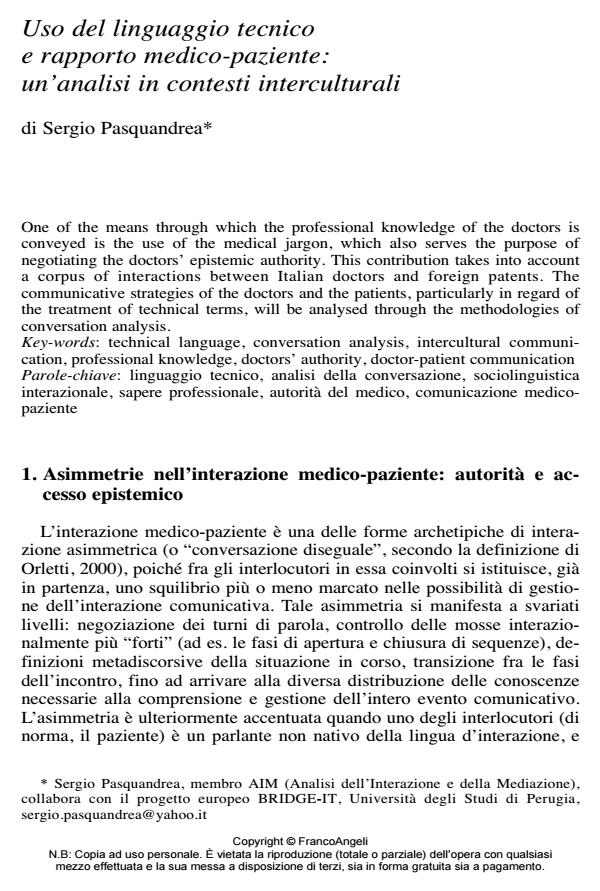
Qui sotto puoi vedere in anteprima la prima pagina di questo articolo.
Se questo articolo ti interessa, lo puoi acquistare (e scaricare in formato pdf) seguendo le facili indicazioni per acquistare il download credit. Acquista Download Credits per scaricare questo Articolo in formato PDF
FrancoAngeli è membro della Publishers International Linking Association, Inc (PILA), associazione indipendente e non profit per facilitare (attraverso i servizi tecnologici implementati da CrossRef.org) l’accesso degli studiosi ai contenuti digitali nelle pubblicazioni professionali e scientifiche.
One of the means through which the professional knowledge of the doctors is conveyed is the use of the medical jargon, which also serves the purpose of negotiating the doctors’ epistemic authority. This contribution takes into account a corpus of interactions between Italian doctors and foreign patents. The communicative strategies of the doctors and the patients, particularly in regard of the treatment of technical terms, will be analysed through the methodologies of conversation analysis.
Parole chiave:Linguaggio tecnico, analisi della conversazione, sociolinguistica interazionale, sapere professionale, autorità del medico, comunicazione medicopaziente
- Bolden G. (2000). Toward understanding practices of medical interpreting: Interpreters’ involvement in history taking. Discourse Studies, 2, 4: 387-419
- Haakana M. (2001). Laughter as a patient’s resource: Dealing with delicate aspects of medical interaction, Text, 21, 1-2: 187-219
- Have P. ten (1991). Talk and institution: a reconsideration of the “asymmetry” of doctor-patient interaction. In: Boden D. and Zimmerman D.H., a cura di, Talk and social structure: studies in ethnomethodology and conversation analysis. Cambridge: Polity Press: 138-163
- Heritage J. (1985). Analyzing news interviews: Aspects of the production of talk for an overhearing audience. In: Van Dijk T., a cura di, Handbook of discourse analysis. London: Academic Press: 95-117
- Heritage J. (2005). Revisiting authority in physician-patient interaction. In: Duchan J.F. and Kovarsky D., a cura di, Diagnosis as culture practice. Amsterdam: Mouton de Gruyter
- Heritage J. (2010). Questioning in medicine. In: Freed A. and Ehrlich S., a cura di, Why Do You Ask? The Function of Questions in Institutional Discourse. New York: Oxford University Press: 42-68
- Heritage J. (2012a). Epistemics in action: Action formation and territories of knowledge. Research on Language and Social Interaction. 45, 1: 1-29
- Heritage J. (2012b). The epistemic engine. Sequence organization and territories of knowledge. Research on Language and Social Interaction. 45, 1: 30-52
- Heritage J. (in corso di stampa). Epistemics in Conversation. In Sidnell J. and Stivers T., a cura di, Handbook of Conversation Analysis. Boston: Wiley-Blackwell
- Heritage J. and Maynard D.W., a cura di (2006). Communication in medical care. Interaction between physicians and patients. Cambridge: Cambridge University Press
- Heritage J. and Raymond G. (2005). The terms of agreement: indexing epistemic authority and subordination in talk-in-interaction. Social Psychology Quarterly, 68, 1: 15-38
- Heritage J. and Raymond G. (in corso di stampa). Navigating epistemic landscape: Acquiescence, agency and resistance in responses to polar questions. In: de Ruiter J.P., a cura di, Questions: Formal, Functional and Interactional Perspectives.Cambridge: Cambridge University Press
- Heritage J. and Watson D.R. (1980). Aspects of the properties of formulations in natural conversation: Some instances analyzed. Semiotica, 30: 245-262
- Maynard W.D. (1991). Interaction and asymmetry in clinical discourse. The American Journal of Sociology, 97, 2: 448-495
- Margutti P., Galatolo R. (questo volume). Forme di riduzione dell’asimmetria nella comunicazione medico-paziente: le iniziative dei pazienti nel corso di visite specialistiche
- Orletti F. (2000). La conversazione diseguale. Potere e interazione. Firenze: Carocci
- Orletti F. (questo volume). L’emergere e la costruzione delle identità nell’interazione medico-paziente in contesti multiculturali
- Pasquandrea S. (2011). Managing multiple actions through multimodality: Doctors’ involvement in interpreter-mediated interactions. Language in Society, 40, 4: 455-481
- Peräkylä A. (1998). Authority and accountability: The delivery of diagnosis in primary health care. Social Psychology Quarterly, 61, 4: 301-320
- Pomerantz A. (1980). Telling my side: “limited access” as a “fishing” device. Sociological Inquiry, 50: 186-198
- Pomerantz A. (1984). Agreeing and disagreeing with assessments: Some features of preferred/dispreferred turn shapes. In Atkinson J. M. and Heritage J., a cura di, Structures of social action. New York: Academic Press: 57-101
- Raymond G. and Heritage J. (2006). The epistemics of social relations: Owning grandchildren. Language in Society, 35: 677-705
- Robinson J.D. (2001). Asymmetry in action: Sequential resources in the negotiation of a prescription request. Text, 21, 1-2: 19-54
- Roter D.L. and Hall J.A. (1992). Doctor talking with patients/Patients talking with doctors. Improving communication in medical visits. Westport (CT)/London: Auburn House
- Stivers T. and Heritage J. (2001). Breaking the sequential mold: Answering “more than the question” during comprehensive history taking. Text, 21, 1-2: 151-185
- Stivers T., Mondada L. and Steensig J., a cura di (2011). The morality of knowledge in conversation. Cambridge: Cambridge University Press
- Teas Gill V. (1998). Doing attributions in medical interaction: Patients’ explanations for illness and doctors’ responses. Social Psychology Quarterly, 61, 4: 342-360
- Serianni L. (2005). Un treno di sintomi. I medici e le parole: percorsi linguistici nel passato e nel presente. Milano: Garzanti
Sergio Pasquandrea, Uso del linguaggio tecnico e rapporto medico-paziente: un’analisi in contesti interculturali in "SALUTE E SOCIETÀ" 1/2013, pp 76-93, DOI: 10.3280/SES2013-001007