Self o mass branding? La relazione tra personalizzazione e marca
Titolo Rivista MERCATI E COMPETITIVITÀ
Autori/Curatori Maria Antonietta Raimondo, Gaetano "Nino" Miceli, Stefania Farace
Anno di pubblicazione 2013 Fascicolo 2013/4
Lingua Italiano Numero pagine 23 P. 149-171 Dimensione file 751 KB
DOI 10.3280/MC2013-004008
Il DOI è il codice a barre della proprietà intellettuale: per saperne di più
clicca qui
Qui sotto puoi vedere in anteprima la prima pagina di questo articolo.
Se questo articolo ti interessa, lo puoi acquistare (e scaricare in formato pdf) seguendo le facili indicazioni per acquistare il download credit. Acquista Download Credits per scaricare questo Articolo in formato PDF
FrancoAngeli è membro della Publishers International Linking Association, Inc (PILA), associazione indipendente e non profit per facilitare (attraverso i servizi tecnologici implementati da CrossRef.org) l’accesso degli studiosi ai contenuti digitali nelle pubblicazioni professionali e scientifiche.
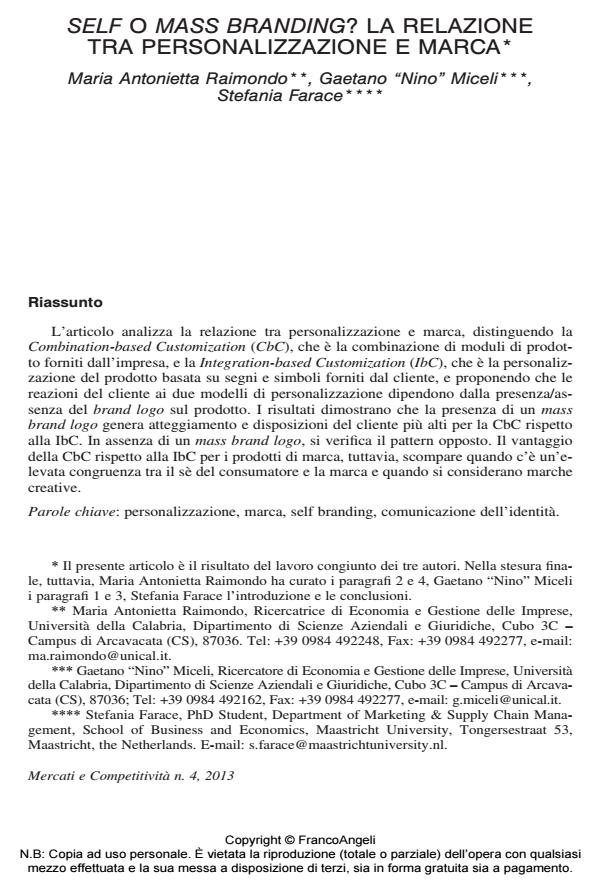
L’articolo analizza la relazione tra personalizzazione e marca, distinguendo la Combination-based Customization (CbC), che è la combinazione di moduli di prodotto forniti dall’impresa, e la Integration-based Customization (IbC), che è la personalizzazione del prodotto basata su segni e simboli forniti dal cliente, e proponendo che le reazioni del cliente ai due modelli di personalizzazione dipendono dalla presenza/assenza del brand logo sul prodotto. I risultati dimostrano che la presenza di un mass brand logo genera atteggiamento e disposizioni del cliente più alti per la CbC rispetto alla IbC. In assenza di un mass brand logo, si verifica il pattern opposto. Il vantaggio della CbC rispetto alla IbC per i prodotti di marca, tuttavia, scompare quando c’è un’elevata congruenza tra il sè del consumatore e la marca e quando si considerano marche creative.
Parole chiave:Personalizzazione, marca, self branding, comunicazione dell’identità.
- Wind J., Rangaswamy A. (2001). Customerization: The Next Revolution in Mass Customization. Journal of Interactive Marketing, 15 (1): 13-32, DOI: 10.1002/1520-6653(200124)
- Aaker D.A. (1996). Building Strong Brands. New York: The Free Press.
- Aaker J.L. (1997). Dimensions of Brand Personality. Journal of Marketing Research, 34 (3): 347-356.
- Aiken L.S., West S.G. (1991). Multiple regression: Testing and interpreting interactions. Newbury Park, CA: Sage Publications.
- Lynn M. Harris J. (1997). Individual Differences in the Pursuit of Self-Uniqueness Through Consumption. Journal of Applied Social Psychology, 27 (21): 1861-1883, DOI: 10.1111/j.1559-1816.1997.tb01629.x
- McCracken G. (1986). Culture and Consumption: A Theoretical Account of the Structure: A Theoretical Account of the Structure and Movement of the Cultural Meaning of Consumer Goods. Journal of Consumer Research, 13 (1): 71-84.
- MacKinnon D.P. (2008). Introduction to Statistical Mediation Analysis. Lawrence Erlbaum Associates, New York.
- Miceli G., Ricotta F., Costabile M. (2007). Customizing Customization: A Conceptual Framework for Interactive Personalization. Journal of Interactive Marketing, 21 (2): 6-25, DOI: 10.1002/dir.20076
- Mick D.G. (1986). Consumer Research and Semiotics: Exploring the Morphology of Signs, Symbols, and Significance. Journal of Consumer Research, 13 (2): 196-213.
- Moreau C.P., Bonney L., Herd K.B. (2011). It’s the Thought and Effort That Counts: How customizing for Others Differs from Customizing for Oneself. Journal of Marketing, 75 (5): 120-133, DOI: 10.1509/jmkg.75.5.120
- Pine B.J. (1993). Mass Customization. The New Frontier in Business Competition. Boston, Mass: Harvard Business School Press.
- Pine B.J., Gilmore J.H. (1999). The experience economy work is theatre & every business a stage. Harvard Business School Press, Boston.
- Peppers D., Rogers M., Dorf B. (1999). Is your company ready for one-to-one marketing?. Harvard Business Review, 77 (1): 151-160.
- Prahalad C.K., Ramaswamy V. (2004). Co-creation Experiences: The Next Practice in Value Creation. Journal of Interactive Marketing, 18 (3): 5-14, DOI: 10.1002/dir.20015
- Raimondo M.A., Miceli G., Farace S. (2009). Customer Intimization: segni e simboli individuali nella personalizzazione dell’offerta. Finanza, Marketing e Produzione, XXVII (3): 31-55.
- Randall T., Terwiesch C., Ulrich K.T. (2005). Principles for User Design of Customized Products. California Management Review, 47 (4): 68-85, DOI: 10.2307/41166317
- Sharma A., Sheth J.N. (2004). Web-based marketing: The coming revolution in marketing thought and strategy. Journal of Business Research, 57 (7): 696-702, DOI: 10.1016/S0148-2963(02)00350-8
- Scott L.M. (1994). Images in Advertising: The Need for a Theory of Visual Rhetoric. Journal of Consumer Research, 21 (2): 252-273.
- Simonson I. (2005). Determinants of Customers’ Responses to Customized Offers: Conceptual Framework and Research Propositions. Journal of Marketing, 69 (1): 32-45, DOI: 10.1509/jmkg.69.1.32.5551
- Sirgy M.J. (1982). Self-Concept in Consumer Behavior: A Critical Review. Journal of Consumer Research, 9 (3), 287-300.
- Steenkamp J.-B.E.M., Baumgartner H. (1998). Assessing Measurement Invariance in Cross-National Consumer Research. Journal of Consumer Research, 25 (1): 78-90, DOI: 10.1086/20952
- Tellis G.J. (2004). Effective Advertising: Understanding When, How and Why Advertising Works. Thousand Oaks, CA: Sage.
- Townsend C., Sood S. (2012). Self-Affirmation through the Choice of Highly Aesthetic Products. Journal of Consumer Research, 39 (2): 415-428, DOI: 10.1086/663775
- Valenzuela A., Dhar R., Zettelmeyer F. (2009). Contingent Response to Self-Customization Procedures: Implications for Decision Satisfaction and Choice. Journal of Marketing Research, 46 (6): 754-763, DOI: 10.1509/jmkr.46.6.754
- von Hippel E., Katz R. (2002). Shifting Innovation to Users via Toolkits. Management Science, 48 (7): 821-833, DOI: 10.1287/mnsc.48.7.821.2817
- Bendapudi N., Leone R.P. (2003). Psychological Implications of Customer Participation in Co-Production. Journal of Marketing, 67 (1): 14-28, DOI: 10.1509/jmkg.67.1.14.18592
- Berger J., Heath C. (2007). Where Consumers Diverge from Others: Identity-Signaling and Product Domains. Journal of Consumer Research, 34 (2): 121-134, DOI: 10.1086/519142
- Berger J., Ward M. (2010). Subtle Signals of Inconspicuous Consumption. Journal of Consumer Research, 37 (4): 555-569, DOI: 10.1086/655445
- Berthon P.R., Pitt L.F., McCarthy I., Kates S.M. (2007). When Customers Get Clever: Managerial Approaches to Dealing with Creative Consumers. Business Horizons, 50 (1): 39-47, DOI: 10.1016/j.bushor.2006.05.005
- Chan C., Berger J., Van Boven L. (2012). Identifiable but Not Identical: Combining Social Identity and Uniqueness Motives in Choice. Journal of Consumer Research, 39 (3): 561-573, DOI: 10.1086/664804
- Dellaert B.G.C., Stremersch S. (2005). Marketing Mass-Customized Products: Striking a Balance Between Utility and Complexity. Journal of Marketing Research, 42 (2): 219-227, DOI: 10.1509/jmkr.42.2.219.62293
- De Pelsmacker P., Geuens M., Van den Bergh J. (2007). Marketing Communications. A European Perspective. Pearson Education, Harlow.
- Diamantopoulos A., Sarstedt M., Fuchs C., Wilczynski P., Kaiser S. (2012). Guidelines for Choosing Between Multi-item and Single-item Scales for Construct Measurement: A Predictive Validity Perspective. Journal of the Academy of Marketing Science, 40 (3): 434-449. DOI 10.1007/s11747-011-0300-3.
- Escalas J.E., Bettman J.R. (2005). Self-Construal, Reference Groups, and Brand Meaning. Journal of Consumer Research, 32 (3): 378-389, DOI: 10.1086/497549
- Fishbein M., Ajzen I. (1975). Belief, Attitude, Intention, and Behavior: An Introduction to Theory and Research. Reading, MA: Addison-Wesley.
- Franke N., Piller F. (2004). Value Creation by Toolkits for User Innovatione and Design: The Case of the Watch Market. Journal of Product Innovation Management, 21 (6): 401-415, DOI: 10.1111/j.0737-6782.2004.00094.x
- Franke N., Schreier M. (2008). Product Uniqueness as a Driver of Customer Utility in Mass Customization. Marketing Letters, 19 (2): 93-107, DOI: 10.1007/s11002-007-9029-7
- Franke N., Keinz P., Steger C.J. (2009). Testing the Value of Customization: When Do Customers Really Prefer Products Tailored to Their Preferences?. Journal of Marketing, 73 (September): 103-121, DOI: 10.1509/jmkg.73.5.103
- Franke N., Schreier M., Kaiser U. (2010). The ‘I Designed it Myself’ Effect in Mass Customization. Management Science, 56 (1): 125-140, DOI: 10.1287/mnsc.1090.1077
- Han Y.J., Nunes J.C., Drèze X. (2010). Signaling Status with Luxury Goods: The Role of Brand Prominence. Journal of Marketing, 74 (4): 15-30, DOI: 10.1509/jmkg.74.4.15
- Hayes A.F., Matthes J. (2009). Computational Procedures for Probing Interactions in OLS and Logistic Regression: SPSS and SAS Implementations. Behavior Research Methods, 41 (3): 924-936, DOI: 10.3758/BRM.41.3.924
- Hayes R.H., Pisano G.P. (1994). Beyond World-Class: The New Manufacturing Strategy. Harvard Business Review, 72 (1): 77-86.
- Holt D.B. (1995). How Consumers Consume: A Typology of Consumption Practices. Journal of Consumer Research, 22 (1): 1-16.
- Keller K.L. (1998). Strategic Brand Management. Upper Saddle River: Prentice Hall.
- Kapferer J.N. (2008). The New Strategic Brand Management. Kogan Page, London.
- Kramer T., Spolter-Weisfeld S.,Thakkar M. (2007). The Effect of Cultural Orientation on Consumer Responses to Personalization. Marketing Science, 26 (2): 246-258, DOI: 10.1287/mksc.1060.0223
- User-Generated Systems of Signs and Meanings in Product Customization: Taxonomies and Research Directions Maria Antonietta Raimondo, Stefania Farace, Gaetano "Nino" Miceli, in MERCATI & COMPETITIVITÀ 2/2018 pp.61
DOI: 10.3280/MC2018-002004
Maria Antonietta Raimondo, Gaetano "Nino" Miceli, Stefania Farace, Self o mass branding? La relazione tra personalizzazione e marca in "MERCATI E COMPETITIVITÀ" 4/2013, pp 149-171, DOI: 10.3280/MC2013-004008