Effetti biomolecolari del maltrattamento infantile: il ruolo dell’epigenetica e dell’infiammazione

Titolo Rivista MALTRATTAMENTO E ABUSO ALL’INFANZIA
Autori/Curatori Luisella Bocchio-Chiavetto, Elisabetta Maffioletti
Anno di pubblicazione 2015 Fascicolo 2015/3
Lingua Italiano Numero pagine 20 P. 35-54 Dimensione file 148 KB
DOI 10.3280/MAL2015-003003
Il DOI è il codice a barre della proprietà intellettuale: per saperne di più clicca qui

Qui sotto puoi vedere in anteprima la prima pagina di questo articolo.

Se questo articolo ti interessa, lo puoi acquistare (e scaricare in formato pdf) seguendo le facili indicazioni per acquistare il download credit. Acquista Download Credits per scaricare questo Articolo in formato PDF
Anteprima articolo

FrancoAngeli è membro della Publishers International Linking Association, Inc (PILA), associazione indipendente e non profit per facilitare (attraverso i servizi tecnologici implementati da CrossRef.org) l’accesso degli studiosi ai contenuti digitali nelle pubblicazioni professionali e scientifiche.

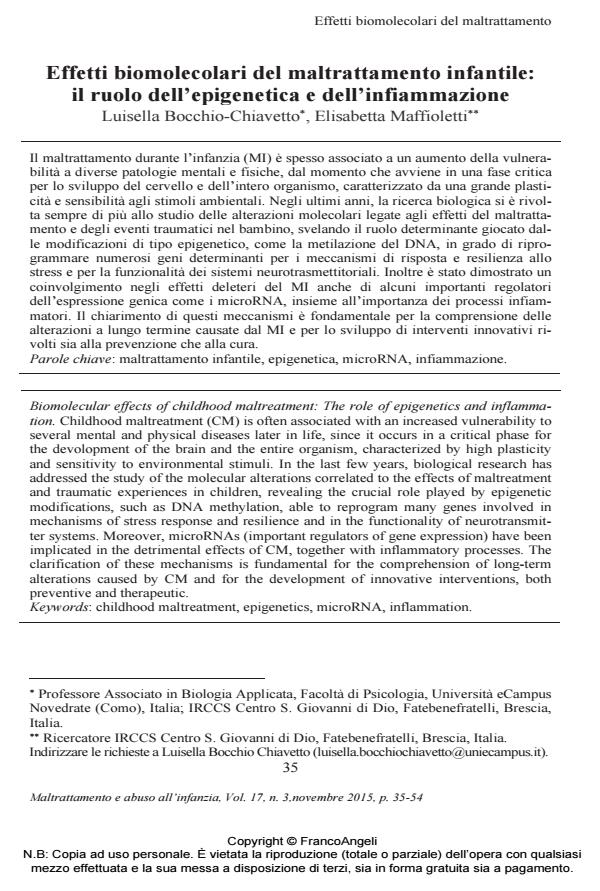
Il maltrattamento durante l’infanzia (MI) è spesso associato a un aumento della vulnerabilità a diverse patologie mentali e fisiche, dal momento che avviene in una fase critica per lo sviluppo del cervello e dell’intero organismo, caratterizzato da una grande plasticità e sensibilità agli stimoli ambientali. Negli ultimi anni, la ricerca biologica si è rivolta sempre di più allo studio delle alterazioni molecolari legate agli effetti del maltrattamento e degli eventi traumatici nel bambino, svelando il ruolo determinante giocato dalle modificazioni di tipo epigenetico, come la metilazione del DNA, in grado di riprogrammare numerosi geni determinanti per i meccanismi di risposta e resilienza allo stress e per la funzionalità dei sistemi neurotrasmettitoriali. Inoltre è stato dimostrato un coinvolgimento negli effetti deleteri del MI anche di alcuni importanti regolatori dell’espressione genica come i microRNA, insieme all’importanza dei processi infiammatori. Il chiarimento di questi meccanismi è fondamentale per la comprensione delle alterazioni a lungo termine causate dal MI e per lo sviluppo di interventi innovativi rivolti sia alla prevenzione che alla cura.

Parole chiave:Maltrattamento infantile, epigenetica, microRNA, infiammazione.

  1. Chekulaeva, M., & Filipowicz, W. (2009). Mechanisms of miRNA-mediated post-transcriptional regulation in animal cells. Current opinion in cell biology, 21, 452-460, DOI: 10.1016/j.ceb.2009.04.009
  2. Cheng, L. C., Pastrana, E., Tavazoie, M., & Doetsch, F. (2009). miR-124 regulates adult neurogenesis in the subventricular zone stem cell niche. Nature neuroscience, 12, 399-408, DOI: 10.1038/nn.2294
  3. Coelho, R., Viola, T. W., Walss Bass, C., Brietzke, E., & Grassi Oliveira, R. (2014). Childhood maltreatment and inflammatory markers: A systematic review. Acta Psychiatrica Scandinavica, 129, 180-192,
  4. 10.1111/acps.12217.
  5. Danese, A., Moffitt, T. E., Pariante, C. M., Ambler, A., Poulton, R., & Caspi, A. (2008). Elevated inflammation levels in depressed adults with a history of childhood maltreatment. Archives of general psychiatry, 65, 409-415, DOI: 10.1001/archpsyc.65.4.409
  6. Davalos, D., & Akassoglou, K. (2012). Fibrinogen as a key regulator of inflammation in disease. In Seminars in immunopathology (Vol. 34, No. 1, pp. 43-62). Springer-Verlag, DOI: 10.1007/s00281-011-0290-8
  7. Dennison, U., McKernan, D., Cryan, J., & Dinan, T. (2012). Schizophrenia patients with a history of childhood trauma have a pro-inflammatory phenotype. Psychological medicine, 42, 1865-1871, DOI: 10.1017/S0033291712000074
  8. Doherty, T. S., Forster, A., & Roth, T. L. (2015). Global and gene-specific DNA methylation alterations in the adolescent amygdala and hippocampus in an animal model of caregiver maltreatment. Behavioural Brain Research, 28, pii: S0166-4328(15)00357-5, DOI: 10.1016/j.bbr.2015.05.028
  9. Dube, S. R., Fairweather, D., Pearson, W. S., Felitti, V. J., Anda, R. F., & Croft, J. B. (2009). Cumulative childhood stress and autoimmune diseases in adults. Psychosomatic medicine, 71, 243, DOI: 10.1097/PSY.0b013e3181907888
  10. Dvir, Y., Ford, J. D., Hill, M., & Frazier, J. A. (2014). Childhood maltreatment, emotional dysregulation, and psychiatric comorbidities. Harvard review of psychiatry, 22, 149, DOI: 10.1097/HRP.0000000000000014
  11. Eddy, J. L., Krukowski, K., Janusek, L., & Mathews, H. L. (2014). Glucocorticoids regulate natural killer cell function epigenetically. Cellular immunology, 290, 120-130, DOI: 10.1016/j.cellimm.2014.05.013
  12. Fabbri, M., Calore, F., Paone, A., Galli, R., & Calin, G. A. (2013). Epigenetic regulation of miRNAs in cancer. In Epigenetic Alterations in Oncogenesis (pp. 137-148). New York: Springer, DOI: 10.1007/978-1-4419-9967-2_6
  13. Felitti, V. J., Anda, R. F., Nordenberg, D., Williamson, D. F., Spitz, A. M., Edwards, V., ... & Marks, J. S. (1998). Relationship of childhood abuse and household dysfunction to many of the leading causes of death in adults: The Adverse Childhood Experiences (ACE) Study. American journal of preventive medicine, 14, 245-258, DOI: 10.1016/S0749-3797(98)00017-8
  14. Goldberg, A. D., Allis, C. D., & Bernstein, E. (2007). Epigenetics: A landscape takes shape. Cell, 128, 635-638, DOI: 10.1016/j.cell.2007.02.006
  15. Green, J. G., McLaughlin, K. A., Berglund, P. A., Gruber, M. J., Sampson, N. A., … & Kessler, R. C. (2010). Childhood adversities and adult psychiatric disorders in the national comorbidity survey replication I: Associations with first onset of DSM-IV disorders. Archives General Psychiatry, 67, 113-123, DOI: 10.1001/archgenpsychiatry.2009.186
  16. Hane, A. A., & Fox, N. A. (2006). Ordinary variations in maternal caregiving influence human infants' stress reactivity. Psychological Science, 17, 550-556, DOI: 10.1111/j.1467-9280.2006.01742
  17. Hao, Y., Huang, W., Nielsen, D. A., Kosten, T. A. (2011). Litter gender composition and sex affect maternal behavior and DNA methylation levels of the oprm1 gene in rat offspring. Frontiers in Psychiatry, 2, 21, DOI: 10.3389/fpsyt.2011.00021
  18. Haramati, S., Navon, I., Issler, O., Ezra-Nevo, G., Gil, S., Zwang, R., ... & Chen, A. (2011). MicroRNA as repressors of stress-induced anxiety: the case of amygdalar miR-34. The Journal of Neuroscience, 31, 14191-14203, DOI: 10.1523/JNEUROSCI.1673-11.2011
  19. Hepgul, N., Pariante, C. M., Dipasquale, S., DiForti, M., Taylor, H., Marques, T. R., ... & Mondelli, V. (2012). Childhood maltreatment is associated with increased body mass index and increased C-reactive protein levels in firstepisode psychosis patients. Psychological medicine, 42, 1893-1901, DOI: 10.1017/S0033291711002947
  20. Hu, W., Wang, T., Xu, J., & Li, H. (2014). MicroRNA mediates DNA methylation of target genes. Biochemical and biophysical research communications, 444, 676-681, DOI: 10.1016/j.bbrc.2014.01.171
  21. Huntzinger, E., & Izaurralde, E. (2011). Gene silencing by microRNAs: contributions of translational repression and mRNA decay. Nature Reviews Genetics, 12, 99-110, DOI: 10.1038/nrg2936
  22. Kessler, R. C., McLaughlin, K. A., Green, J. G., Gruber, M. J., Sampson, N. A., Zaslavsky, A. M., ... & Williams, D. R. (2010). Childhood adversities and adult psychopathology in the WHO World Mental Health Surveys. The British Journal of Psychiatry, 197, 378-385, DOI: 10.1192/bjp.bp.110.080499
  23. Klengel, T., & Binder, E. B. (2015). Epigenetics of stress-related psychiatric disorders and gene x environment interactions. Neuron, 86, 1343-1357, DOI: 10.1016/j.neuron.2015.05.036
  24. Klengel, T., Mehta, D., Anacker, C., Rex-Haffner, M., Pruessner, J. C., Pari ante, C. M., ... & Binder, E. B. (2013). Allele-specific FKBP5 DNA demethylation mediates gene-childhood trauma interactions. Nature neuroscience, 16, 33-41, DOI: 10.1038/nn.3275
  25. Krol, J., Loedige, I., & Filipowicz, W. (2010). The widespread regulation of microRNA biogenesis, function and decay. Nature Reviews Genetics, 11, 597, DOI: 10.1038/nrg2843
  26. Liu, D., Diorio, J., Tannenbaum, B., Caldji, C., Francis, D., … & Meaney, M. J. (1997). Maternal care, hippocampal glucocorticoid receptors, and hypothalamic-pituitary-adrenal responses to stress. Science, 277, 1659-62, DOI: 10.1126/science.277.5332.1659
  27. Lutz, P. E., Turecki, G. (2014). DNA methylation and childhood maltreatment: from animal models to human studies. Neuroscience, 264, 142-156, DOI: 10.1016/j.neuroscience.2013.07.069
  28. McGowan, P. O., & Szyf, M. (2010). The epigenetics of social adversity in early life: implications for mental health outcomes. Neurobiology of disease, 39, 66-72, DOI: 10.1016/j.nbd.2009.12.026
  29. McLaughlin, K. A., Kubzansky, L. D., Dunn, E. C., Waldinger, R., Vaillant, G., Koenen, K. C. (2010). Childhood social environment, emotional reactivity to stress, and mood and anxiety disorders across the life course. Depress Anxiety, 27, 1087-1094, DOI: 10.1002/da.20762
  30. Mitchelmore, C., & Gede, L. (2014). Brain derived neurotrophic factor: Epigenetic regulation in psychiatric disorders. Brain Research, 1586, 162-172, DOI: 10.1016/j.brainres.2014.06.037
  31. Murgatroyd, C., Patchev, A. V., Wu, Y., Micale, V., Bockmühl, Y., … & Spengler, D. (2009). Dynamic DNA methylation programs persistent adverse effects of early-life stress. Nature Neuroscience, 12, 1559-66, DOI: 10.1038/nn.2436
  32. O’Carroll, D., & Schaefer, A. (2013). General principals of miRNA biogenesis and regulation in the brain. Neuropsychopharmacology, 38, 39-54, DOI: 10.1038/npp.2012.87
  33. Wang, A., Nie, W., Li, H., Hou, Y., Yu, Z., Fan, Q., & Sun, R. (2014). Epigenetic upregulation of corticotrophin-releasing hormone mediates postnatal maternal separation-induced memory deficiency. PloS one, 9(4), DOI: 10.1371/journal.pone.0094394
  34. Wanner, B., Vitaro, F., Tremblay, R. E., Turecki, G. (2012). Childhood trajectories of anxiousness and disruptiveness explain the association between early-life adversity and attempted suicide. Psychological Medicine, 42, 2373-2382, DOI: 10.1017/S0033291712000438
  35. Watanabe, K., & Takai, D. (2013). Disruption of the expression and function of microRNAs in lung cancer as a result of epigenetic changes. Frontiers in genetics, 4. DOI: 10.3389/fgene.2013.00275
  36. Weaver, I. C., Cervoni, N., Champagne, F. A., D’Alessio, A. C., Sharma, S., … & Meaney, M. J. (2004). Epigenetic programming by maternal behavior. Nat Neurosci, 7, 847-854, DOI: 10.1038/nn1276
  37. Webster, J. I., Tonelli, L., & Sternberg, E. M. (2002). Neuroendocrine regulation of immunity. Annual review of immunology, 20, 125-163, DOI: 10.1146/annurev.immunol.20.082401.104914
  38. Wu, Y., Patchev, A.V., Daniel, G., Almeida, O.F., Spengler, D. (2014). Earlylife stress reduces DNA methylation of the Pomc gene in male mice. Endocrinology, 155, 1751-1762, DOI: 10.1210/en.2013-1868
  39. Yehuda, R., Daskalakis, N. P., Desarnaud, F., Makotkine, I., Lehrner, A. L., Koch, E., ... & Bierer, L. M. (2013). Epigenetic biomarkers as predictors and correlates of symptom improvement following psychotherapy in combat veterans with PTSD. Frontiers in psychiatry, 4, DOI: 10.3389/fpsyt.2013.00118
  40. Zhang, T. Y., Hellstrom, I. C., Bagot, R. C., Wen, X., Diorio, J., Meaney, M. J. (2010). Maternal care and DNA methylation of a glutamic acid decarboxylase 1 promoter in rat hippocampus. Journal of Neuroscience, 30, 13130-13137, DOI: 10.1523/JNEUROSCI.1039-10.2010
  41. Adachi, N., Numakawa, T., Richards, M., Nakajima, S., & Kunugi, H. (2014). New insight in expression, transport, and secretion of brain-derived neurotrophic factor: Implications in brain-related diseases. World journal of biological chemistry, 5, 409, DOI: 10.4331/wjbc.v5.i4.409
  42. Afifi, T. O., Enns, M. W., Cox, B. J., Asmundson, G. J., Stein, M. B., & Sareen, J. (2008). Population attributable fractions of psychiatric disorders and suicide ideation and attempts associated with adverse childhood experiences. American journal of public health, 98, 946-952, DOI: 10.2105/AJPH.2007.120253
  43. Ahmed, A. O., Mantini, A. M., Fridberg, D. J., & Buckley, P. F. (2015). Brainderived neurotrophic factor (BDNF) and neurocognitive deficits in people with schizophrenia: A meta-analysis. Psychiatry research, 226, 1-13, DOI: 10.1016/j.psychres.2014.12.069
  44. Babenko, O., Golubov, A., Ilnytskyy, Y., Kovalchuk, I., & Metz, G. A. (2012). Genomic and epigenomic responses to chronic stress involve miRNAmediated programming. PloS one, 7, e29441, DOI: 10.1371/journal.pone.0029441
  45. Bagot, R. C., van Hasselt, F. N., Champagne, D. L., Meaney, M. J., Krugers, H. J., & Joëls, M. (2009). Maternal care determines rapid effects of stress mediators on synaptic plasticity in adult rat hippocampal dentate gyrus. Neurobiology of learning and memory, 92, 292-300, DOI: 10.1016/j.nlm.2009.03.004
  46. Bagot, R. C., Tse, Y. C., Nguyen, H. B., Wong, A. S., Meaney, M. J., & Wong, T. P. (2012a). Maternal care influences hippocampal N-methyl-D-aspartate receptor function and dynamic regulation by corticosterone in adulthood. Biological psychiatry, 72, 491-498, DOI: 10.1016/j.biopsych.2012.03.016
  47. Bagot, R. C., Zhang, T. Y., Wen, X., Nguyen, T. T. T., Nguyen, H. B., Diorio, J., ... & Meaney, M. J. (2012b). Variations in postnatal maternal care and the epigenetic regulation of metabotropic glutamate receptor 1 expression and hippocampal function in the rat. Proceedings of the National Academy of Sciences, 109, 17200-17207, DOI: 10.1073/pnas.1204599109
  48. Beach, S. R., Brody, G. H., Todorov, A. A., Gunter, T. D., & Philibert, R. A. (2011). Methylation at 5HTT mediates the impact of child sex abuse on women’s antisocial behavior: An examination of the Iowa adoptee sample. Psychosomatic Medicine, 73, 83-87, DOI: 10.1097/PSY.0b013e3181fdd074
  49. Bilbo, S. D. (2013). Frank A. Beach award: programming of neuroendocrine function by early-life experience: A critical role for the immune system. Hormones and behavior, 63, 684-691, DOI: 10.1016/j.yhbeh.2013.02.017
  50. Blaze, J., Asok, A., & Roth, T. L. (2015a). The long-term impact of adverse caregiving environments on epigenetic modifications and telomeres. Front Behavioral Neuroscience, 9, 79, DOI: 10.3389/fnbeh.2015.00079
  51. Blaze, J., Asok, A., & Roth, T. L. (2015b). Long-term effects of early-life caregiving experiences on brain-derived neurotrophic factor histone acetylation in the adult rat mPFC. Stress, 25, 1-9, DOI: 10.3109/10253890.2015.1071790
  52. Bocchio-Chiavetto, L., Bagnardi, V., Zanardini, R., Molteni, R., Nielsen, M. G., … & Gennarelli, M. (2010). Serum and plasma BDNF levels in major depression: a replication study and meta-analyses. World Journal of Biological Psychiatry, 11, 763-773, DOI: 10.3109/15622971003611319
  53. Borrelli, E., Nestler, E.J., Allis, C.D., Sassone-Corsi, P. (2008). Decoding the epigenetic language of neuronal plasticity. Neuron, 60, 961-974, DOI: 10.1016/j.neuron.2008.10.01
  54. Brown, D. W., Anda, R. F., Felitti, V. J., Edwards, V. J., Malarcher, A. M., Croft, J. B., & Giles, W. H. (2010). Adverse childhood experiences are associated with the risk of lung cancer: A prospective cohort study. BMC Public Health, 10, 20, DOI: 10.1186/1471-2458-10-20
  55. Brenhouse, H. C., & Andersen, S. L. (2011). Nonsteroidal anti-inflammatory treatment prevents delayed effects of early life stress in rats. Biological psychiatry, 70, 434-440, DOI: 10.1016/j.biopsych.2011.05.006
  56. Carpenter, L. L., Gawuga, C. E., Tyrka, A. R., Lee, J. K., Anderson, G. M., & Price, L. H. (2010). Association between plasma IL-6 response to acute stress and early-life adversity in healthy adults. Neuropsychopharmacology, 35, 2617-2623, DOI: 10.1038/npp.2010.159
  57. Oberlander, T. F., Weinberg, J., Papsdorf, M., Grunau, R., Misri, S., & Devlin, A. M. (2008). Prenatal exposure to maternal depression, neonatal methylation of human glucocorticoid receptor gene (NR3C1) and infant cortisol stress responses. Epigenetics, 3, 97-106, DOI: 10.4161/epi.3.2.6034
  58. Perroud, N., Paoloni-Giacobino, A., Prada, P., Olié, E., Salzmann, A., Nicastro, R., ... & Malafosse, A. (2011). Increased methylation of glucocorticoid receptor gene (NR3C1) in adults with a history of childhood maltreatment: a link with the severity and type of trauma. Translational psychiatry, 1, e59, DOI: 10.1038/tp.2011.60
  59. Prados, J., Stenz, L., Courtet, P., Prada, P., Nicastro, R., Adouan, W., ... & Perroud, N. (2015). Borderline personality disorder and childhood maltreatment: a genome􀇦wide methylation analysis. Genes, Brain and Behavior, 14, 177-188, DOI: 10.1111/gbb.12197
  60. Radtke, K. M., Ruf, M., Gunter, H. M., Dohrmann, K., Schauer, M., Meyer, A., & Elbert, T. (2011). Transgenerational impact of intimate partner violence on methylation in the promoter of the glucocorticoid receptor. Translational Psychiatry, 1, e21, DOI: 10.1038/tp.2011.21
  61. Radtke, K. M., Schauer, M., Gunter, H. M., Ruf-Leuschner, M., Sill, J., Meyer, A., & Elbert, T. (2015). Epigenetic modifications of the glucocorticoid receptor gene are associated with the vulnerability to psychopathology in childhood maltreatment. Translational Psychiatry, 5, e571, DOI: 10.1038/tp.2015.63
  62. Romans, S., Belaise, C., Martin, J., Morris, E., & Raffi, A. (2002). Childhood abuse and later medical disorders in women. Psychotherapy and psychosomatics, 71, 141-150, DOI: 10.1159/000056281
  63. Roth, T. L., Lubin, F. D., Funk, A. J., & Sweatt, J. D. (2009). Lasting epigenetic influence of early-life adversity on the BDNF gene. Biological psychiatry, 65, 760-769, DOI: 10.1016/j.biopsych.2008.11.028
  64. Roth, T. L., Matt, S., Chen, K., & Blaze, J. (2014). Bdnf DNA methylation modifications in the hippocampus and amygdala of male and female rats exposed to different caregiving environments outside the homecage. Developmental psychobiology, 56, 1755-1763, DOI: 10.1002/dev.21218
  65. Smith, C. J., & Ryckman, K. K. (2015). Epigenetic and developmental influences on the risk of obesity, diabetes, and metabolic syndrome. Diabetes, Metabolic Syndrome and Obesity: Targets and Therapy, 8, 295, DOI: 10.1002/dev.21218
  66. Suderman, M., Borghol, N., Pappas, J. J., Pereira, S. M. P., Pembrey, M., Hertzman, C., ... & Szyf, M. (2014). Childhood abuse is associated with methylation of multiple loci in adult DNA. BMC Medical Genomics, 7, 13, DOI: 10.1186/1755-8794-7-13
  67. Sun, H., Kennedy, P. J., & Nestler, E. J. (2013). Epigenetics of the depressed brain: role of histone acetylation and methylation. Neuropsychopharmacology, 38, 124-137, DOI: 10.1038/npp.2012.73
  68. Szyf, M. (2013). DNA methylation, behavior and early life adversity. Journal of Genetics & Genomics, 40, 331-338, DOI: 10.1016/j.jgg.2013.06.004
  69. Tyrka, A. R., Price, L. H., Marsit, C., Walters, O. C., & Carpenter, L. L. (2012). Childhood adversity and epigenetic modulation of the leukocyte glucocorticoid receptor: preliminary findings in healthy adults. PloS one, 7, e30148, DOI: 10.1371/journal.pone.0030148
  70. Uchida, S., Hara, K., Kobayashi, A., Funato, H., Hobara, T., Otsuki, K., ... & Watanabe, Y. (2010). Early life stress enhances behavioral vulnerability to stress through the activation of REST4-mediated gene transcription in the medial prefrontal cortex of rodents. The Journal of Neuroscience, 30, 15007-15018, DOI: 10.1523/JNEUROSCI.1436-10.2010

  • Le memorie traumatiche e il corpo: uno studio su maltrattamento infantile, consapevolezza interocettiva e sintomi somatici Luana La Marca, Andrea Scalabrini, Clara Mucci, Adriano Schimmenti, in MALTRATTAMENTO E ABUSO ALL'INFANZIA 3/2018 pp.47
    DOI: 10.3280/MAL2018-003004
  • Abuse, emotion regulation, and interoception: What can studies on the brain-body interaction tell us? Laura Angioletti, Michela Balconi, in MALTRATTAMENTO E ABUSO ALL'INFANZIA 1/2020 pp.9
    DOI: 10.3280/MAL2020-001002
  • Maltrattamento e abuso: una rassegna su definizioni, tipologie e interventi per la tutela dei soggetti a rischio Flaviana Tenuta, Maria Giuseppina Bartolo, Daniela Diano, Angela Costabile, in MALTRATTAMENTO E ABUSO ALL'INFANZIA 2/2020 pp.85
    DOI: 10.3280/MAL2020-002005

Luisella Bocchio-Chiavetto, Elisabetta Maffioletti, Effetti biomolecolari del maltrattamento infantile: il ruolo dell’epigenetica e dell’infiammazione in "MALTRATTAMENTO E ABUSO ALL’INFANZIA" 3/2015, pp 35-54, DOI: 10.3280/MAL2015-003003