Ombre: le vuote presenze del neglect genitoriale tra assenza di riparazioni e conflitti di lealtà
Titolo Rivista RIVISTA DI PSICOTERAPIA RELAZIONALE
Autori/Curatori Chiara Bastianoni
Anno di pubblicazione 2025 Fascicolo 2025/61
Lingua Italiano Numero pagine 17 P. 41-57 Dimensione file 112 KB
DOI 10.3280/PR2025-061003
Il DOI è il codice a barre della proprietà intellettuale: per saperne di più
clicca qui
Qui sotto puoi vedere in anteprima la prima pagina di questo articolo.
Se questo articolo ti interessa, lo puoi acquistare (e scaricare in formato pdf) seguendo le facili indicazioni per acquistare il download credit. Acquista Download Credits per scaricare questo Articolo in formato PDF
FrancoAngeli è membro della Publishers International Linking Association, Inc (PILA), associazione indipendente e non profit per facilitare (attraverso i servizi tecnologici implementati da CrossRef.org) l’accesso degli studiosi ai contenuti digitali nelle pubblicazioni professionali e scientifiche.
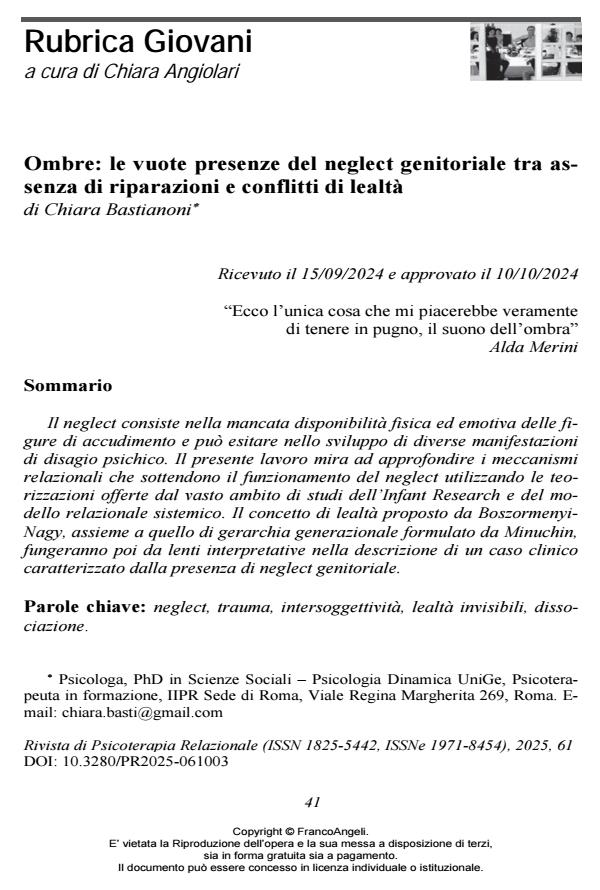
Il neglect consiste nella mancata disponibilità fisica ed emotiva delle figure di accudimento e può esitare nello sviluppo di diverse manifestazioni di disagio psichico. Il presente lavoro mira ad approfondire i meccanismi relazionali che sottendono il funzionamento del neglect utilizzando le teorizzazioni offerte dal vasto ambito di studi dell’Infant Research e del modello relazionale sistemico. Il concetto di lealtà proposto da Boszormenyi-Nagy, assieme a quello di gerarchia generazionale formulato da Minuchin, fungeranno poi da lenti interpretative nella descrizione di un caso clinico caratterizzato dalla presenza di neglect genitoriale.
Parole chiave:neglect, trauma, intersoggettività, lealtà invisibili, dissociazione.
- American Psychiatric Association (2013). Manuale Diagnostico e Statistico dei Disturbi Mentali, Quinta Edizione. DSM-5. Tr. it. Milano: Raffaello Cortina, 2014.
- Ammaniti M. (2015). Abuso e trascuratezza nell’infanzia: implicazioni cliniche. Infanzia e Adolescenza, 14, 1: 2-21. DOI: 10.1710/1862.2033
- Beebe B., Lachmann F.M. (2002). Infant research e trattamento degli adulti: un modello sistemico-diadico delle interazioni. Milano: Raffaello Cortina.
- Belsky J. (1980). Child maltreatment: An ecological integration. American Psychologist, 35, 4: 320-335.
- Boszormenyi-Nagy I., Grunebaum J. Ulrich D. (1995). Terapia contestuale. In A.S. Gurman & D.P. Kniskern (Eds.). Manuale di terapia della famiglia. Torino: Bollati Boringhieri.
- Boszormenyi-Nagy I., Spark G. (1988). Lealtà invisibili. Roma: Astrolabio.
- Bronfenbrenner U. (1979). Contexts of child rearing. American Psychologist, 34: 844-858.
- Cancrini L. (2013). La cura delle infanzie infelici. Milano: Raffaello Cortina.
- Dubowitz H., Pitts S.C., Black M.M. (2004). Measurement of three major subtypes of child neglect. Child Maltreatment, 9: 344-356. DOI: 10.1177/107755950426919
- Fonagy P., Gergely G., Jurist E.L., Target M. (2002). Affect regulation, mentalization, and the development of the self. New York, NY: Other Press.
- Gallinari M., Paulis A.M. (2018). La dimensione dissociativa: il peso delle esperienze traumatiche e della disorganizzazione nei legami famigliari. Rivista di Psicoterapia Relazione, 48: 5-54.
- Gallinari M., Paulis A.M. (2019). La dissociazione nei contesti di lealtà frammentate: un caso clinico. Rivista di Psicoterapia Relazione, 50: 5-23.
- Gershater-Molko R.M., Lutzker J.R., Sherman J.A. (2003). Assessing child neglect. Aggression and Violent Behavior, 8: 563-585.
- Janet P. (1935). Réalisation et interprétation. Annales Médico-Psychologiques, 93: 329-366.
- Kempe C.H., Silverman F.N., Steele B.F., Droegemueller W., Silver H.K. (1962). The battered-child syndrome. Journal of the American Medical Association, 181: 17-24.
- Loriedo C., Picardi A. (2017). Dalla teoria generale dei sistemi alla teoria dell’attaccamento. Percorsi e modelli della psicoterapia sistemico-relazionale. Milano: Franco Angeli.
- Lyons-Ruth K. (2003). Dissociation and the parent infant dialogue: A longitudinal perspective from attachment research. J. Am. Psycho-Anal. Assn, 51: 833-914.
- Mazzoni S., Tafà M. (2007). L’intersoggettività nella famiglia. Procedure multimetodo per l’osservazione e la valutazione delle relazioni familiari. Milano: Franco Angeli.
- Minuchin S. (1974). Families and Family Therapy. Harvard University Press, Cambridge. Trad. it (1976). Famiglie e Terapia della Famiglia. Astrolabio: Roma.
- Pignatelli A.M., Wampers M., Loriedo C., Biondi M., Vanderlinden J. (2017) Childhood neglect in eating disorders: A systematic review and metaanalysis. Journal of Trauma & Dissociation, 18: 100-115. DOI: 10.1080/15299732.2016.119895
- Stern D.N. (2004). Il momento presente. Milano: Raffaello Cortina.
- Stoltenborgh M., Bakermans-Kranenburg M.J., Van Ijzendoorn M.H. (2013). The neglect of child neglect: A meta-analytic review of the prevalence of neglect. Social Psychiatry and Psychiatric Epidemiology, 48: 345-355.
- U.S. Department of Health and Human Services (1996). Child maltreatment 1994: Reports from the states to the National Center on Child Abuse and Neglect. Washington, DC: U.S. Government Printing Office.
- U.S. Department of Health and Human Services (2022). Child maltreatment 2020: Reports from the states to the National Center on Child Abuse and Neglect. Washington, DC: U.S. Government Printing Office.
- World Health Organization. (1999). Report of the consultation on child abuse prevention.
Chiara Bastianoni, Ombre: le vuote presenze del neglect genitoriale tra assenza di riparazioni e conflitti di lealtà in "RIVISTA DI PSICOTERAPIA RELAZIONALE " 61/2025, pp 41-57, DOI: 10.3280/PR2025-061003