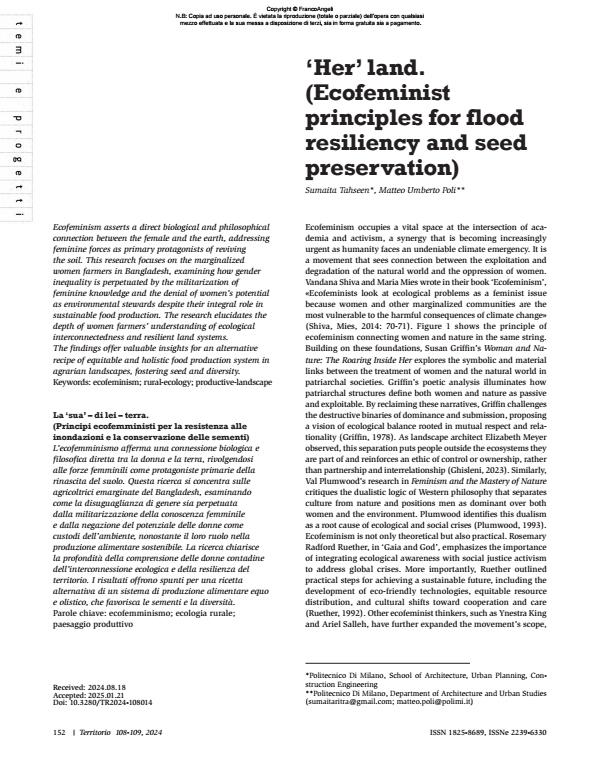
‘Her’ land. (Ecofeminist principles for flood resiliency and seed preservation)

Journal title TERRITORIO
Author/s Sumaita Tahseen, Matteo Umberto Poli
Publishing Year 2025 Issue 2024/108-109
Language English Pages 14 P. 152-165 File size 656 KB
DOI 10.3280/TR2024-108014
DOI is like a bar code for intellectual property: to have more infomation click here

Below, you can see the article first page

If you want to buy this article in PDF format, you can do it, following the instructions to buy download credits

Article preview

FrancoAngeli is member of Publishers International Linking Association, Inc (PILA), a not-for-profit association which run the CrossRef service enabling links to and from online scholarly content.

Ecofeminism asserts a direct biological and philosophical connection between the female and the earth, addressing feminine forces as primary protagonists of reviving the soil. This research focuses on the marginalized women farmers in Bangladesh, examining how gender inequality is perpetuated by the militarization of feminine knowledge and the denial of women’s potential as environmental stewards despite their integral role in sustainable food production. The research elucidates the depth of women farmers’ understanding of ecological interconnectedness and resilient land systems. The findings offer valuable insights for an alternative recipe of equitable and holistic food production system in agrarian landscapes, fostering seed and diversity.

Keywords: ecofeminism; rural-ecology; productive-landscape

  1. Agarwal B., 1994, A Field of One’s Own: Gender and Land Rights in South Asia. Cambridge: Cambridge University Press.
  2. Agarwal B., 1994, «Gender and command over property: A critical gap in economic analysis and policy in South Asia». World Development, 22, 10: 1455-1478. DOI: 10.1016/0305-750X(94)90031-0
  3. Akhter F., 2007, Seeds of Movements. City: Narigrantha Prabartana. Ahmed H.U., 2018, «Women’s contribution to agriculture». The Financial Express. www.thefinancialexpress.com.bd/views/womens-contribu- tion-to-agriculture-1535127549 (access: 2024.12.19).
  4. Akhter F., 2021, «Women’s perspectives on 50 years of agriculture». New Age Bangladesh. www.newagebd.net/article/157442/womens-perspec- tives-on-50-years-of-agriculture (access: 2024.02.18).
  5. Ali A., 2005, Livelihood and food security in rural Bangladesh. Phd thesis, Doctorate in Philosophy, Wageningen University.
  6. Arya M.P., Singh D., 2024, «An eco-feminist study in the select works of Bina Agarwal». International Journal of Research in English, 6, 2: 436-438.
  7. Begum S., Sharma I.K., 2024, «The invisibility of women’s labor in Bangladesh’s agriculture». International Water Management Institute. www. iwmi.org/blogs/the-invisibility-of-womens-labor-in-bangladeshs-agriculture/ (access: 2024.12.19).
  8. Bell G.J., 1992, The Permaculture Way. White River Junction: Chelsea Green Publishing.
  9. Bouw M., Eekelen V.E., 2021, Building with Nature: Creating, Implementing and Upscaling Nature-Based Solutions. Rotterdam: Nai010 publishers.
  10. Conley J., 2020, «Where Humans Destroy Nature, Women Also Suffer More Violence». Ecowatch. www.ecowatch.com/nature-destruction-vi- olence-women-2644975232.html (access: 2024.02.22).
  11. Costle D.M., 1978, epa History: Women and the Environment. https:// web.archive.org/web/20140422104644/http://www2.epa.gov/aboute- pa/epa-history-women-and-environment (access: 2024.02.18).
  12. Das D., 2021, «No stone crushing zone in Sylhet even 4 years after HC directive». The Business Standard. www.tbsnews.net/bangladesh/ no-stone-crushing-zone-sylhet-even-4-years-after-hc-directive-321937 (access: 2024.02.22).
  13. Das T.K., Bhattacharyya R., Alam M F., Pervin A., 2016, «Domestic Violence in Sylhet, Bangladesh: Analysing the Experiences of Abused Women». Social Change, 46, 1: 106-123. DOI: 10.1177/00490857156185
  14. Datta D., Gupta N., 2004, «Domestic abuses against housewives in haor areas of Bangladesh: understanding the impact of Concern’s intervention in reducing abuses». Participatory Learning and Action, 49: xxx-xxx.
  15. Dhaka Tribune, 2020, Women twice as active as men in farm activities. www.dhakatribune.com/bangladesh/agriculture/232260/women- twice-as-active-as-men-in-farm-activities (access: 2024.02.18).
  16. EcoShape, 2021, «Building with Nature Indonesia». Ecoshape. www. ecoshape.org/en/pilots/building-with-nature-indonesia/ (access: 2024.02.18).
  17. Ghisleni C., 2023, «Ecofeminism in Architecture: Empowerment and Environmental Concern». Archdaily. www.archdaily.com/1000291/ ecofeminism-in-architecture-empowerment-and-environmental-concern (access: 2024.02.18).
  18. Gimbutas M., Doni M., 2005, Le dee viventi. Milano: Medusa Edizioni. Griffin S., 1978, Woman and Nature: The Roaring Inside Her. New York: Harper & Row.
  19. Haor Banglapedia, (n.d.). https://en.banglapedia.org/index.php/Haor (access: 2024.02.22).
  20. Jain S., 1984. «Women and People’s Ecological Movement: A Case Study of Women’s Role in the Chipko Movement in Uttar Pradesh». Economic and Political Weekly, 19, 41: 1788-1794.
  21. Kalabamu F., 2004, «Patriarchy and women’s land rights in Botswana». Land Use Policy, 23: 237-246. of Agricultural Research, 6, 1: 40-49. Economics, 46: 1-20.
  22. Mallick B., 2022, «Nature-based solution most effective for environment». The Daily Observer. www.observerbd.com/news.php?id=368944 (access: 2024.02.18).
  23. Mellor M., 1997, Feminism and Ecology. New York: John Wiley & Sons.
  24. Mollison B., 2015, «The ethics, principles and methodologies of permaculture (Bill Mollison)». The permaculture project. www.permacultureproject.com/wp-content/uploads/2015/02/The-EthicsPrinciplesMethodsofPermaculture.pdf (access: 2024.02.22).
  25. Napawan N.C., Burke E., Yui S., 2017, «Women’s Work: An Eco-Feminist Approach to Environmental Design». The Avery Review. https:// averyreview.com/issues/27/womens-work#fn:27 (access: 2024.02.18). Nayakrishi A., 2017, «A Short Introduction». ubinig. https://ubinig. org/index.php/nayakrishidetails/showAerticle/2/46/english (access: 2024.02.18).
  26. Pallavi, 2022, «Remembering Chipko Movement: The Women-led Indigenous Struggle. Feminism in India». https://feminisminindia. com/2019/07/11/chipko-movement-indigenous-women-movement/ (access: 2022.02.18).
  27. Partha P., 2019, «Alpona Rani Mistri and her sparkling journey». barcik. www.barcikbd.org/alpona-rani-mistri-and-her-sparkling-journey/ (access: 2024.02.22).
  28. Plumwood V., 1993, Feminism and the Mastery of Nature. London-New York: Routledge.
  29. Raney T., Anríquez G., Croppenstedt A., Gerosa S., Lowder S.K., Matuschke I., Skoet J., 2011, The role of women in agriculture. Food and Agriculture Organization of the United Nations (fao), Agricultural Development Economics Division (esa).
  30. Shiva V., Mies M., 2014, Ecofeminism. London: Zed Books.
  31. Sergey P., 2015, «Flooding Risk in Bangladesh». Tim St. Onge. https:// timstonge.github.io/floodingbangladesh.html (access: 2024.02.22). Sourav R.I., 2015, «Unjust Land Right of Women in Bangladesh». In-ternational Research Journal of Interdisciplinary & Multidisciplinary Studies, 1: 5-13.
  32. The land found in the haors. EBangla. https://e-bangla.blogspot. com/2011/11/land-found-in-haors.html (access: 2024.02.18).
  33. Uddin M.M., 2011. «Land Rights of Women and Hindus in Bangladesh: Defending the ‘Justice Claim’». Chittagong University Journal of Law, 14: 1-31.
  34. Unb S., 2012, «Violence against women on rise in Sylhet». The Daily Star. www.thedailystar.net/news-detail-261936 (access: 2024.12.22).
  35. 2018, Stone Crushing Machines in Sylhet district, Bangladesh, EJAtlas, Environmental Justice Atlas. https://ejatlas.org/conflict/stone-crushing-machine-sylhet (access: 2024.02.18).
  36. 2018, Sylhet Regional Study. Bengal Institute for Architecture, Landscapes and Settlements. https://bengal.institute/research/sylhet-regional-study/ (access: 2024.02.22).
  37. 2021, Sylhet, Bangladesh Deforestation Rates & Statistics, GFW, Global Forest Watch. www.globalforestwatch.org/dashboards/country/ BGD/7/ (access: 2024.02.22).

Sumaita Tahseen, Matteo Umberto Poli, ‘Her’ land. (Ecofeminist principles for flood resiliency and seed preservation) in "TERRITORIO" 108-109/2024, pp 152-165, DOI: 10.3280/TR2024-108014