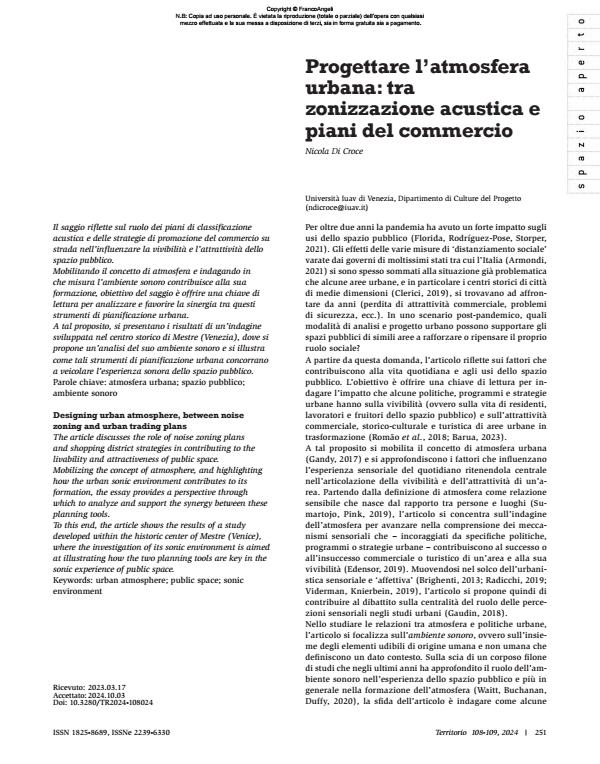
Designing urban atmosphere, between noise zoning and urban trading plans

Journal title TERRITORIO
Author/s Nicola Di Croce
Publishing Year 2025 Issue 2024/108-109
Language Italian Pages 10 P. 251-260 File size 391 KB
DOI 10.3280/TR2024-108024
DOI is like a bar code for intellectual property: to have more infomation click here

Below, you can see the article first page

If you want to buy this article in PDF format, you can do it, following the instructions to buy download credits

Article preview

FrancoAngeli is member of Publishers International Linking Association, Inc (PILA), a not-for-profit association which run the CrossRef service enabling links to and from online scholarly content.

The article discusses the role of noise zoning plans and shopping district strategies in contributing to the livability and attractiveness of public space. Mobilizing the concept of atmosphere, and highlighting how the urban sonic environment contributes to its formation, the essay provides a perspective through which to analyze and support the synergy between these planning tools. To this end, the article shows the results of a study developed within the historic center of Mestre (Venice), where the investigation of its sonic environment is aimed at illustrating how the two planning tools are key in the sonic experience of public space.

Keywords: urban atmosphere; public space; sonic environment

  1. Simpson P., 2011, «Street Performance and the City: Public Space, Sociality, and Intervening in the Everyday». Space and Culture, 14, 4: 415-430. DOI: 10.1177/1206331211412270
  2. Adey P., 2009, «Facing Airport Security: Affect, Biopolitics, and the Preemptive Securitisation of the Mobile Body». Environment and Planning D: Society and Space, 27, 2: 274–295.
  3. Aletta, F., Kang J., 2018, «Towards an Urban Vibrancy Model: A Soundscape Approach». International Journal of Environmental Research and Public Health 15, 8: 1712.
  4. Armondi S., 2021, «Spazi e scale del presente. Rileggere le geografie nella pandemia di Covid-19». Territorio. 98: 67-70. DOI: 10.3280/TR2021-098011
  5. Atkinson R., 2007, «Ecology of Sound: The Sonic Order of Urban Space». Urban Studies 44, 10: 1905-17. DOI: 10.1080/00420980701471901
  6. Barua M., 2023, Lively Cities. Reconfiguring Urban Ecology. Minneapolis: Minnesota University Press.
  7. Bild E., Steele D., Guastavino C., 2021, «At Home in Montreal’s Quartier Des Spectacles Festival Neighborhood». Journal of Sonic Studies, 21. www.researchcatalogue.net/view/1278472/1278473 (accesso: 2022.05.17).
  8. Bille M., Bjerregaard P., Sørensen T. F., 2015, «Staging Atmospheres: Materiality, Culture, and the Texture of the in-Between». Emotion, Space and Society, 15: 31-38.
  9. Böhme G., 2016, The Aesthetics of Atmospheres. London-New York: Routledge.
  10. Brighenti A.M., 2013, «La dimensione aurale. Nota per un’urbanistica sensoriale». Studi Culturali, 1: 135-142. DOI: 10.1405/73210
  11. Buser M., 2014, «Thinking through non-representational and affective atmospheres in planning theory and practice». Planning Theory, 13, 3: 227-243. DOI: 10.1177/1473095213491744
  12. Comune di Venezia, Ufficio statistica, 2022, Popolazione residente. www. comune.venezia.it/it/content/serie-storiche (accesso: 2024.10.03).
  13. Confesercenti Città Metropolitana di Venezia, 2019, Osservatorio sul Commercio Mestrino. https://confesercentivero.it/wp-content/uploads/2019/10/Osservatorio-su-Mestre-2019.pdf (accesso: 2022.05.17).
  14. Confesercenti Città Metropolitana di Venezia, 2020, Osservatorio sul Commercio Mestrino. https://confesercentivero.it/in-evidenza/2020/07/15/ osservatorio-sul-commercio-2020-a-mestre-meno-abbigliamento-aumentano-i-parrucchieri/ (accesso: 2022.05.17).
  15. Clerici M.A., 2019, Competere nel commercio. Milano e le città medie tra deregulation e grande recessione. Milano: FrancoAngeli.
  16. Di Croce N., 2021, «Le trasformazioni del commercio nell’atmosfera urbana. Ambiente sonoro e attrattività dello spazio pubblico nel centro storico di Mestre». Archivio Studi Urbani e Regionali, 130: 5-26. DOI: 10.3280/ASUR2021-13000
  17. Di Croce N., Bild E., 2023, «How do urban policies shape atmosphere? A multi method inquiry of the sonic environment». Urban Research and Practice, 17, 3: 416-437. DOI: 10.1080/17535069.2023.2232344
  18. Edensor T., 2019, «Book Review: Atmospheres and the Experiential World: Theory and Methods». Cultural Geographies, 26, 4: 542-43. DOI: 10.1177/1474474019838305
  19. Edensor T., Falconer E., 2015, «Dans Le Noir? Eating in the Dark: Sensation and Conviviality in a Lightless Place». Cultural Geographies, 22, 4: 601-18. DOI: 10.1177/1474474014534814
  20. Edensor T., Sumartojo S., 2015, «Designing Atmospheres: introduction to Special Issue». Visual Communication, 14, 3: 251-265. DOI: 10.1177/1470357215582305
  21. Florida R., Rodríguez-Pose A., Storper M., 2021, «Cities in a post-COVID world». Urban Studies, 60, 8: 1509-1531. DOI: 10.1177/00420980211018072
  22. Fondazione Pellicani, 2022, Venezia, Come stai? Giovani, Base sociale e Mercato del lavoro. www.ripensarevenezia.it/giovani-base-socia- le-e-mercato-del-lavoro/venezia-come-stai/ (accesso: 2022.05.17).
  23. Gandy M., 2017, «Urban Atmospheres». Cultural Geographies, 24, 3: 353-74. DOI: 10.1177/1474474017712995
  24. Gaudin O., 2018, «Pragmatist view of urban experience: Sensorial perception in urban studies». Pragmatism Today, 9, 1: 173-188.
  25. Griffero T., 2010, Atmospheres: Aesthetics of Emotional Spaces. Surrey: Ashgate.
  26. Lynch K., 1964, L’immagine della città, Venezia: Marsilio.
  27. McCormack D.P., 2008, «Engineering affective atmospheres on the moving geographies of the 1897 Andrée expedition». Cultural geographies,15, 4: 413-430. DOI: 10.1177/1474474008094314
  28. Morandi C., 2008, «Politiche pubbliche e networking pubblico-privato per la valorizzazione del commercio urbano». Territorio, 46, 3: 152-163.
  29. Nieuwenhuis M., 2019, «Atmospheric things: on the allure of elemental envelopment». Social & Cultural Geography, 20, 9: 1337-1339. DOI: 10.1080/14649365.2019.1616874
  30. Paiva D., Sánchez-Fuarros I., 2020, «The territoriality of atmosphere: Rethinking affective urbanism through the collateral atmospheres of Lisbon’s tourism». Transactions of the Institute of British Geographers, 46, 2: 392-405.
  31. Petrilli E., Stefanizzi S., 2022, «Il controllo della movida: la parola al popolo della notte torinese». Autonomie locali e servizi sociali, Quadrimestrale di studi e ricerche sul welfare, 1: 177-194. DOI: 10.1177/0263775815600443
  32. Quinn B., 2010, «Arts festivals, urban tourism and cultural policy».
  33. Journal of Policy Research in Tourism, Leisure and Events, 2, 3: 264-279. DOI: 10.1080/19407963.2010.512207
  34. Radicchi A., 2019, «The notion of soundscape in the realm of sensuous urbanism. A historical perspective». In: Wilson A. (ed.), Sound Worlds from the Body to the City: Listen! Cambridge: Cambridge Scholars Publisher, 99-125.
  35. Romão J., Kourtit K., Neuts B., Nijkamp P., 2018, «The Smart City as a Common Place for Tourists and Residents: A Structural Analysis of the Determinants of Urban Attractiveness». Cities 78: 67-75.
  36. Schafer M.,1977, The tuning of the world, New York, Knopf.
  37. Schulte-Fortkamp B., Brooks M., Bray W.R., 2007, «Soundscape: An approach to rely on human perception and expertise in the post-modern community noise era». Acoustics Today 3, 1: 7-15.
  38. Southworth M., 1969, «Sonic environments of cities». Environment and Behavior 1, 1: 49-70.
  39. Steele D., Fraisse V., Bild E., Guastavino C., 2021, «Bringing Music to the Park: The Effect of Musikiosk on the Quality of Public Experience». Applied Acoustics, 177: 107910.
  40. Steele D., Kerrigan C., Guastavino C., 2020, «Sounds in the city: bridging the gaps from research to practice through soundscape workshops». Journal of Urban Design, 25, 5: 646-664. DOI: 10.1080/13574809.2019.1699399
  41. Sumartojo S., 2016, «Commemorative atmospheres: memorial sites, collective events and the experience of national identity». Transactions of the Institute of British Geographers, 41, 4: 541-553.
  42. Sumartojo S., Pink S., 2019, Atmospheres and the Experiential World: Theory and Methods. London: Routledge.
  43. Viderman T., Knierbein S., 2019, «Affective urbanism: towards inclusive design praxis». Urban design International, 25, 1: 53-62.
  44. Vona R., 2013, «Shopping e movida nei centri urbani: opportunità e criticità del rapporto tra città, commercio, consumo e turismo». Atti del IV Seminario Internazionale: Città, commercio urbano e consumo, Università degli studi di Napoli L’Orientale, Dipartimento di Scienze Umane e Sociali, 14-17 ottobre 2013.
  45. Waitt G., Buchanan I., Duffy M., 2020, «Lively cities made in sound: A study of the sonic sensibilities of listening and hearing in Wollongong, New South Wales». Urban Studies 57, 10: 2131-2146. DOI: 10.1177/0042098019871170
  46. Westerkamp, H., 2007, «Soundwalking», in A. Carlyle, (ed.) Autumn Leaves, Sound and the Environment in Artistic Practice, Paris: Double Entendre, 49.

Nicola Di Croce, Progettare l’atmosfera urbana: tra zonizzazione acustica e piani del commercio in "TERRITORIO" 108-109/2024, pp 251-260, DOI: 10.3280/TR2024-108024