Political Fandoms and Social Media: Affectivity before Elections

Journal title SOCIOLOGIA DELLA COMUNICAZIONE
Author/s Marco Mazzoni, Sara Consonni
Publishing Year 2025 Issue 2025/69
Language Italian Pages 19 P. 30-48 File size 251 KB
DOI 10.3280/SC2025-069002
DOI is like a bar code for intellectual property: to have more infomation click here

Article preview

FrancoAngeli is member of Publishers International Linking Association, Inc (PILA), a not-for-profit association which run the CrossRef service enabling links to and from online scholarly content.

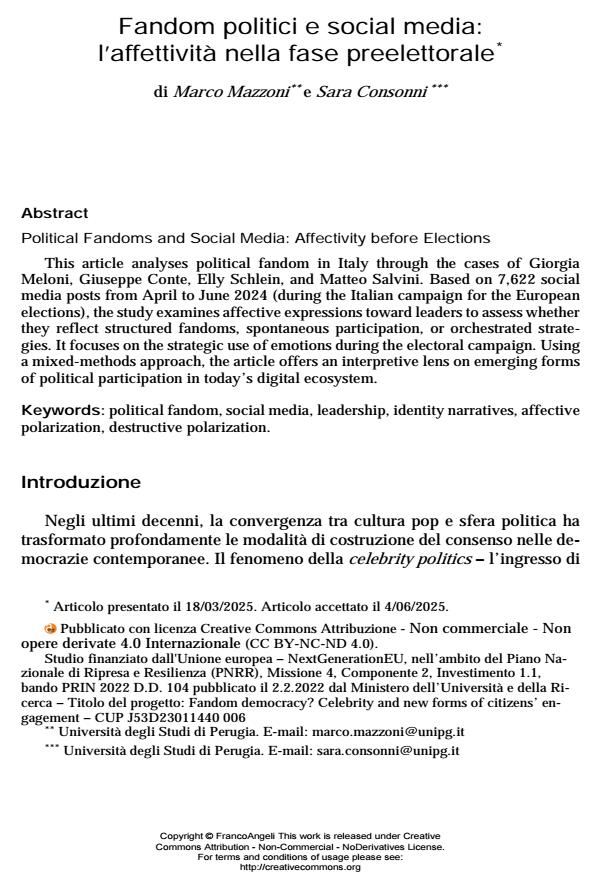
This article analyses political fandom in Italy through the cases of Giorgia Meloni, Giuseppe Conte, Elly Schlein, and Matteo Salvini. Based on 7,622 social media posts from April to June 2024 (during the Italian campaign for the European elections), the study examines affective expressions toward leaders to assess whether they reflect structured fandoms, spontaneous participation, or orchestrated strategies. It focuses on the strategic use of emotions during the electoral campaign. Using a mixed-methods approach, the article offers an interpretive lens on emerging forms of political participation in today’s digital ecosystem.

Keywords: political fandom, social media, leadership, identity narratives, affective polarization, destructive polarization.

  1. Thompson J.B. (1995), The Media and Modernity: A Social Theory of the Media, Polity Press, Cambridge.
  2. Treré E., Bonini T. (2024), Algorithms of Resistance: The Everyday Fight against Platform Power, MIT Press, Cambridge.
  3. Abidin C. (2021), The Influencer Industry: The Quest for Authenticity on Social Media, Polity Press, Cambridge.
  4. Achen C.H., Bartels L.M. (2016), Democracy for realists: Why elections do not produce responsive government, Princeton University Press, New Jersey.
  5. Bennett W.L. (1998), The uncivic culture: Communication, identity, and the rise of lifestyle politics, in «PS: Political Science & Politics», 31(4), pp. 741-761.
  6. Boccia Artieri G. (2022), Research using hashtags: A meta-synthesis, in «Frontiers in Sociology», 7, pp. 1-12.
  7. Campus D. (2016), Lo stile del leader: decidere e comunicare nelle democrazie contemporanee, il Mulino, Bologna.
  8. Campus D. (2020), Celebrity leadership. Quando i leader politici fanno le star, in «Comunicazione politica», 21(2), pp. 185-203. DOI: 10.3270/9790
  9. Campus D., Mazzoni M., Mincigrucci R. (2024), Engaging With Fandom and Politics: The Case of Giuseppe Conte’s Fans on Instagram, in «The International Journal of Press/Politics», 30(1), pp. 145-166. DOI: 10.1177/1940161223121842
  10. Chadwick A. (2013), The Hybrid Media System: Politics and Power, Oxford University Press, Oxford.
  11. Colombo F. (2020), Ecologia dei media, Vita e Pensiero, Milano.
  12. Dean J. (2017), Politicising fandom, in «The British Journal of Politics and International Relations», 19(2), pp. 408-424. DOI: 10.1177/136914811770175
  13. Van Santen R., Van Zoonen L. (2010), The personal in political television biographies, in «Biography», 33(1), pp. 46-67.
  14. Dean J., Andrews J. (2021), Celebritization from Below: Celebrity, Fandom, and Anti-Fandom in British Politics, in «New Political Science», 43(3), pp. 320-338. DOI: 10.1080/07393148.2021.195760
  15. Delli Carpini M.X., Williams B. (2001), Let Us Entertain You: Politics in the New Media Environment, in Bennett W.L., Entman R. (a cura di), Mediated Politics: Communication in the Future of Democracy, Cambridge University Press, New York, pp. 160-181.
  16. Esau K., Choucair T., Vilkins S., Svegaard S.F.K., Bruns A., O’Connor-Farfan K.S., Lubicz-Zaorski C. (2024), Destructive polarization in digital communication contexts: a critical review and conceptual framework, in «Information, Communication & Society», 28(8), pp. 1499-1520.
  17. Gray J. (2006), Watching with The Simpsons: Television, Parody, and Intertextuality, Routledge, New York.
  18. Green D.P., Palmquist B., Schickler E. (2002), Partisan hearts and minds: Political parties and the social identities of voters, Yale University Press, New Heaven.
  19. Gruzd A., Wellman B., Takhteyev Y. (2011), Imagining Twitter as an Imagined Community, in «American Behavioral Scientist», 55, pp. 12-94. DOI: 10.1177/000276421140937
  20. Iyengar S., Lelkes Y., Levendusky M., Malhotra N., Westwood S.J. (2019), The Origins and Consequences of Affective Polarization in the United States, in «Annual Review of Political Science», 22, pp. 129-146.
  21. Kreiss D. (2018), The media are about identity, not information, in Boczkowski P., Papacharissi Z. (a cura di), Trump and the Media, MIT Press, Cambridge, pp. 93-100.
  22. Kress G.R., Van Leeuwen T. (2006), Reading Images: The Grammar of Visual Design, Routledge, London.
  23. Lowe W. (2017), Text as Data: An Overview, in «Political Analysis», 25(3), pp. 356-377.
  24. Manin B. (1997), The principles of representative government, Cambridge University Press, Cambridge.
  25. Mazzoni M., Ciaglia A. (2015), Il gossip al potere. Il politico celebrità nell’era della politica pop, Apogeo, Milano.
  26. Mazzoni M., Mincigrucci R. (2022), Storytelling through images: how leaders managed their visual communication on Facebook during the 2019 European election campaign, in «Journal for Cultural Research», 26(3-4), pp. 221-243. DOI: 10.1080/14797585.2022.210644
  27. McGregor S.C. (2018), Personalization, social media, and voting: Effects of candidate self-personalization on vote intention, in «New Media & Society», 20(3), pp. 1139-1160. DOI: 10.1177/146144481668610
  28. Meyrowitz J. (1986), No Sense of Place: The Impact of Electronic Media on Social Behavior, Oxford University Press, Oxford.
  29. Papacharissi Z. (2015), Affective Publics: Sentiment, Technology, and Politics, Oxford University Press, Oxford.
  30. Sandvoss C. (2013), Fans: The Mirror of Consumption, Polity Press, Cambridge.
  31. Starita G.D., Consonni S., Mincigrucci R. (2025), Affect and its role in the formation of Italian political fandoms on social media, in «Mediascapes Journal», 25(1), pp. 306-329.
  32. Starita G.D., Trillò T. (2022), ‘Happy Monday friends! coffee?’ Matteo Salvini, good morning selfies, and the influencer politician, in «Contemporary Italian Politics», 14(3), pp. 331-351. DOI: 10.1080/23248823.2021.200533
  33. Stayner J. (2013), Intimate Politics: Publicity, Privacy and the Personal Lives of Politicians in Media-Saturated Democracies, Polity Press, Cambridge.
  34. Street J. (2004), The Celebrity Politician: Political Style and Popular Culture, in Louw E. (a cura di), The Media and Political Process, SAGE Publications, London, pp. 85-102.
  35. Van Zoonen L. (2004), Entertaining the Citizen: When Politics and Popular Culture Converge, Rowman & Littlefield, Lanham.
  36. Wheeler M. (2013), Celebrity Politics: Image and Identity in Contemporary Political Communications, Polity Press, Cambridge.
  37. Wood M., Corbett J., Flinders M. (2016), Just like us: Everyday celebrity politicians and the pursuit of popularity in an age of anti-politics, in «The British Journal of Politics and International Relations», 18(3), pp. 581-598. DOI: 10.1177/136914811663218

Marco Mazzoni, Sara Consonni, Fandom politici e social media: l’affettività nella fase preelettorale in "SOCIOLOGIA DELLA COMUNICAZIONE " 69/2025, pp 30-48, DOI: 10.3280/SC2025-069002