Narrative Paths and Digital Consumption Practices in Fast Fashion: Analysis of SHEIN Platform’s Usability and User Experience

Journal title SOCIOLOGIA DELLA COMUNICAZIONE
Author/s Geraldina Roberti, Alfredo Matrella
Publishing Year 2025 Issue 2025/69
Language Italian Pages 22 P. 49-70 File size 217 KB
DOI 10.3280/SC2025-069003
DOI is like a bar code for intellectual property: to have more infomation click here

Below, you can see the article first page

If you want to buy this article in PDF format, you can do it, following the instructions to buy download credits

Article preview

FrancoAngeli is member of Publishers International Linking Association, Inc (PILA), a not-for-profit association which run the CrossRef service enabling links to and from online scholarly content.

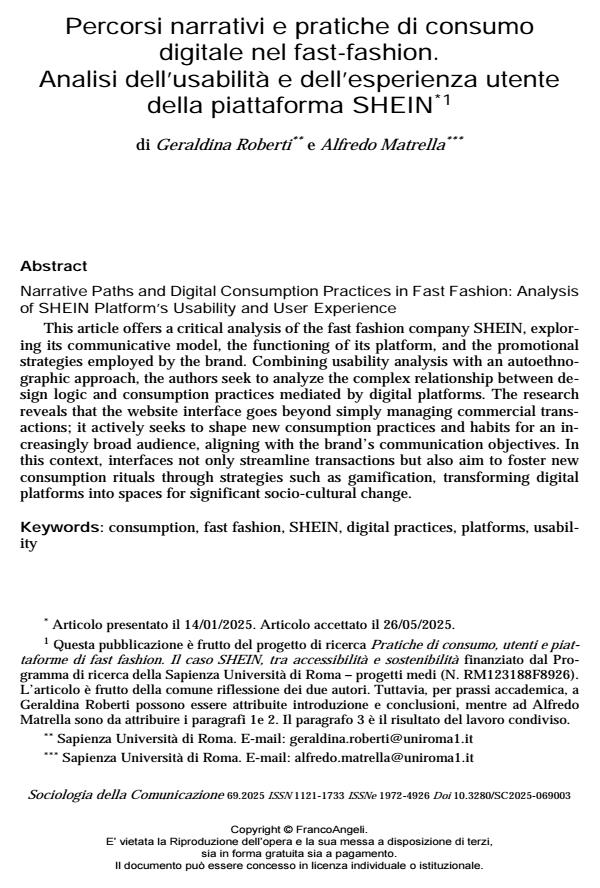
This article offers a critical analysis of the fast fashion company SHEIN, exploring its communicative model, the functioning of its platform, and the promotional strategies employed by the brand. Combining usability analysis with an autoethnographic approach, the authors seek to analyze the complex relationship between design logic and consumption practices mediated by digital platforms. The research reveals that the website interface goes beyond simply managing commercial transactions; it actively seeks to shape new consumption practices and habits for an increasingly broad audience, aligning with the brand’s communication objectives. In this context, interfaces not only streamline transactions but also aim to foster new consumption rituals through strategies such as gamification, transforming digital platforms into spaces for significant socio-cultural change.

Keywords: consumption, fast fashion, SHEIN, digital practices, platforms, usability

  1. Addeo F., Paoli A.D., Esposito M., Bolcato M.Y. (2019), Doing social research on online communities: The benefits of netnography, in «Athens Journal of Social Sciences», 7(1), pp. 9-38.
  2. Aggarwal N., More M. (2021), Fast Fashion: A Testimony on Violation of Environment and Human Rights, in «International Journal of Policy Sciences and Law», 1(3), pp. 1277-1304.
  3. Bhardwaj V., Fairhurst A. (2010), Fast fashion: response to changes in the fashion industry, in «The International Review of Retail, Distribution and Consumer Research», 20(1), pp. 165-173. DOI: 10.1080/0959396090349830
  4. Boccia Artieri G., Bartoletti R. (2023), Algoritmi e vita quotidiana: un approccio socio-comunicativo critico, in «Sociologia della Comunicazione», 66, pp. 5-20, DOI: 10.3280/SC2023-06600
  5. Bonini T., Treré E. (2024), Algorithms of resistance: The everyday fight against platform power, Mit Press, Boston.
  6. Bucher T. (2018), If... then: Algorithmic power and politics, Oxford University Press, New York.
  7. Cardano M., Gariglio L. (2022), Metodi qualitativi. Pratiche di ricerca in presenza, a distanza e ibride, Carocci, Roma.
  8. Cavagnuolo M., Capozza V., Matrella A. (2022), The Walkthrough Method: State of the Art, Innovative Aspects, and Application Fields, in Punziano G., Delli Paoli A. (eds), Handbook of Research on Advanced Research Methodologies for a Digital Society, IGI Global, Hershey, pp. 461-486.
  9. Cialdini R.B. (2021), Influence, New and Expanded: The Psychology of Persuasion, Harper Business, New York.
  10. Curry D. (2023), SHEIN Revenue and Usage Statistics, «Business of apps», testo disponibile in https://www.businessofapps.com/data/SHEIN-statistics/ (13 dicembre 2024).
  11. Degli Esposti P., Mortara A., Roberti G. (2024), Unsustainable Fashion: SHEIN and the Fast Fashion Consumption Model, in «Italian Sociological Review», 14(3), pp. 929-951.
  12. Desfiandi A. (2020), Factors of Preference for International Fast Fashion Brands: A Study on Generation Z, in «Talent Development & Excellence», 12(1), pp. 1-30.
  13. Dzhengiz T., Haukkala T., Sahimaa O. (2023), (Un)Sustainable transitions towards fast and ultra-fast fashion, in «Fashion and Textiles», 10(19).
  14. Eco U. (1994), Sei passeggiate nei boschi narrativi, Bompiani, Milano.
  15. Gallo L., Gentile D., Ruggiero S., Botta A., Ventre G. (2024), The human factor in phishing: Collecting and analyzing user behavior when reading emails, in «Computers & Security», 139, 103671.
  16. Gariglio L. (2017), L’autoetnografia nel campo etnografico, in «Etnografia e ricerca qualitativa», 3, pp. 487-504. DOI: 10.3240/88717
  17. Giddens A. (1991), Modernity and Self-Identity: Self and Society in the Late Modern Age, Polity Press, Cambridge; trad. it. (1999) Identita` e societa` moderna, Ipermedium libri, Napoli.
  18. Glaser B., Strauss A. (1967), The Discovery of Grounded Theory: Strategies for Qualitative Research, Aldine Publishing, Chicago.
  19. Latour B. (2005), Reassembling the Social: An Introduction to Actor-Network-Theory, Oxford University Press, Oxford.
  20. Lewandowska I. (2018), Game-based marketing, in «Zarzadzanie. Teoria i Praktyka», 23(1), pp. 43-48.
  21. Light B. (2016), Producing sexual cultures and pseudonymous publics with digital networks, Routledge, London.
  22. Light B., Burgess J., Duguay S. (2016), The walkthrough method: An approach to the study of apps, in «New Media & Society», 20(3), pp. 881-900. DOI: 10.1177/146144481667543
  23. Paterson M. (2023), Consumption and Everyday Life, Routledge, New York.
  24. McNeill L., Moore R. (2015), Sustainable fashion consumption and the fast fashion conundrum: fashionable consumers and attitudes to sustainability in clothing choice, in «International Journal of Consumer Studies», 39(3), pp. 212-222.
  25. Raji M. A., Olodo H. B., Oke T. T., Addy W. A., Ofodile O. C., Oyewole A. T. (2024), E-commerce and consumer behavior: A review of AI-powered personalization and market trends, in «GSC Advanced Research and Reviews», 18(3), pp. 66-77.
  26. Rogers R. (2013), Digital Methods, MIT Press, Cambridge.
  27. Swart J. (2021), Experiencing Algorithms: How Young People Understand, Feel About, and Engage with Algorithmic News Selection on Social Media, in «Social Media + Society», 7(2). DOI: 10.1177/20563051211008828
  28. van Dijck J., Poell T., de Waal M. (2018), The Platform Society, Oxford University Press, New York; trad. it. (2019) Platform society. Valori pubblici e società connessa, Guerini Scientifica, Milano.
  29. Wang C., Chen M., Wang Q., Fang Y. (2023), The study of value network reconstruction and business model innovation driven by entrepreneurial orientation, in «International Entrepreneurship and Management Journal», 19(4), pp. 2013-2036.
  30. Zurovac E. (2024), Specchio riflesso! Un’esperienza etnografica con Tiktok, in «Sociologia della comunicazione», 68(2), pp. 83-101. DOI 10.3280/SC2024-068007

Geraldina Roberti, Alfredo Matrella, Percorsi narrativi e pratiche di consumo digitale nel fast-fashion. Analisi dell’usabilità e dell’esperienza utente della piattaforma SHEIN in "SOCIOLOGIA DELLA COMUNICAZIONE " 69/2025, pp 49-70, DOI: 10.3280/SC2025-069003