Intelligenza Artificiale e Tecnologie Assistive: accessibilità, sfide e opportunità
Titolo Rivista SALUTE E SOCIETÀ
Autori/Curatori Alessandro Pepino, Ersilia Vallefuoco, Michele Mele
Anno di pubblicazione 2025 Fascicolo 2025/3
Lingua Italiano Numero pagine 15 P. 67-81 Dimensione file 440 KB
DOI 10.3280/SES2025-003005
Il DOI è il codice a barre della proprietà intellettuale: per saperne di più
clicca qui
Qui sotto puoi vedere in anteprima la prima pagina di questo articolo.
Se questo articolo ti interessa, lo puoi acquistare (e scaricare in formato pdf) seguendo le facili indicazioni per acquistare il download credit. Acquista Download Credits per scaricare questo Articolo in formato PDF
FrancoAngeli è membro della Publishers International Linking Association, Inc (PILA), associazione indipendente e non profit per facilitare (attraverso i servizi tecnologici implementati da CrossRef.org) l’accesso degli studiosi ai contenuti digitali nelle pubblicazioni professionali e scientifiche.
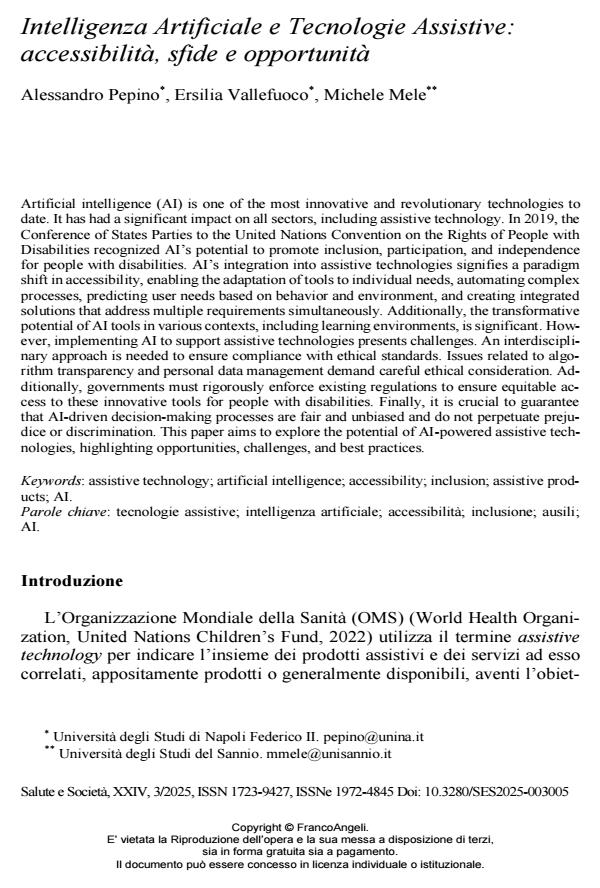
Artificial intelligence (AI) is one of the most innovative and revolutionary technologies to date. It has had a significant impact on all sectors, including assistive technology. In 2019, the Conference of States Parties to the United Nations Convention on the Rights of People with Disabilities recognized AI’s potential to promote inclusion, participation, and independence for people with disabilities. AI’s integration into assistive technologies signifies a paradigm shift in accessibility, enabling the adaptation of tools to individual needs, automating complex processes, predicting user needs based on behavior and environment, and creating integrated solutions that address multiple requirements simultaneously. Additionally, the transformative potential of AI tools in various contexts, including learning environments, is significant. However, implementing AI to support assistive technologies presents challenges. An interdisciplinary approach is needed to ensure compliance with ethical standards. Issues related to algorithm transparency and personal data management demand careful ethical consideration. Additionally, governments must rigorously enforce existing regulations to ensure equitable access to these innovative tools for people with disabilities. Finally, it is crucial to guarantee that AI-driven decision-making processes are fair and unbiased and do not perpetuate prejudice or discrimination. This paper aims to explore the potential of AI-powered assistive technologies, highlighting opportunities, challenges, and best practices.
Parole chiave:tecnologie assistive; intelligenza artificiale; accessibilità; inclusione; ausili; AI.
- Abdi S., Kitsara I., Hawley M.S., De Witte L.P. (2021). Emerging technologies and their potential for generating new assistive technologies. Assistive Technology, 33: 17-26. DOI: 10.1080/10400435.2021.194570
- Aggarwal S., Chugh N. (2022). Review of Machine Learning Techniques for EEG Based Brain Computer Interface. Archives of Computational Methods in Engineering, 29.
- Almufareh M.F., Kausar S., Humayun M., Tehsin S. (2024). A conceptual model for inclusive technology: advancing disability inclusion through artificial intelligence. Journal of Disability Research, 3(1): 1-11. DOI: 10.57197/JDR-2023-006
- Al-Muqbali F., Al-Tourshi N., Al-Kiyumi K., Hajmohideen F. (2020). Smart Technologies for Visually Impaired: Assisting and conquering infirmity of blind people using AI Technologies. 2020 12th annual undergraduate research conference on applied computing (URC), 1-4. DOI: 10.1109/URC49805.2020.909918
- AlSaid H., AlKhatib L., AlOraidh A., AlHaidar S., Bashar A. (2019). Deep learning assisted smart glasses as educational aid for visually challenged students. 2019 2nd International Conference on new Trends in Computing Sciences (ICTCS), 1-6. DOI: 10.1109/ICTCS.2019.892304
- Ayala S. (2023). ChatGPT as a Universal Design for Learning Tool Supporting College Students with Disabilities. Educational Renaissance, 12: 22-41.
- Aziz N., Khusaini N.S., Mohamed Z., Hamid A., Yusof Y., Aziz M.R. (2022). Smart wheelchairs: A review on Control Methods. 2022 IEEE International Conference on Artificial Intelligence in Engineering and Technology (IICAIET), 1-6. DOI: 10.1109/IICAIET55139.2022.993683
- Bekhelifi O., Berrached N.-E. (2024). On Optimizing Deep Neural Networks Inference on CPUs for Brain-Computer Interfaces using Inference Engines. 2024 IEEE International Symposium on Circuits and Systems (ISCAS), 1-5. DOI: 10.1109/ISCAS58744.2024.1055861
- Bryen D.N., Potts B.B., Carey A.C. (2007). So you want to work? What employers say about job skills, recruitment and hiring employees who rely on AAC. Augmentative and Alternative Communication, 23(2): 126-139. DOI: 10.1080/0743461060099117
- Ciani F., Fattacciu I., Griffo G. (2025). Storia, lotte e prospettive del diritto al lavoro per le persone con disabilità in Italia. Le radici storiche del diritto al lavoro per le persone con disabilità, Società Italiana di Storia del Lavoro. Testo disponibile al sito: https://www.storialavoro.it/ al- presente- 45/ (29/06/2025).
- Coser O., Tamantini C., Soda P., Zollo L. (2024). AI-based methodologies for exoskeleton-assisted rehabilitation of the lower limb: A review. Frontiers in Robotics and AI, 11: 1341580.
- de Freitas M.P., Piai V.A., Farias R.H., Fernandes A.M., de Moraes Rossetto A.G., Leithardt V.R.Q. (2022). Artificial intelligence of things applied to assistive technology: A systematic literature review. Sensors, 22(21): 8531.
- Decreto Legislativo 14 settembre 2015, n. 151. Riordino della normativa in materia di lavoro. Gazzetta Ufficiale, n. 221, 23 settembre 2015.
- Decreto Legislativo 3 maggio 2024, n. 62. Attuazione della Legge Delega n. 227/2021. Gazzetta Ufficiale, in fase di pubblicazione.
- El Morr C., Kundi B., Mobeen F., Taleghani S., El-Lahib Y., Gorman R. (2024). AI and disability: A systematic scoping review. Health Informatics Journal, 30(3).
- Elmo M.G. (2025). Condizione di disabilità e stato di salute del lavoratore alla luce del decreto legislativo n. 62 del 2024. Diritto della sicurezza sul lavoro, 1: 58-78. DOI: 10.14276/2531-4289.491
- Feiz S., Borodin A., Bi X., Ramakrishnan I.V. (2021). Towards enabling blind people to fill out paper forms with a wearable smartphone assistant. Proceedings. Graphics Interface (Conference), 2021: 156-165. DOI: 10.20380/GI2021.1
- Fenghour S., Chen D., Guo K., Li B., Xiao P. (2021). Deep learning-based automated lip-reading: A survey. IEEE Access, 9: 121184-121205. DOI: 10.1109/ACCESS.2021.310794
- Gadekallu T.R., Yenduri G., Kaluri R., Rajput D.S., Lakshmanna K., Fang K., Chen J., Wang W. (2025). The role of GPT in promoting inclusive higher education for people with various learning disabilities: A review. PeerJ Computer Science, 11: e2400.
- Giansanti D., Pirrera A. (2025). Integrating AI and Assistive Technologies in Healthcare: Insights from a Narrative Review of Reviews. Healthcare, 13(5): 556.
- González-Pérez L.I., Ramírez-Montoya M.S. (2022). Components of Education 4.0 in 21st century skills frameworks: Systematic review. Sustainability, 14(3): 1493.
- Granquist C., Sun S.Y., Montezuma S.R., Tran T.M., Gage R., Legge G.E. (2021). Evaluation and Comparison of Artificial Intelligence Vision Aids: Orcam MyEye 1 and Seeing AI. Journal of Visual Impairment & Blindness, 115(4): 277-285. DOI: 10.1177/0145482X21102749
- Hamarashid H.K., Saeed S.A., Rashid T.A. (2022). A comprehensive review and evaluation on text predictive and entertainment systems. Soft Computing, 1-22.
- Hutchinson T.E., White Jr K.P., Martin W.N., Reichert K.C., Frey L.A. (1989). Human-computer interaction using eye-gaze input. IEEE Transactions on Systems, Man, and Cybernetics, 19(6): 1527-1534. DOI: 10.1109/21.44068
- Hwang G.-J., Xie H., Wah B.W., Gaševic D. (2020). Vision, challenges, roles and research issues of Artificial Intelligence in Education. Computers and Education: Artificial Intelligence, 1: 100001.
- Kazimzade G., Patzer Y., Pinkwart N. (2019). Artificial Intelligence in Education Meets Inclusive Educational Technology - The Technical State-of-the-Art and Possible Directions. In: J. Knox, Y. Wang, M. Gallagher, a cura di, Artificial Intelligence and Inclusive Education. Singapore: Springer.
- Koch Fager S., Fried-Oken M., Jakobs T., Beukelman D.R. (2019). New and emerging access technologies for adults with complex communication needs and severe motor impairments: State of the science. Augmentative and Alternative Communication, 35(1): 13-25. DOI: 10.1080/07434618.2018.155673
- Legge 12 marzo 1999, n. 68. Norme per il diritto al lavoro dei disabili. Gazzetta Ufficiale, n. 68, 23 marzo 1999.
- Legge 22 dicembre 2021, n. 227. Delega al Governo in materia di disabilità. Gazzetta Ufficiale, n. 309, 30 dicembre 2021.
- Legge 5 febbraio 1992, n. 104. Legge-quadro per l’assistenza, l’integrazione sociale e i diritti delle persone handicappate. Gazzetta Ufficiale, n. 39, 17 febbraio 1992.
- Mittal U., Sai S., Chamola V. (2024). A comprehensive review on generative ai for education. IEEE Access, 1-1. DOI: 10.1109/ACCESS.2024.346836
- Morris L., Cramp M., Turton A. (2022). User perspectives on the future of mobility assistive devices: Understanding users’ assistive device experiences and needs. Journal of Rehabilitation and Assistive Technologies Engineering, 9: 20556683221114790. DOI: 10.1177/2055668322111479
- Mosaiyebzadeh F., Pouriyeh S., Parizi R., Dehbozorgi N., Dorodchi M., Macêdo Batista D. (2023). Exploring the Role of ChatGPT in Education: Applications and Challenges. The 24th Annual Conference on Information Technology Education, 84-89. DOI: 10.1145/3585059.361144
- Okonkwo C.W., Ade-Ibijola A. (2021). Chatbots applications in education: A systematic review. Computers and Education: Artificial Intelligence, 2: 100033. DOI: 10.1145/3585059.36114
- ONU Italia, Agenda 2030. (2025, aprile 25). Testo disponibile al sito: https://unric.org/it/agenda-2030/ (29/06/2025).
- Pomare Z.S., Hossain G., Maguluri D.S., Prybutok G. (2024). ChatGPT as Assistive Technology: Opportunities and Challenges. 2024 IEEE International Conference on Contemporary Computing and Communications (InC4), 1: 1-5.
- Sahoo S.K., Choudhur B. B. (2023). AI advances in wheelchair navigation and control: A comprehensive review. Journal of process management and new technologies, 11(3-4): 115-132.
- Smith E.M., Graham D., Morgan C., MacLachlan M. (2023). Artificial intelligence and assistive technology: Risks, rewards, challenges, and opportunities. Assistive Technology, 35(5): 375-377. DOI: 10.1080/10400435.2023.225924
- Sood V.V., Bansal K., Agarwal N. (2022). IoT-Based Smart Stick for the Blind: A Review. Advanced Sensing in Image Processing and IoT, 353-364. DOI: 10.1007/978-981-16-6636-0_3
- Torggler A., Edwards J., Wintersberger P. (2022). Beyond the Halo: Investigation of Trust and Functional Specificity in Automated Driving with Conversational Agents. Proceedings of the 14th International Conference on Automotive User Interfaces and Interactive Vehicular Applications, 195-203. DOI: 10.1145/3543174.354683
- Tsouktakou A., Hamouroudis A., Horti A. (2024). The use of artificial intelligence in the education of people with visual impairment. World Journal of Advanced Engineering Technology and Sciences, 13(1): 734-744.
- Vélez-Guerrero M.A., Callejas-Cuervo M., Mazzoleni S. (2021). Artificial intelligence-based wearable robotic exoskeletons for upper limb rehabilitation: A review. Sensors, 21(6): 2146.
- World Health Organization and United Nations Children’s Fund (?UNICEF) (2022). Global report on assistive technology. World Health Organization. Testo disponibile al sito: https://iris.who.int/handle/10665/354357 (29/06/2025).
- Ye X., Zhang W., Zhou Y., Li X., Zhou Q. (2025). Improving students’ programming performance: An integrated mind mapping and generative AI chatbot learning approach. Humanities and Social Sciences Communications, 12(1): 1-13.
- Zallio M., Ohashi T. (2022). The evolution of assistive technology: A literature review of technology developments and applications. Human Factors in Accessibility and Assistive Technology, 37: 85.
- Zdravkova K. (2022). The Potential of Artificial Intelligence for Assistive Technology in Education. In: Ivanovic M., Klašnja-Milicevic A., Jain L.C., a cura di, Handbook on Intelligent Techniques in the Educational Process. Switzerland: Springer International Publishing.
Alessandro Pepino, Ersilia Vallefuoco, Michele Mele, Intelligenza Artificiale e Tecnologie Assistive: accessibilità, sfide e opportunità in "SALUTE E SOCIETÀ" 3/2025, pp 67-81, DOI: 10.3280/SES2025-003005