Psychophobia: un termine preciso per un antico pregiudizio
Titolo Rivista SALUTE E SOCIETÀ
Autori/Curatori Marco Bottazzoli, Albertina Pretto, Macarena Galvan
Anno di pubblicazione 2025 Fascicolo 2025/3
Lingua Italiano Numero pagine 14 P. 103-116 Dimensione file 289 KB
DOI 10.3280/SES2025-003007
Il DOI è il codice a barre della proprietà intellettuale: per saperne di più
clicca qui
Qui sotto puoi vedere in anteprima la prima pagina di questo articolo.
Se questo articolo ti interessa, lo puoi acquistare (e scaricare in formato pdf) seguendo le facili indicazioni per acquistare il download credit. Acquista Download Credits per scaricare questo Articolo in formato PDF
FrancoAngeli è membro della Publishers International Linking Association, Inc (PILA), associazione indipendente e non profit per facilitare (attraverso i servizi tecnologici implementati da CrossRef.org) l’accesso degli studiosi ai contenuti digitali nelle pubblicazioni professionali e scientifiche.
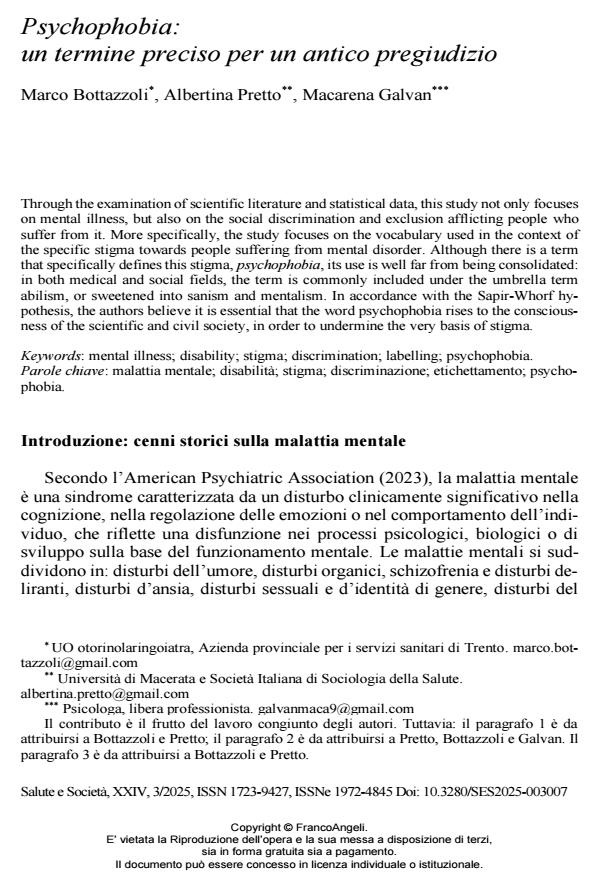
Through the examination of scientific literature and statistical data, this study not only focuses on mental illness, but also on the social discrimination and exclusion afflicting people who suffer from it. More specifically, the study focuses on the vocabulary used in the context of the specific stigma towards people suffering from mental disorder. Although there is a term that specifically defines this stigma, psychophobia, its use is well far from being consolidated: in both medical and social fields, the term is commonly included under the umbrella term abilism, or sweetened into sanism and mentalism. In accordance with the Sapir-Whorf hypothesis, the authors believe it is essential that the word psychophobia rises to the consciousness of the scientific and civil society, in order to undermine the very basis of stigma.
Parole chiave:malattia mentale; disabilità; stigma; discriminazione; etichettamento; psychophobia.
- Dings A., Kubillus L.K. (2025). Beyond Case Vignettes: Do Diagnostic Labels Affect How Symptoms of Mental Illness are Perceived?. J Ment Health Disord., 5(1): 1-14.
- Franz D.J., Richter T., Lenhard W., Marx P., Stein R., Ratz C. (2023). The Influence of Diagnostic Labels on the Evaluation of Students: a Multilevel Meta-Analysis. Educ Psychol Rev, 35(17).
- Al-Makhamreh S. (2016). Hearing the voices of young deaf people: Implications for social work practice in Jordan. International Social Work, 59(1): 47-59. DOI: 10.1177/002087281349905
- Almomen Z.A., Alqahtani A.H., Alafghani L.A., Alfaraj A.F., Alkhalifah G.S., Jalalah N.H., Alsuwailem N.A., Hilal R.M. (2022). Homicide in relation to mental illness: stigma versus reality. Cureus, 4(12).
- American Psychiatric Association - APA (2023). DSM-5-TR. Manuale diagnostico e statistico dei disturbi mentali. Milano: Raffaello Cortina Editore.
- Antunes A., Silva M., Azeredo Lopes S., Cardoso G. e Caldas de Almeida J.M. (2022). Perceived stigma and discrimination among persons with mood and anxiety disorders: Results from the WHO World Mental Health Survey Portugal. The European Journal of Psychiatry, 36(4): 280-287.
- Barlow D.H., Durand V.M., Hofmann S.G. (2017). Abnormal Psychology. An Integrative Approach. Belmont, CA: Cengage Learning.
- Barnes C., Mercer G. (2005). Disability, work, and welfare: challenging the social exclusion of disabled people. Work, Employment and Society, 19(3): 527-545. DOI: 10.1177/095001700505566
- Bastide R. (1965). Sociologie des maladies mentales. Paris: Flammarion.
- Bentz W.K., Edgerton J.W. (1971). The consequences of labeling a person as mentally ill. Social Psychiatry, 6(1): 29-33. DOI: 10.1007/BF0058411
- Birnbaum M. (1960). The Right To Treatment. American Bar Association Journal, 46(5): 499-505.
- Casey T., Hu X., Carden C., Lee Q.Y. (2025). Sticky interventions for a sticky problem: A systematic review of recent workplace mental health stigma reduction interventions with implications for training transfer. Journal of Safety Research, 92(1): 448-458.
- Castiglione Humani A. (2019). Il principio di identità. Venezia: Marcianum Press.
- Cattarinussi B. (1987). Voce “Svantaggio”. In: Cattarinussi B., Demarchi F., Ellena A., a cura di, Nuovo Dizionario di Sociologia. Milano: Edizioni Paoline, pp. 2149-2155.
- Chamberlin J. (1979). On Our Own: Patient Controlled Alternatives to the Mental Health System. New York: McGraw-Hill.
- Charlson F., van Ommeren M., Flaxman A., Cornett J., Whiteford H., Saxena S. (2019). New WHO prevalence estimates of mental disorders in conflict settings: a systematic review and meta-analysis. The Lancet, 394(10194): 240-248. DOI: 10.1016/S0140-6736(19)30934-
- Di Santo R. (2021). Sociologia della disabilità. Teorie, modelli, attori e istituzioni. Milano: FrancoAngeli.
- Hayward P., Bright J.A. (1997). Stigma and mental illness: A review and critique. Journal of Mental Health, 6(4): 345-354. DOI: 10.1080/0963823971867
- Healy B. (1991). The Yentl Syndrome. The New England Journal of Medicine. 325(4): 274-6. DOI: 10.1056/NEJM19910725325040
- Heiddeger M. (1959). Unterwegs zur Sprache. Pfullingen: Neske.
- Hinshaw S.P. (2007). Historical perspectives on mental illness and stigma. The Mark of Shame: Stigma of Mental Illness and an Agenda for Change. Oxford: Oxford University Press.
- Johannsen W.J (1969). Attitudes toward mental patients. Mental Hygiene, 53(2): 218-228.
- Johnstone M.J. (2001). Stigma, social justice and the rights of the mentally ill: Challenging the status quo. Australian & New Zealand Journal of Mental Health Nursing, 10(4): 200-209.
- La Vergata A. (2009). Colpa di Darwin? Razzismo, eugenetica, guerra e altri mali. Torino: Utet.
- Lemkau P.V., Crocetti G.M (1962). An urban population’s opinion and knowledge about mental illness. American Journal of Psychiatry, 118: 692-700.
- Link B.G., Struening E., Cullen F.T., Shrout P., Dohrenwend B.P. (1989). A modified labeling theory approach to mental disorders: An empirical assessment. American Sociological Review, 54(3): 400-423.
- Loscalzo J., Fauci A., Kasper D., Hauser S., Long D., Jameson J.L. (2022). Harrison’s Principles of Internal Medicine. New York: McGraw-Hill Education.
- Magliano L. (2017). Salute mentale, stigma e accesso alle cure. Nuova rassegna di studi psichiatrici. Rivista di Salute Mentale di Comunità, 15.
- Martinez A.G., Piff P.K., Mendoza-Denton R., Hinshaw S.P. (2011). The Power of a Label: Mental Illness Diagnoses, Ascribed Humanity, and Social Rejection. Journal of Social and Clinical Psychology, 30(1): 1-23.
- Ministero della Salute (2023). Rapporto salute mentale. Analisi dei dati del Sistema Informativo per la Salute Mentale (SISM). Anno 2022. Testo disponibile al sito: https://www.pnrr.salute.gov.it/imgs/C_17_pubblicazioni_3369_allegato.pdf (28/04/2025)
- Nasser M. (1987). Psychiatry in Ancient Egypt. Bulletin of the Royal College of Psychiatrists, 11(12): 420-422.
- Nemet-Nejat K.R. (1998). Daily Life in Ancient Mesopotamia. Santa Barbara, CA: Greenwood Press.
- Organizzazione Mondiale della Sanità - OMS (2011). World Report on Disability. Ginevra: WHO Press.
- Organizzazione Mondiale della Sanità - OMS (2022). World mental health report: Transforming mental health for all. Ginevra: WHO Press.
- Organizzazione per la cooperazione e lo sviluppo economico - OECD (2025). Combatting Discrimination in the European Union. Paris: OECD Publishing.
- Parcesepe A.M., Cabassa L.J. (2013). Public stigma of mental illness in the united states: A systematic literature review. Administration and Policy in Mental Health and Mental Health Services Research, 40(5): 384-399.
- Pescosolido B.A., Martin J.K., Long J.S., Medina T.R., Phelan J.C., Link B.G. (2010). “A disease like any other”? a decade of change in public reactions to schizophrenia, depression, and alcohol dependence. American Journal of Psychiatry, 167(11): 1321-1330.
- Phelan J.C., Link B.G., Stueve A., Pescosolido B.A. (2000). Public conceptions of mental illness in 1950 and 1996: What is mental illness and is it to be feared? Journal of Health and Social Behavior, 41(2): 188-207. DOI: 10.2307/267630
- Pretto A. (2016). Prigionieri di una diagnosi. Punti di vista sulla disabilità. Padova: Libreriauniversitaria.it Edizioni.
- Rabkin J. (1974). Public attitudes toward mental illness: a review of the literature. Schizophrenia Bulletin, 1(10): 9-33.
- Ravelli M.R. (2009). Struttura e funzione in Herbert Spencer. In: Pollini G. e Pretto A., a cura di, Sociologi: teorie e ricerche. Sussidio per la storia dell’analisi sociologica. Milano: FrancoAngeli, pp. 50-62.
- Rosmarin D.H., Koenig H.G., a cura di (1998). Handbook of Religion and Mental Health. San Diego, CA: Academic Press.
- Rüsch N, Angermeyer M.C., Corrigan P.W. (2005). Mental illness stigma: Concepts, consequences, and initiatives to reduce stigma. European Psychiatry, 20(8): 529-539.
- Sapir E. (1929). The Status of Linguistics as a Science. Language, 5(4): 207-214.
- Seeman N., Tang S., Brown A.D., Ing A. (2016). World survey of mental illness stigma. Journal of Affective Disorders, 190: 115-121.
- Serafin G. (2012). L’interpretazione del crimine. Criminologia, devianza e controllo sociale. Trento: Tangram Edizioni Scientifiche.
- Smith D.E., David S.J. (1975). Women Look at Psychiatry. Vancouver: Press Gang Publishers.
- Smith-Chandler N., Swart E. (2014). In Their Own Voices: Methodological Considerations in Narrative Disability Research. Qualitative Health Research, 24(3): 420-430. DOI: 10.1177/104973231452384
- Spencer H. (1864). The Principles of Biology. Londra: William and Norgate.
- Star S.A. (1955). The public’s ideas about mental illness. Annual Meeting of the National Association for Mental Health, 1-9.
- Tseng W.-S., Wu D.Y.H., a cura di (1985). Chinese Culture and Mental Health. Orlando, FL: Academic Press.
Marco Bottazzoli, Albertina Pretto, Macarena Galvan, Psychophobia: un termine preciso per un antico pregiudizio in "SALUTE E SOCIETÀ" 3/2025, pp 103-116, DOI: 10.3280/SES2025-003007