Car dependency in contesti periurbani e a bassa densità. Sfide interpretative

Titolo Rivista TERRITORIO
Autori/Curatori Paola Pucci
Anno di pubblicazione 2026 Fascicolo 2024/110
Lingua Italiano Numero pagine 10 P. 73-82 Dimensione file 322 KB
DOI 10.3280/TR2024-110007
Il DOI è il codice a barre della proprietà intellettuale: per saperne di più clicca qui

Qui sotto puoi vedere in anteprima la prima pagina di questo articolo.

Se questo articolo ti interessa, lo puoi acquistare (e scaricare in formato pdf) seguendo le facili indicazioni per acquistare il download credit. Acquista Download Credits per scaricare questo Articolo in formato PDF
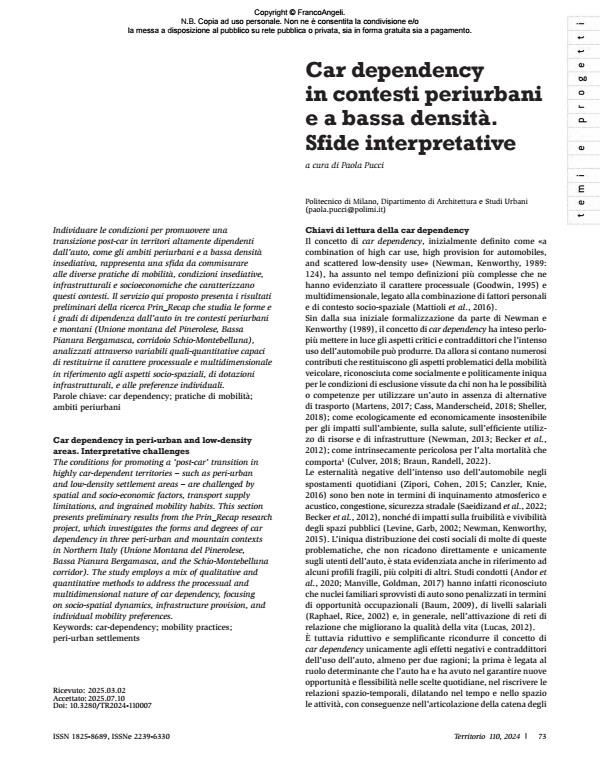
Anteprima articolo

FrancoAngeli è membro della Publishers International Linking Association, Inc (PILA), associazione indipendente e non profit per facilitare (attraverso i servizi tecnologici implementati da CrossRef.org) l’accesso degli studiosi ai contenuti digitali nelle pubblicazioni professionali e scientifiche.

Individuare le condizioni per promuovere una transizione postcar in territori altamente dipendenti dall’auto, come gli ambiti periurbani e a bassa densità insediativa, rappresenta una sfida da commisurare alle diverse pratiche di mobilità, condizioni insediative, infrastrutturali e socioeconomiche che caratterizzano questi contesti. Il servizio qui proposto presenta i risultati preliminari della ricerca Prin_Recap che studia le forme e i gradi di dipendenza dall’auto in tre contesti periurbani e montani (Unione montana del Pinerolese, Bassa Pianura Bergamasca, corridoio SchioMontebelluna), analizzati attraverso variabili qualiquantitative capaci di restituirne il carattere processuale e multidimensionale in riferimento agli aspetti sociospaziali, di dotazioni infrastrutturali, e alle preferenze individuali.

Parole chiave:car dependency; pratiche di mobilità; ambiti periurbani

  1. Allam Z., Bibri S.E., Chabaud D., Moreno C., 2022, «The ‘15Minute City’ concept can shape a netzero urban future». Humanities and Social Sciences Communications, 9, 1: 15.
  2. Baehler D., Rérat P., 2020, «Beyond the car. Carfree housing as a laboratory to overcome the system of automobility». Applied Mobilities, 7, 3: 280297. DOI: 10.1080/23800127.2020.1860513
  3. Bauchinger L., Reichenberger A., GoodwinHawkins B., Kobal J., Hrabar M., OedlWieser T., 2021, «Developing Sustainable and Flexible Rural–Urban Connectivity through Complementary Mobility Services». Sustainability,13, 3: 1280.
  4. Baum C. L., 2009, «The effects of vehicle ownership on employment». Journal of Urban Economics, 66, 3: 151163.
  5. Becker U. J., Becker T., Gerlach J., 2012, The True Costs of Automobility: External Costs of Cars Overview on Existing Estimates in EU27. Dresden: Greens/efa.
  6. Blaudin de Thé C., Carantino B., Lafourcade M., 2021, «The carbon ‘carprint’ of urbanization: New evidence from French cities». Regional Science and Urban Economics, 89, 103693.
  7. Boeing G., 2020, «Off the Grid… and Back Again?». Journal of the American Planning Association, 87, 1: 123137. DOI: 10.1080/01944363.2020.1819382
  8. Braun R., 2019, Autonomous Vehicles: From Science Fiction to Sustainable Future. In: Aguiar A., Mathieson C., Pearce L. (eds.), Mobilities, Literature, Culture. Cham: Palgrave Macmillan, 259280.
  9. Braun R., Randell R., 2022, «Towards postautomobility: destituting automobility». Applied Mobilities, 8, 1:117. Urbanization. Berlin: Iovis Verlage.
  10. Büttner B., Seisenberger S., Baquesro Larriva M.T., Rivas De Gante A.G., Haxhija S., Ramirez A., McCormick B., 2022, Urban Mobility Next 9 ±15Minute City: Humancentred planning in action Mobility for more liveable urban spaces. www.eiturbanmobility.eu/wpcontent/ uploads/2022/11/EITUrbanMobilityNext9_15minCity_144dpi.pdf (accesso: 2025.01.14).
  11. Canzler W., Knie A., 2016, «Mobility in the age of digital modernity: why the private car is losing its significance, intermodal transport is winning and why digitalisation is the key», Applied Mobilities, 1, 1: 5667. DOI: 10.1080/23800127.2016.1147781
  12. Cass N., Manderscheid K., 2018, The Autonomobility System: Mobility Justice and Freedom under Sustainability. In: Cook N., Butz D. (eds.) Mobilities, Mobility Justice and Social Justice. LondonNew York: Routledge, 101115.
  13. Coppola P.L., Pucci P., 2023, «Post car city un modello in cerca di politiche». In: Coppola P.L., Pucci P., Pirlo G. (a cura di), Mobilità & Città: verso una postcar cit. Ottavo Rapporto Urban@it sulle città. Bologna: Il Mulino.
  14. Culver G., 2018, «Death and the Car: On (Auto)mobility, Violence, and Injustice». ACME: An International Journal for Critical Geographies, 17, 1: 144170.
  15. Dunning R.J., Dolega L., Nasuto A., Nurse A., Calafiore A., 2023, «Age and the 20min city: Accounting for variation in mobility». Applied geography, 156, 103005.
  16. Elldér E., Haugen K., Vilhelmson B., 2020, «When local access matters: A detailed analysis of place, neighbourhood amenities and travel choice». Urban Studies, 59, 1: 120139. DOI: 10.1177/0042098020951001
  17. Ewing R., Cervero R., 2010, «Travel and the Built Environment». Journal of the American Planning Association, 76, 3: 265294. DOI: 10.1080/01944361003766766
  18. Feneri A.M., Rasouli S., Timmermans H.J., 2022, «Modeling the effect of MobilityasaService on mode choice decisions». Transportation Letters, 14: 324331. DOI: 10.1080/19427867.2020.1730025
  19. Goodwin P., 1995, «Car Dependence». Transport Policy, 2, 3: 151152. DOI: 10.1016/0967070X(95)967446
  20. Gorham R., 2002, Car Dependence as a Social Problem: A Critical Essay on the Existing Literature and Future Needs. In: Black W.R., Nijkamp P. (eds.), Social Change and Sustainable Transport. Bloomington: Indiana University Press, 108115.
  21. Gower A., Grodach C., 2022, «Planning Innovation or City Branding? Exploring How Cities Operationalise the 20Minute Neighbourhood Concept». Urban Policy and Research, 40, 1:117. DOI: 10.1080/08111146.2021.2019701
  22. Geurs K., Münzel K., Duran D., Gkavra R., Graf A., Grigolon A., Hansel J., Kirchberger C., Klementschitz R., Martinez Ramirez L., Pappers J., 2022, «A multidimensional mobility hub typology and inventory». SmartHubs Deliverable D 2.1. DOI: 10.34726/3567
  23. GrahamRowe E., Skippon S., Gardner B., Abraham C., 2011, «Can we reduce car use and, if so, how?» Transportation Research, 45: 401418.
  24. GrossFengels S., FromholdEisebith M., 2018, «Adapting transport related innovations to rural needs: Smart Mobility and the example of the Heinsberg region, Germany». In: Advances in Transport Policy and Planning, 2: 125162.
  25. Haarstad H., Sareen S., Kandt J., Coenen L., Cook, M., 2022, «Beyond automobility? Lockin of past failures in lowcarbon urban mobility innovations». Energy Policy, 166, 113002.
  26. Handy S., 2020, «Is accessibility an idea whose time has finally come?». Transportation Research Part D: Transport and Environment, 83.
  27. Handy S., Weston L., Mokhtarian P.L., 2005, «Driving by choice or necessity?». Transportation Research Part A: Policy and Practice, 39, 23: 183203. DOI: 10.1016/J.TRA.2004.09.002
  28. Huang Y., Ma L., De Vos J., 2024, «Travel behaviour and multimodality: a conceptual framework and critical review of research», Transport Reviews, 44, 3: 709730. DOI: 10.1080/01441647.2023.2300088
  29. Hunecke M., Haustein S., Böhler S., Grischkat S., 2008, «AttitudeBased Target Groups to Reduce the Ecological Impact of Daily Mobility Behavior». Environment and Behavior, 42, 1: 343. DOI: 10.1177/0013916508319587
  30. Jeekel H., 2013. The Cardependent Society: A European Perspective. Farnham: Ashgate.
  31. Jiang Y., Gu P., Chen Y., He D., Mao Q. 2017, «Influence of land use and street characteristics on car ownership and use: Evidence from Jinan, China». Transportation Research Part D: Transport and Environment, 52: 518534. DOI: 10.1016/J.TRD.2016.08.030
  32. Keller R., Vance C., 2013, «Landscape pattern and car use: Linking household data with satellite imagery». Journal of Transport Geography, 33: 250257. DOI: 10.1016/J.JTRANGEO.2013.07.006
  33. Kenworthy J.R., Laube F.B., 1996, «Automobile dependence in cities». Environmental Impact Assessment Review, 16: 279308.
  34. Lanza G., Pucci P., Carboni L., 2023, «Measuring accessibility by proximity for an inclusive city». Cities, 143. motion of accessibility or mobility?». Transport Policy, 9, 3, 179188.
  35. Litman T., 2014, Congestion Evaluation Best Practices. Victoria Transport Policy Institute. www.vtpi.org/ITED_congestion.pdf (accesso: 2025.01.14). Lucas K., 2012, «Transport and social exclusion: Where are we now?». Transport Policy, 20: 105113.
  36. Research Record: Journal of the Transportation Research Board, 2118: 815. DOI: 10.3141/211802
  37. Lyons G., Davidson C., 2016, «Guidance for transport planning and policymaking in the face of an uncertain future». Transportation Research Part A, 88: 104116.
  38. Manville M., Goldman E., 2017, «Would Congestion Pricing Harm the Poor? Do Free Roads Help the Poor?». Journal of Planning Education and Research.
  39. Martens K., 2017, Transport Justice. Designing fair transportation systems. Abingdon: Routledge
  40. Martens K., Lukas K., 2018, «Perspectives on transport and social justice». In: Craig G.(ed.), Handbook on Global Social Justice. Cheltenham: Edward Elgar Publishing, 351370.
  41. Mattioli G., Anable J., Vrotsou K., 2016, «Car dependent practices: Findings from a sequence pattern mining study of uk time use data». Transportation Research Part A: Policy and Practice, 89: 5672.
  42. Mattioli G., Roberts C., Steinberger J.K., Brown A., 2020, «The Political Economy of Car Dependence: A Systems of Provision Approach». Energy Research & Social Science, 66.
  43. Moreno C., Allam Z., Chabaud D., Gall C., Pratlong F., 2021, «Introducing the 15Minute City: Sustainability, Resilience and Place Identity in Future PostPandemic Cities». Smart Cities, 4, 1: 93111.
  44. Newman D., 2013, «Cars and Consumption». Capital & Class, 37, 3: 457 476. DOI: 10.1177/0309816813505164
  45. Newman P., Kenworthy J., 2015, The End of Automobile Dependence. How Cities are Moving Beyond CarBased Planning. Washington: Island Press Newman P., Kenworthy J.R., 1989, Cities and automobile dependence: An international sourcebook. Aldershot: Gower Technical.
  46. Newman P., Kenworthy J., 2006, «Urban Design to Reduce Automobile Dependence». Opolis, 2: 3552, https://escholarship.org/uc/item/2b76f089 (accesso: 2025.01.14).
  47. Poorthuis A., Zook M., 2023, «Moving the 15minute city beyond the urban core: The role of accessibility and public transport in the Netherlands». Journal of Transport Geography, 110, 103629.
  48. Pucci P., 2017, «Mobility behaviours in periurban areas. The Milan Urban Region». Transportation Research Procedia, 25: 42334248.
  49. Pucci P., Colleoni M., Daconto L., Vendemmia B., 2021, «Accessibilità di prossimità in contesti a bassa densità: reti e servizi di mobilità per territori inclusivi». In: Coppola A., Del Fabbro M., Lanzani A., Pessina G., Zanfi F. (a cura di), Politiche e progetti territoriali contro le disuguaglianze e per la transizione ecologica. Bologna: Il Mulino, 311321. Pucci P., Carboni L., Lanza G., 2022, «Accessibilità di prossimità per una città più equa. Sperimentazione in un quartiere di Milano». Territorio, 99: 4052. DOI: 10.3280/TR2021099006
  50. Pucci P., Vecchio G., 2024, eds., Questioning Proximity. Opportunities and Challenges for Urban Planning and Mobility Policies. Cham: Springer. Pucher J., Renne J.L., 2005, «Rural mobility and mode choice: Evidence from the 2001, National Household Travel Survey». Transportation, 32, 2: 165186.
  51. Raphael S., Rice L., 2002, «Car ownership, employment, and earnings. Journal of Urban Economics, 52, 1: 109130.
  52. Saeidizand P., Fransen K., Boussauw K., 2022, «Revisiting car dependency: A worldwide analysis of car travel in global metropolitan areas». Cities, 120, 103467.
  53. Schwanen T., 2016, «Rethinking Resilience as Capacity to Endure: Automobility and the City». City, 20, 1: 152160. DOI: 10.1080/13604813.2015.1125718
  54. Sheller M., 2018, Mobility Justice: The Politics of Movement in an Age of Extremes. London: Verso.
  55. Shen Q., Chen P., Pan H., 2016, «Factors affecting car ownership and mode choice in rail transitsupported suburbs of a large Chinese city». Transportation Research Part A: Policy and Practice, 94: 3144. DOI: 10.1016/J.TRA.2016.08.027
  56. Sierra Muñoz J., Duboz L., Pucci P., Ciuffo B., 2024, «Why do we rely on cars? Car dependence assessment and dimensions from a systematic literature review». European Transport Research Review. 16, 17.
  57. Šipuš D., Abramovic B., 2017, «The possibility of using public transport in rural area». Procedia engineering, 192: 788793.
  58. Soja E.W., 2011, «Regional Urbanization and the End of the Metropolis Era». In: Bridge, G., Watson, S. (eds.). New Companion to the City. Cambridge: Blackwell, 679689.
  59. Sorenson A., 2015, «Taking Path Dependence Seriously: A historical institutionalist research agenda in planning». Planning perspectives, 30, 1: 1738. DOI: 10.1080/02665433.2013.874299
  60. Speich M.J.R., Bernhard L., Teuling A.J., Zappa M., 2015, «Application of bivariate mapping for hydrological classification and analysis of temporal change and scale effects in Switzerland». Journal of Hydrology, 523: 804821. DOI: 10.1016/J.JHYDROL.2015.01.086
  61. Steven R., Lorien R., 2002, «Car ownership, employment, and earnings». Journal of Urban Economics, 52, 1: 109130. DOI: 10.1016/S00941190(02)000177
  62. Sultana S., Weber J., 2014, «The Nature of Urban Growth and the Commuting Transition: Endless Sprawl or a Growth Wave?». Urban Studies, 51: 463476. DOI: 10.1177/0042098013498284
  63. Urry J. 2004, «The ‘System’ of Automobility». Theory, Culture & Society, 21, 45: 2539. DOI: 10.1177/0263276404046059
  64. van Eenoo E., Fransen K., Boussauw K., 2022, «Perceived car dependence and multimodality in urban areas in Flanders (Belgium)». European Journal of Transport and Infrastructure Research, 22, 1: 4262. DOI: 10.18757/EJTIR.2022.22.1.6044
  65. Vitale Brovarone E., Cotella G., Staricco L., 2022, Rural accessibility in European regions. Abingdon: Routledge.
  66. Wang X., Yin C., Zhang J., Shao C., Wang S., 2021, «Nonlinear effects of residential and workplace built environment on car dependence». Journal of Transport Geography, 96, 103207.
  67. Webster F., Bly P.H., Johnston R.H., Paulley N., Dasgupta M., 1986, «Changing patterns of urban travel». Transport Reviews, 6, 1: 4986. DOI: 10.1080/01441648608716618
  68. Weustenenk A.G., Mingardo G., 2023, «Towards a typology of mobility hubs». Journal of Transport Geography, 106, 103514.
  69. Wiersma J., Bertolini L., Straatemeier T., 2016, «How does the spatial context shape conditions for car dependency? An analysis of the differences between and within regions in the Netherlands». Journal of Transport and Land Use, 9: 3555.
  70. Wiersma J.K., Bertolini L., Harms L., 2021, «Spatial conditions for car dependency in midsized European city regions». European Planning Studies, 29, 7: 13141330. DOI: 10.1080/09654313.2020.1854691
  71. Wiersma J.K., 2020, «Commuting patterns and car dependency in urban regions». Journal of Transport Geography, 84, 102700.
  72. Yang L., Ding C., Ju Y., Yu B., 2021, «Driving as a commuting travel mode choice of car owners in urban China: Roles of the built environment». Cities, 112, 103114. DOI: 10.1016/J.CITIES.2021.103114
  73. Yin C., Shao C., Wang X., 2019, «Exploring the impact of built environment on car use: does living near urban rail transit matter?». Transportation Letters, 12, 6: 391398. DOI: 10.1080/19427867.2019.1611196
  74. Zipori E., Cohen M.J., 2015, «Anticipating postautomobility: design policies for fostering urban mobility transitions». International Journal of Urban Sustainable Development, 7, 2: 147165. DOI: 10.1080/19463138.2014.991737

Paola Pucci, Car dependency in contesti periurbani e a bassa densità. Sfide interpretative in "TERRITORIO" 110/2024, pp 73-82, DOI: 10.3280/TR2024-110007