Car dependency’s user attitudes and perceptions across diverse Lombardia spatial contexts

Titolo Rivista TERRITORIO
Autori/Curatori Jaime Sierra Muñoz
Anno di pubblicazione 2026 Fascicolo 2024/110
Lingua Inglese Numero pagine 13 P. 115-127 Dimensione file 358 KB
DOI 10.3280/TR2024-110011
Il DOI è il codice a barre della proprietà intellettuale: per saperne di più clicca qui

Qui sotto puoi vedere in anteprima la prima pagina di questo articolo.

Se questo articolo ti interessa, lo puoi acquistare (e scaricare in formato pdf) seguendo le facili indicazioni per acquistare il download credit. Acquista Download Credits per scaricare questo Articolo in formato PDF
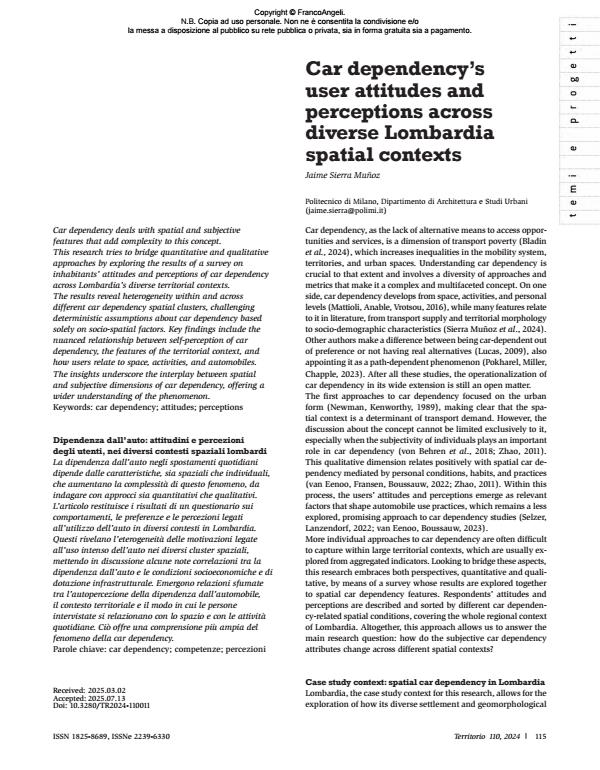
Anteprima articolo

FrancoAngeli è membro della Publishers International Linking Association, Inc (PILA), associazione indipendente e non profit per facilitare (attraverso i servizi tecnologici implementati da CrossRef.org) l’accesso degli studiosi ai contenuti digitali nelle pubblicazioni professionali e scientifiche.

Car dependency deals with spatial and subjective features that add complexity to this concept. This research tries to bridge quantitative and qualitative approaches by exploring the results of a survey on inhabitants’ attitudes and perceptions of car dependency across Lombardia’s diverse territorial contexts. The results reveal heterogeneity within and across different car dependency spatial clusters, challenging deterministic assumptions about car dependency based solely on sociospatial factors. Key findings include the nuanced relationship between selfperception of car dependency, the features of the territorial context, and how users relate to space, activities, and automobiles. The insights underscore the interplay between spatial and subjective dimensions of car dependency, offering a wider understanding of the phenomenon.

La dipendenza dall’auto negli spostamenti quotidiani dipende dalle caratteristiche, sia spaziali che individuali, che aumentano la complessità di questo fenomeno, da indagare con approcci sia quantitativi che qualitativi. L’articolo restituisce i risultati di un questionario sui comportamenti, le preferenze e le percezioni legati all’utilizzo dell’auto in diversi contesti in Lombardia. Questi rivelano l’eterogeneità delle motivazioni legate all’uso intenso dell’auto nei diversi cluster spaziali, mettendo in discussione alcune note correlazioni tra la dipendenza dall’auto e le condizioni socioeconomiche e di dotazione infrastrutturale. Emergono relazioni sfumate tra l’autopercezione della dipendenza dall’automobile, il contesto territoriale e il modo in cui le persone intervistate si relazionano con lo spazio e con le attività quotidiane. Ciò offre una comprensione più ampia del fenomeno della car dependency.

Parole chiave:car dependency; competenze; percezioni

  1. Bladin L., Vecchio G., Hurtubia R., TiznadoAitken I., 2024, «Car dependency in the urban margins: The influence of perceived accessibility on mode choice». Transportation Research Part A: Policy and Practice, 184, 104098.
  2. Bose P.S., 2024, «Getting people to food and food to people: considering transportation barriers and food access in the future of food». Geographical Review, 115, 12: 117137. DOI: 10.1080/00167428.2024.2383459
  3. Ewing R., Cervero R., 2010, «Travel and the Built Environment». Journal of the American Planning Association, 76, 3: 265294. DOI: 10.1080/01944361003766766
  4. Farber S., Páez A., 2009, «My car, my friends, and me: a preliminary analysis of automobility and social activity participation». Journal of Transport Geography, 17, 3: 216225.
  5. Handy S., Weston L., Mokhtarian P.L., 2005, «Driving by choice or necessity?». Transportation Research Part A: Policy and Practice, 39, 23: 183203. DOI: 10.1016/J.TRA.2004.09.002
  6. Istat, 2023, «Il Censimento permanente della popolazione in Lombardia – Anno 2021». www.istat.it/comunicatoterritoriale/ilcensimentopermanentedellapopulazioneinlombardiaanno2021/ (accessed: 2024.10.23).
  7. Langer M., DuránRodas D., Pajares E., 2023, «Exploring a quantitative assessment approach for car dependence: A case study in Munich». Journal of Transport and Land Use, 16, 1: 87104. DOI: 10.5198/JTLU.2023.2111
  8. Lucas K., 2009, «Actual and Perceived Car Dependence». Transportation Research Record: Journal of the Transportation Research Board, 2118: 815. DOI: 10.3141/211802
  9. Ma L., Cao J., 2019, «How perceptions mediate the effects of the built environment on travel behavior?». Transportation, 46, 1: 175197. DOI: 10.1007/S1111601798004/FIGURES/12
  10. Mattioli G., Anable J., Vrotsou K., 2016, «Car dependent practices: Findings from a sequence pattern mining study of UK time use data». Transportation Research Part A: Policy and Practice, 89: 5672.
  11. Mertens K., 2016, Transport Justice: Designing Fair Transportation Systems. New York: Routledge.
  12. Newman P., Kenworthy J.R., 1989, Cities and automobile dependence: An international sourcebook. Aldershot: Gower Technical.
  13. Pokharel R., Miller E.J., Chapple K., 2023, «Modeling car dependency and policies towards sustainable mobility: A system dynamics approach». Transportation Research Part D: Transport and Environment, 125, 103978.
  14. Pucci P., 2017, «Mobility behaviours in periurban areas. The Milan Urban Region case study». Conference proceedings of World Conference on Transport Research WCTR 2016 Shanghai. 1015 July 2016. Transportation Research Procedia, 25: 42294244.
  15. Selzer S., Lanzendorf M., 2022, «Car independence in an automobile society? The everyday mobility practices of residents in a carreduced housing development». Travel Behaviour and Society, 28: 90105. DOI: 10.1016/J.TBS.2022.02.008
  16. Sierra Muñoz J., Duboz L., Pucci P., Ciuffo B., 2024, «Why do we rely on cars? Car dependence assessment and dimensions from a systematic literature review». European Transport Research Review, 16, 17.
  17. Silva C., Altieri M., 2022, «Is regional accessibility undermining local accessibility?». Journal of Transport Geography, 101, 103336. DOI: 10.1016/J.JTRANGEO.2022.103336
  18. Thorhauge M., Kassahun H.T., Cherchi E., Haustein S., 2020, «Mobility needs, activity patterns and activity flexibility: How subjective and objective constraints influence mode choice». Transportation Research Part A: Policy and Practice, 139: 255272.
  19. van Eenoo E., Fransen K., Boussauw K., 2022, «Perceived car dependence and multimodality in urban areas in Flanders (Belgium)». European Journal of Transport and Infrastructure Research, 22: 4262. DOI: 10.18757/EJTIR.2022.22.1.6044
  20. van Eenoo E., Boussauw K., 2023, «‘That’s not feasible without a car’: An exploration of cardependent practices». Transport Policy, 144: 110.
  21. von Behren S., Minster C., Magdolen M., Chlond B., Hunecke M., Vortisch P., 2018, «Bringing Travel Behavior and Attitudes Together: An Integrated Survey Approach for Clustering Urban Mobility Types». Conference proceedings of Transportation Research Board, 97th Annual Meeting, Washington DC, United States, 711 January 2018.
  22. Yu Z., Li P., Schwanen T., Zhao P., Zhao Z., 2023, «Role of rural built environment in travel mode choice: Evidence from China». Transportation Research Part D: Transport and Environment, 117, 103649. DOI: 10.1016/J.TRD.2023.103649
  23. Zhang M., 2006, «Travel Choice with No Alternative». Journal of Planning Education and Research, 25, 3: 311326.

Jaime Sierra Muñoz, Car dependency’s user attitudes and perceptions across diverse Lombardia spatial contexts in "TERRITORIO" 110/2024, pp 115-127, DOI: 10.3280/TR2024-110011