Gentrificazione digitale e potere algoritmico: disuguaglianze urbane nell’era della smart city

Titolo Rivista SOCIOLOGIA URBANA E RURALE
Autori/Curatori Angelo Falzarano
Pubblicazione Online First 19/02/2026 Fascicolo 2026/Online First
Lingua Italiano Numero pagine 19 P. 1-19 Dimensione file 91 KB
DOI 10.3280/SUR2026-20828
Il DOI è il codice a barre della proprietà intellettuale: per saperne di più clicca qui

Qui sotto puoi vedere in anteprima la prima pagina di questo articolo.

Se questo articolo ti interessa, lo puoi acquistare (e scaricare in formato pdf) seguendo le facili indicazioni per acquistare il download credit. Acquista Download Credits per scaricare questo Articolo in formato PDF
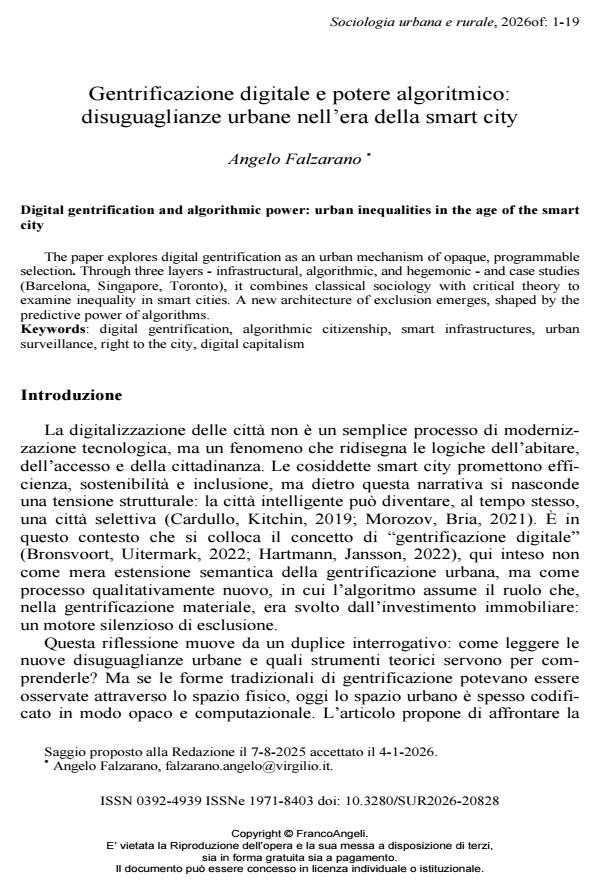
Anteprima articolo

FrancoAngeli è membro della Publishers International Linking Association, Inc (PILA), associazione indipendente e non profit per facilitare (attraverso i servizi tecnologici implementati da CrossRef.org) l’accesso degli studiosi ai contenuti digitali nelle pubblicazioni professionali e scientifiche.

The paper explores digital gentrification as an urban mechanism of opaque, programmable selection. Through three layers - infrastructural, algorithmic, and hegemonic - and case studies (Barcelona, Singapore, Toronto), it combines classical sociology with critical theory to examine inequality in smart cities. A new architecture of exclusion emerges, shaped by the predictive power of algorithms.

Parole chiave:digital gentrification, algorithmic citizenship, smart infrastructures, urban surveillance, right to the city, digital capitalism

  1. Bauman Z. (2000). Liquid modernity. Cambridge: Polity Press.
  2. Beck U. (1992). Risk Society: Towards a New Modernity. London: Sage.
  3. Bonomi A. (2008). La società delle reti. Roma-Bari: Laterza.
  4. Bratton B. (2015). The Stack: On software and sovereignty. Cambridge (MA): MIT Press.
  5. Bronsvoort I., Uitermark J.L. (2022). Seeing the street through Instagram: Digital platforms and the amplification of gentrification. Urban Studies, 59(14): 2857-2874. DOI: 10.1177/00420980211046539
  6. Cardullo P., Kitchin R. (2019). Smart urbanism and smart citizenship: The neoliberal logic of ‘citizen-focused’ smart cities in Europe. Environment and planning C: politics and space, 37(5): 813-830. DOI: 10.1177/0263774X18806508
  7. Castells M. (1996). The rise of the network society. Oxford: Blackwell.
  8. Couldry N., Mejias U.A. (2019). The costs of connection: How data is colonizing human life and appropriating it for capitalism. Stanford: Stanford University Press.
  9. Durkheim É. (1893). La division du travail social. Paris: Alcan.
  10. Foucault M. (1975). Surveiller et punir: Naissance de la prison. Paris: Gallimard.
  11. Graham M., Dittus M. (2022). Geographies of Digital Exclusion: Data and Inequality. Pluto Press.
  12. Gramsci A. (1975). Quaderni del carcere. Torino: Einaudi.
  13. Hartmann M., Jansson A. (2022). Gentrification and the Right to the Geomedia City. Space and Culture, 27(1): 4-13. DOI: 10.1177/12063312221090600
  14. Harvey D. (2003). The new imperialism. Oxford: Oxford University Press.
  15. Ho E. (2017). Smart subjects for a Smart Nation? Governing (smart)mentalities in Singapore. Urban Studies, 54(13): 3101-3118. DOI: 10.1177/0042098016664305
  16. Lanzani A. (2011). I paesaggi italiani. Roma-Bari: Laterza.
  17. Lefebvre H. (1968). Le droit à la ville. Paris: Anthropos.

Angelo Falzarano, Gentrificazione digitale e potere algoritmico: disuguaglianze urbane nell’era della smart city in "SOCIOLOGIA URBANA E RURALE" Online First/2026, pp 1-19, DOI: 10.3280/SUR2026-20828