Describing, classifying and counting: the representations of work and its criticism
Journal title SOCIOLOGIA DEL LAVORO
Author/s Barbara Giullari, Marco Ruffino
Publishing Year 2013 Issue 2013/129
Language Italian Pages 13 P. 9-21 File size 265 KB
DOI 10.3280/SL2013-129002
DOI is like a bar code for intellectual property: to have more infomation
click here
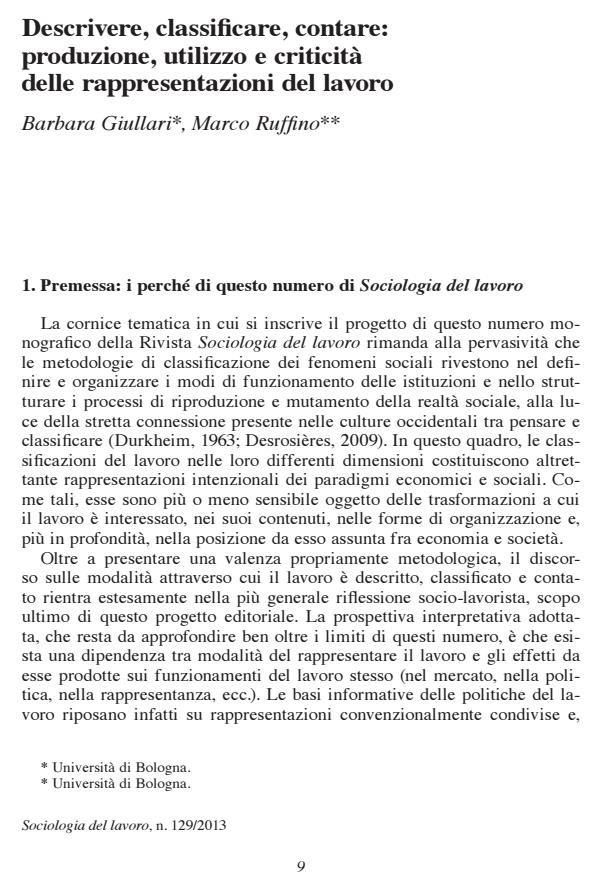
Below, you can see the article first page
If you want to buy this article in PDF format, you can do it, following the instructions to buy download credits
FrancoAngeli is member of Publishers International Linking Association, Inc (PILA), a not-for-profit association which run the CrossRef service enabling links to and from online scholarly content.
The paper his divided into two parts, preceded by a brief premise. The first part deal with the reasons why it is important to reflect on work classification methodologies; this allowed to map the path of volume and the essays collected, presented in the second part of the contribution. The issues discussed concern the relation between work classifications and the representation of economic and social paradigms; the relation between ways to represent the work and effects they produce on work real experiences (in the market, politics, representation, ecc.). In this perspective, the article depicts the characteristics of transparency/ opacity of production processes of classifications of work and the problem about open the "black box" of classifications. Furthermore the article analyzes on the relationship between the object of representation (job content) and subject of representation (workers). Finally, it concludes with the analysis of the consequences of the representations in terms of impact on inequality, on the attribution of responsibility, on capacity of voice, on democratic processes.
Keywords: Classifications of work, common knowledge, representation, capacity of voice, public sphere
- Sicurezza, lavoro e giustizia sociale: trasformazioni in corso Vando Borghi, in SOCIOLOGIA DEL LAVORO 130/2013 pp.7
DOI: 10.3280/SL2013-130001 - Potenzialità e criticità di un'esperienza locale di creazione e utilizzo di strumenti di analisi delle traiettorie scolastiche e delle transizioni al lavoro alla luce del capability approach Barbara Giullari, in SOCIOLOGIA DEL LAVORO 141/2016 pp.107
DOI: 10.3280/SL2016-141007 - La costruzione organizzativa della sicurezza: il ruolo della formazione Barbara Giullari, in SOCIOLOGIA DEL LAVORO 130/2013 pp.172
DOI: 10.3280/SL2013-130011
Barbara Giullari, Marco Ruffino, Descrivere, classificare, contare: produzione, utilizzo e criticità delle rappresentazioni del lavoro in "SOCIOLOGIA DEL LAVORO " 129/2013, pp 9-21, DOI: 10.3280/SL2013-129002