Riflessività a scuola. Tra resistenze al cambiamento ed aperture formative

Journal title EDUCATIONAL REFLECTIVE PRACTICES
Author/s Antonia Cunti, Alessandra Priore
Publishing Year 2015 Issue 2014/1
Language Italian Pages 19 P. 82-100 File size 71 KB
DOI 10.3280/ERP2014-001005
DOI is like a bar code for intellectual property: to have more infomation click here

Below, you can see the article first page

If you want to buy this article in PDF format, you can do it, following the instructions to buy download credits
Article preview

FrancoAngeli is member of Publishers International Linking Association, Inc (PILA), a not-for-profit association which run the CrossRef service enabling links to and from online scholarly content.

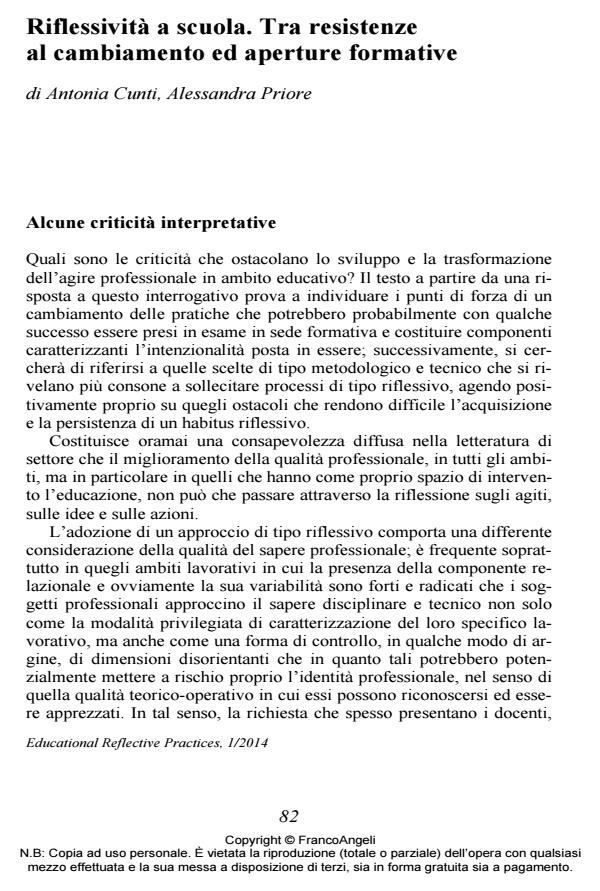
The paper, starting from research and education experiences with teachers, tries to identify the strengths of a change of practices that could be considered in the teacher education to develop a reflexive habitus. The analysis of the ways in which the reflexivity can be taught must consider the spread and typical criticality of teacher professional practices to find education specific to uncovering and redefinition. A reflexive process based on the promotion of resources supports the teacher, when it is in a zone of conflict or tension, to experiment with openness to further possibilities that reside in personal qualities often obfuscated or undervalued, rather than persevere in a limiting factor. To help teachers to conceptualize their teaching images, it is ncessary to invoke autoeducative methodologies, such as narrative and observation, which are able to ease the verbalization of the practice and the key step to building an active relationship with it.

  1. Camaioni, L., Aureli, T., & Perucchini, P. (2004). Osservare e valutare il comportamento infantile. Bologna: il Mulino
  2. Cambi, F. (2002). L’autobiografia come metodo formativo. Bari: Laterza
  3. Cambi, F. (2007). Società della conoscenza e formazione degli insegnanti. Pedagogia oggi, 1-2, pp. 24-29
  4. Cherrington, S., Loveridge, J. (2014). Using video to promote early childhood teachers’ thinking and reflection. Teaching and Teacher Education, 41, pp. 42-51
  5. Comenio, G. (1993). Didactica Magna. Firenze: La Nuova Italia.
  6. Crispoldi, S. (2008). Strumenti di ricerca per l’educatore sociale. Perugia: Morlacchi
  7. Demetrio, D. (1996). Raccontarsi. L’autobiografia come cura di sé. Milano: Cortina
  8. Demetrio, D. (2000). L’Educatore auto(bio)grafico. Il metodo delle storie di vita nelle relazioni d’aiuto. Milano: Unicopli
  9. Demetrio, D. (2003). Introduzione. In Mezirow, J. Apprendimento e trasforma- zione. Il significato dell’esperienza e il valore della riflessione nell’apprendimento degli adulti, (pp. VII-XXV). Milano: Raffaello Cortina
  10. Demetrio, D. (Eds.) (2013). Educare è narrare. Le teorie, le pratiche, la cura. Milano: Mimesis
  11. Dilts, R. (1990). Changing belief systems with NLP. Cupertino: Meta Publications Effron, S., & Joseph, P.B. (1994). Reflections in a mirror: Teacher-generated metaphors from self and others. In Joseph, P.B., & Burnaford, G.E. (Eds.). Images of schoolteachers in twentieth-century America - paragons, polarities, complexities, (pp. 54-77). New York: St. Martin's Press
  12. Eisner, E.W. (1997). The promise and perils of alternative forms of data representation. Educational Researcher, 26 (6), pp. 4–10
  13. Fabbri, L. (2007). L’insegnante riflessivo. In Scaglioso, C. (a cura di). Per una paideia del terzo millennio. Volume 3 Proposte operative per vecchi e nuovi attori. Roma: Armando Editore.
  14. Fabbri, L., Striano, M., & Melacarne, C. (2008). L’insegnante riflessivo. Coltivazione e trasformazione delle pratiche professionali. Milano: FrancoAngeli
  15. Formenti, L. (2009). In prima persona: pedagogia composizionale per futuri insegnanti. Quaderni di didattica della scrittura, 2, pp. 71-90
  16. Geerink, I., Masschelein, J. & Simons, M. (2010). Teaching and knowledge: A necessary combination? An elaboration of forms of teachers’ reflexivity. Studies in Philosophy and Education, 29, pp. 379-393
  17. Gonçalves, T.N.R., Azevedo, N.R., & Alves M.G. (2013). Teachers’ beliefs about teaching and learning: an exploratory study. Educational Research eJournal, 2(1), pp. 54-70
  18. Harford, J., & MacRuairc, G. (2008). Engaging student teachers in meaningful reflective practice. Teaching and Teacher Education, 24 (7), pp. 1884-1892
  19. Johnson, M. (1989). Embodied knowledge. Curriculum Inquiry, 19 (4), pp. 361–377
  20. Johnson, K.E., & Golombek, P.R. (2002). Inquiry into experience. Teachers’ personal and professional growth. In Johnson, K.E., & Golombek, P.R.
  21. (Eds.). Teachers’ narrative inquiry as professional development (pp. 1-14). New York: Cambridge University Press
  22. Kanizsa, S. (Eds.) (2007). Il lavoro educativo. L’importanza della relazione nel processo di insegnamento-apprendimento. Milano: Mondadori
  23. Korthagen, F., & Vasalos, A. (2005). Levels in reflection: core reflection as a means to enhance professional growth. Teachers and Teaching: theory and practice, 11(1), pp. 47–71
  24. Larrivee, B. (2008). Development of a tool to assess teachers’ level of reflective practice. Reflective Practice, 9(3), pp. 341–360
  25. Black, A.L., & Halliwell, G. (2000). Accessing practical knowledge: how? why? Teaching and Teacher Education, 16 (1), pp 103-115
  26. Beijaard, D. (1995). Teachers’ prior experiences and actual perceptions of professional identity. Teachers and teaching: theory and practice, 1(2), pp. 281–294
  27. Boucouvalas, M. (1988). An analysis and critique of the concept ‘self’ in selfdirected learning: toward a more robust construct for research and practice.
  28. In Zukas, M. (Eds.) Proceedings of the trans-Atlantic dialogue conference, (pp.56–61). Leeds: University of Leeds
  29. Brookfield, S. (1998). Critically reflective practice. The Journal of Continuing Education in Health Professions, 18, pp. 197-205
  30. Bruner, J. (1992). La ricerca del significato. Torino: Boringhieri
  31. Bruner, J. (2002). La fabbrica delle storie. Bari: Laterza
  32. Larrivee, B. (2010). What we know and don’t know about teacher reflection. In Pultorak, E.G. (Eds.). The purposed, practices and professionalism of teacher reflectivity: Insights for Twenty-First-Century Teachers and Students, (pp. 137-162). Lanham: Rowman & Littlefield Education Massa, R. (2004). Aprire al mondo: la scuola come spazio di vita. In Rezzara, A. (a cura di). Dalla scienza pedagogica alla clinica della formazione. Sul pensiero e l’opera di Riccardo Massa, (pp. 173-193). Milano: FrancoAngeli
  33. Moore, A. (2007). Beyond reflection: contingency, idiosyncracy and reflectivity in initial teacher education. In Hammersley, M. Educational Research and Evidence-based Practice, (pp. 121-138). London: The Open University-Sage
  34. Moore-Russo, D.A., & Wilsey, J.N. (2014). Delving into the meaning of productive: A study of future teachers’ reflections on representations of teaching. Teaching and Teacher Education, 37, pp. 76-90
  35. Mortari, L. (2009). Ricercare e riflettere. La formazione del docente professionista. Roma: Carocci
  36. Pedditzi, M.L. (2005). La fatica di insegnare. Stress e burnout nel mondo della scuola. Cagliari: Cuec
  37. Riva, M.G. (2004). Il lavoro pedagogico come ricerca dei significati e ascolto delle emozioni. Milano: Guerini Studio.
  38. Tickle, L. (1999). Teacher self-appraisal and appraisal of self. In Lipka R.P., & Brinthaupt T.M. (Eds). The role of self in teacher development, (121-141). Albany: State University of New York Press
  39. Townsend, T., & Bates, R. (2007). Handbook of teacher education: globalization, standards and professionalism in time of change. Springer
  40. Weber, S., & Mitchell, C. (1996). Drawing ourselves into teaching: Studying the images that shape and distort teacher education. Teaching and Teacher Education, 12 (3), pp. 303-313

  • Employability & Competences Antonia Cunti, pp.103 (ISBN:978-88-6453-671-2)

Antonia Cunti, Alessandra Priore, Riflessività a scuola. Tra resistenze al cambiamento ed aperture formative in "EDUCATIONAL REFLECTIVE PRACTICES" 1/2014, pp 82-100, DOI: 10.3280/ERP2014-001005