Identity of an Organizational System: Reflections on Brands)
Journal title SOCIOLOGIA E RICERCA SOCIALE
Author/s Monica Gilli
Publishing Year 2016 Issue 2015/108
Language Italian Pages 19 P. 137-155 File size 101 KB
DOI 10.3280/SR2015-108007
DOI is like a bar code for intellectual property: to have more infomation
click here
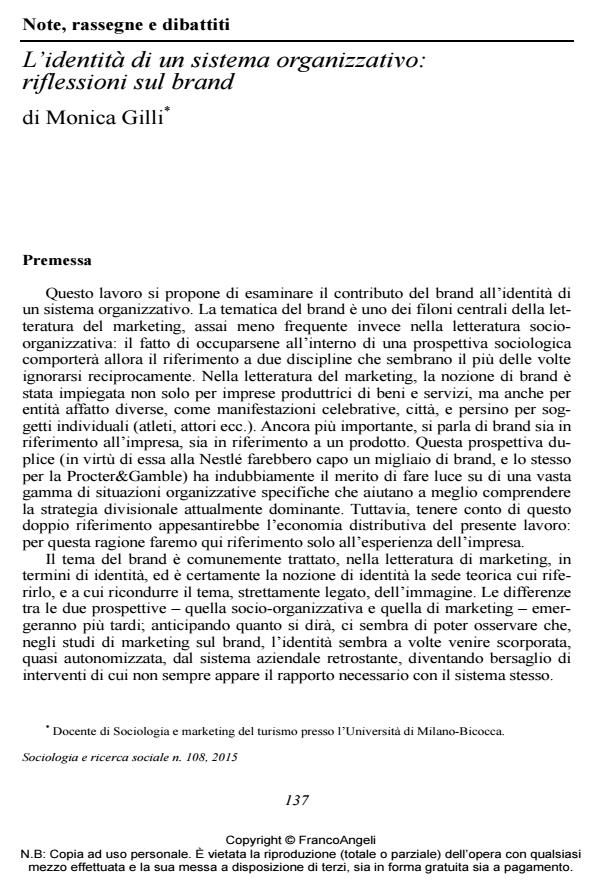
Below, you can see the article first page
If you want to buy this article in PDF format, you can do it, following the instructions to buy download credits
FrancoAngeli is member of Publishers International Linking Association, Inc (PILA), a not-for-profit association which run the CrossRef service enabling links to and from online scholarly content.
Although branding initiatives can be a decisive factor in the success of a business, the subject is treated more often in marketing literature than in that of organizational sociology. This paper aims to establish the importance of brands for organizational identity, and to review differences between the two literatures. Brands are a powerful creator of organizational identity: they can create a feeling of security, trust, loyalty, and even a sense of belonging, going beyond the initial terms of the economic relationship, and giving the company an almost «human» identity. Of course, any branding initiative has to deal with the company’s culture, which is crucial in building its identity, both internally and externally. Acting on the culture, however, is not as simple as some marketing literature would seem to suggest. First of all, culture is not monolithic: values, norms and practices may be different, and often contradictory. It is therefore difficult to outline a brand that «represents» the entire company. Secondly, the company is an adaptive system, and therefore its culture involves not only adapting to the New but also preserving the Old, in other words, the collective practices, the sense of self, and continuity. Any branding initiative should be consistent with the cultural tradition of the organization to prevent uneasiness, avoid being overwhelmed by change, and having the company’s identity threatened
- S.M. Clark, D.A. Gioia, D.J. Ketchen, J.B. Thomas (2010), «Transitional Identity as a Facilitator of Organizational Identity Change during a Merger», Administrative Science Quarterly, LV, 3, pp. 397-438, DOI: 10.2189/asqu.2010.55.3.397
- V. Coda (1988), L’orientamento strategico dell’impresa, Torino, Utet.
- V. Codeluppi (2010), Dalla produzione al consumo. Processi di cambiamento delle società contemporanee, Milano, FrancoAngeli.
- V. Codeluppi (2012), Il potere della marca. Disney, McDonald’s, Nike e le altre, Torino, Bollati Boringhieri.
- K.G. Corley, D.A. Gioia (2004), «Identity Ambiguity and Change in the Wake of a Corporate Spin-off», Administrative Science Quarterly, XLIX, 2, pp. 173-208, DOI: 10.2307/4131471
- P. Corti (2005), Identità e immagine dell’impresa – Verso il nuovo paradigma del Corporate Branding, Milano, FrancoAngeli.
- D. Dolak (2003), Building a Strong Brand: Brands and Branding Basics, www.davedolak.com.
- J.E. Dutton, J.M. Dukerich (1991), «Keeping an Eye on the Mirror: Image and Identity in Organizational Adaptation», Academy of Management Journal, XXXIV, 3, pp. 517-51, DOI: 10.2307/256405
- K.D. Elsbach, R.M. Kramer (1996), «Members’ Responses to Organizational Identity Threats: Encountering and Countering the Business Week Ratings», Administrative Science Quarterly, XLI, 3, pp. 442-76.
- F. Emiliani, B. Zani (1998), Elementi di psicologia sociale, Bologna, il Mulino.
- M. Ezzamel, H. Willmott (1998), «Accounting for Teamwork: A Critical Study of Groupbased Systems of Organizational Control», Administrative Science Quarterly, XLIII, 2, pp. 358-96.
- G. Fabris, L. Minestroni (2004), Valore e valori della marca – Come costruire e gestire una marca di successo, Milano, FrancoAngeli.
- M. Ferraresi (2011), «Brand Engagement and Brand Experience: Similarieties and Differences », Micro & Macro Marketing, 2, pp. 245-54, DOI: 10.1431/35138
- M. Ferraresi, B.H. Schmitt (2006), Marketing esperienziale. Come sviluppare l’esperienza di consumo, Milano, FrancoAngeli.
- J.M. Floch (2002), Semiotica, marketing e comunicazione, Milano, FrancoAngeli.
- S. Fournier (1998), «Consumers and Their Brands: Developing Relationship Theory in Consumer Research», Journal of Consumer Research, XXIV, 4, pp. 343-73, DOI: 10.1086/209515.D.A.Gioia,K.Chittipaddi(1991),«SensemakingandSensegivinginStrategicChangeInitiation»,StrategicManagementJournal,XII,6,pp.433-48,doi:10.1002/smj.4250120604
- M.A. Glynn, R. Abzug (2002), «Institutionalizing Identity: Symbolic Isomorphism and Organizational Names», Academy of Management Journal, XLV, 1, pp. 267-80, DOI: 10.2307/3069296
- M.R. Habibi, M. Laroche, M.-O. Richard (2014), «Brand Communities Based on Social Media: How Unique are They? Evidence from Two Exemplary Brand Communities», International Journal of Information Management, XXXIV, 2, pp. 123-32, DOI: 10.1016/j.ijinfomgt.2013.11.010
- M.T. Hannan, J. Freeman (1984), «Structural Inertia and Organizational Change», American Sociological Review, XLIX, 2, pp. 149-64.
- M.J. Hatch, M. Schultz (1997), «Relations between Organizational Culture, Identity and Image », European Journal of Marketing, XXXI, 5-6, pp. 356-65.
- M.J. Hatch, M. Schultz (2002), «The Dynamics of Organizational Identity», Human Relations, LV, 8, pp. 989-1018, DOI: 10.1177/0018726702055008181
- H.A. Haveman (1992), «Between a Rock and a Hard Place: Organizational Change and Performance under Conditions of Fundamental Environmental Transformation», Administrative Science Quarterly, XXXVII, 1, pp. 48-75.
- D. Aaker (1991), Managing Brand Equity: Capitalizing on the Value of a Brand Name, New York, The Free Press.
- D. Aaker (1996), Building Strong Brands, New York, The Free Press.
- D. Aaker (2011), Brand Relevance – Making Competitors Irrelevant, San Francisco, Jossey-Bass.
- S. Albert (1992), «The Algebra of Change», Research in Organizational Behavior, 14: 179-229.
- S. Albert, B.E. Ashforth, G.E. Dutton (2000), «Organizational Identity and Identification: Charting New Waters and building New Bridges», Academy of Management Review, XXV, 1, pp. 13-7, DOI: 10.5465/AMR.2000.2791600
- S. Albert, D. Whetten (1985), «Organizational Identity», Research in Organizational Behavior, 7, pp. 263-295.
- B.E.Ashford, B.W. Gibbs (1990), «The Double Edge of Organizational Legitimation», Organization Science, I, 2, pp. 177-94.
- M. Atvesson (1990), «Organization: From Substance to Image?», Organization Studies, XI, 3, pp. 373-94, DOI: 10.1177/017084069001100303
- J.M. Bartunek, K. Moch (1987), «First-order, Second-order and Third-order Change and Organization Development Interventions: A Cognitive Approach», Journal of Applied Behavioral Science, XXIII, 4, pp. 483-500, DOI: 10.1177/002188638702300404
- D. Bingöl, I. Şener, E. Ḉevik (2013), «The Effect of Organizational Culture on Organizational Image and Identity: Evidence from a Pharmaceutical Company», Procedia – Social and Behavioral Sciences, 99, pp. 222-9, DOI: 10.1016/j.sbspro.2013.10.489
- R. Blackburn, B. Rosen (1993), «Total Quality and Human Resource Management: Lessons Learned from Baldridge Award-winning Companies», Academy of Management Executive, VII, 1, pp. 49-66. S.L. Brickson (2007), «Organizational Identity Orientation: The Genesis of the Role of the Firm and Distinct Forms of Social Value», Academy of Management Review, XXXII, 3, pp. 864-88, DOI: 10.5465/AMR.2007.25275679
- S. Brogi (2014), «Online Brand Communities: A Literature Review», Procedia – Social and Behavioral Sciences, 109, pp. 385-9, DOI: 10.1016/j.sbspro.2013.12.477
- I.P. Buckingham (2007), Brand Engagement, London, Palgrave-Macmillan.
- R.A. Burgelman (2002), «Strategy as Vector and the Inertia of Coevolutionary Lock-in», Administrative Science Quarterly, XLVII, 2, pp. 325-57, DOI: 10.2307/3094808
- K.S. Cameron, R.E. Quinn (2006), Diagnosing and Changing Organizational Culture, Reading, Addison-Wesley.
- F. Carmagnola, M. Ferraresi (1999), Merci di culto. Ipermerci e società mediale, Roma, Castelvecchi.
- M.C. Cătălin, P. Andreea (2014), «Brands as a Mean of Consumer Self-expression and Desired Personal Lifestyle», Procedia – Social and Behavioral Sciences, 109, pp. 103-7, DOI: 10.1016/j.sbspro.2013.12.427
- J.-N. Kapferer (2000), Les marques à l’épreuve de la pratique, Paris, Editions d’Organisation.
- K.L. Keller (2003), Strategic Brand Management: Building, Measuring and Managing Brand Equity, Upper Saddle River, Prentice-Hall.
- K.L. Keller (2008), Strategic Brand Management – Building, Measuring and Managing Brand Equity, Uppersaddle River NJ, Prentice-Hall.
- D. Leonard-Barton (1992), «Core Capabilities and Core Rigidities: A Paradox in Managing New Product Development», Strategic Management Journal, XIII, 1, pp. 111-25, DOI: 10.1002/smj.4250131009
- N. Luhmann (1982), Soziologische Aufklärung, vol. II: Aufsätze zur Theorie der Gesellschaft, Opladen, West-deutscher Verlag, 2te ed.; tr. it., Illuminsmo sociologico, Milano, Il Saggiatore, 1983.
- N. Luhmann (1984), Soziale Systeme. Grundriss einer allgemeinen Theorie, Frankfurt a.M., Suhrkamp; tr. it., Sistemi sociali. Fondamenti di una teoria generale, Bologna, il Mulino, 1990.
- S. Maguire, N. Phillips (2008), «Citibankers at Citigroup: A Study of the Loss of Institutional Trust after a Merger», Journal of Management Studies, XLV, 2, pp. 372-401, DOI: 10.1111/j.1467-6486.2007.00760.x
- W.P. Margulies (1977), «Make the most of Your Corporate Identity», Harvard Business Review, 58, July-August, pp. 66-72.
- N. Markwick, C. Fill (1997), «Towards a Framework for managing Corporate Identity», European Journal of Marketing, XXXI, 5-6, pp. 396-409.
- G. Marrone (2007), Il discorso di marca. Modelli semiotici per il branding, Bari, Laterza.
- R.E. Moore (2003), «From Genericide to Viral Marketing: On “Brand”», Language & Communication, 23, pp. 331-57, DOI: 10.1016/S0271-5309(03)00017-X
- E.W. Morrison, S.L. Robinson (1997), «When Employees feel Betrayed: A Model of how Psychological Contract Violation develops», Academy of Management Review, XXII, 1, pp. 226-56, DOI: 10.5465/AMR.1997.9707180265
- A.M. Muniz, T.C. O’Guinn (2001), «Brand Community», Journal of Consumer Research, XXVII, 4, pp. 412-32, DOI: 10.1086/319618
- S. Murtiasih, Sucherly, H. Siringoringo (2013), «How Word-of-mouth influence Brand Equity for Automotive Products in Indonesia», Procedia – Social and Behavioral Sciences, 81, pp. 40-4, DOI: 10.1016/j.sbspro.2013.06.384
- R. Nag, K.G. Corley, D.A. Gioia (2007), «The Intersection of Organizational Identity, Knowledge, and Practice: Attempting Strategic Change via Knowledge Grafting», Academy of Management Journal, L, 4, pp. 821-47, DOI: 10.5465/AMJ.2007.26279173
- J. Nam, Y. Ekinci, G. Whyatt (2011), «Brand Equity, Brand Loyalty and Consumer Satisfaction », Annals of Tourism Research, XXXVIII, 3, pp. 1009-30, DOI: 10.1016/j.annals.2011.01.015
- A. Palmonari, N. Cavazza, M. Rubini (2002), Psicologia sociale, Bologna, il Mulino.
- T. Parsons (1951), The Social System, Glencoe, The Free Press.
- T. Parsons, N.J. Smelser (1956), Economy and Society, London, Routledge and Kegan Paul.
- M.G. Pratt, P.O. Foreman (2000), «Classifying Managerial Responses to Multiple Organizational Identities», Academy of Management Review, XXV, 1, pp. 18-42, DOI: 10.5465/AMR.2000.2791601
- D. Ravasi, M. Schultz (2006), «Responding to Organizational Identity Threats: Exploring the Role of Organizational Culture», Academy of Management Journal, XLIX, 3, pp. 433-58, DOI: 10.5465/AMJ.2006.21794663
- R.K. Reger, L.T. Gustafson, S.N. Demarie, J.V. Mullane (1994), «Reframing the Organization: Why implementing Total Quality is Easier said than done», Academy of Management Review, XIX, 3, pp. 565-84, DOI: 10.5465/AMR.1994.9412271815
- R.P. Rumelt (1995), Inertia and Transformation, in C.A. Montgomery (ed.), Resourcebased and Evolutionary Theories of the Firm: Towards a Synthesis, Boston, Kluwer.
- H.J. Schau, A.M. Muniz, E.G. Arnould (2009), «How Brand Community Practices create Value», Journal of Marketing, LXXIII, 5, pp. 30-51, DOI: 10.1509/jmkg.73.5.30
- E.H. Schein (1992), Organizational Culture and Leadership, San Francisco, Jossey-Bass, 2nd ed.
- A. Semprini (1996), La marca. Dal prodotto al mercato, dal mercato alla società, Bologna, Lupetti.
- A. Semprini (2006), La marca postmoderna. Potere e fragilità della marca nelle società contemporanee, Milano, FrancoAngeli.
- R. Shalit (1999), The Name Game, salon.com, http://www.salon.com/1999/11/30/naming/.
- N. Siggelkow (2002), «Evolution toward Fit», Administrative Science Quarterly, XLVII, 1, pp. 125-59, DOI: 10.2307/3094893
- J.C. Spender (1989), Industry Recipes, Oxford, Basil Blackwell.
- B.M. Staw, L.E. Sandelands, J.E. Dutton (1981), «Threat-rigidity Effects in Organizational Behaviour: A Multilevel Analysis», Administrative Science Quarterly, XXVI, 4, pp. 501-24.
- B. Townley (2002), «The Role of Competing Rationalities in Institutional Change», Academy of Management Journal, XLV, 1, pp. 163-79, DOI: 10.2307/3069290
- J.C. Turner (1985), Social Categorization and the Self Concept, in E.J. Lawler (ed.), Advances in Group Processes, Greenwich, CT, JAI Press, vol. II.
- L.B. Upshaw (1995), Building Brand Identity, New York, Wiley.
Monica Gilli, L’identità di un sistema organizzativo: riflessioni sul brand in "SOCIOLOGIA E RICERCA SOCIALE " 108/2015, pp 137-155, DOI: 10.3280/SR2015-108007