Il deposito deindustriale. Storia e prospettive dei Deindustrialization Studies
Journal title IMPRESE E STORIA
Author/s Gilda Zazzara
Publishing Year 2022 Issue 2021/44
Language Italian Pages 15 P. 187-201 File size 217 KB
DOI 10.3280/ISTO2021-044009
DOI is like a bar code for intellectual property: to have more infomation
click here
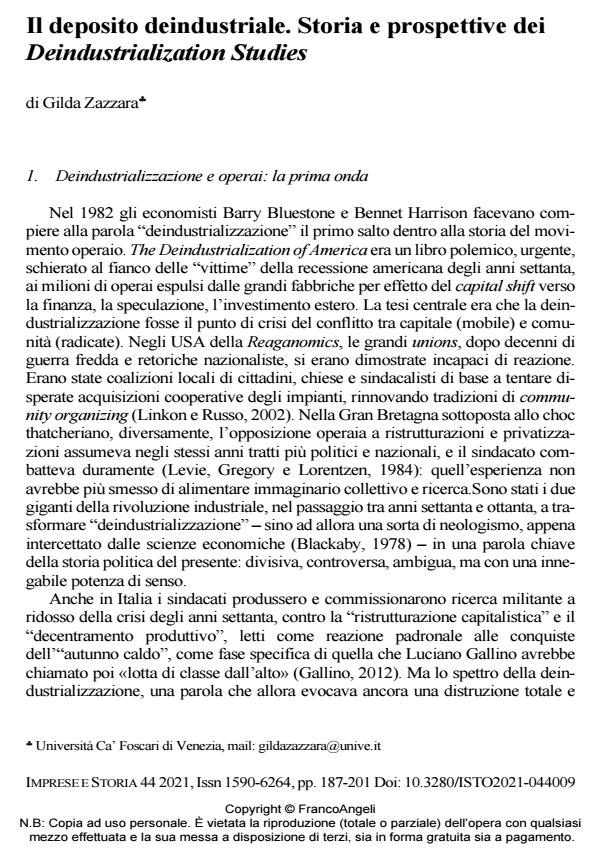
Below, you can see the article first page
If you want to buy this article in PDF format, you can do it, following the instructions to buy download credits
FrancoAngeli is member of Publishers International Linking Association, Inc (PILA), a not-for-profit association which run the CrossRef service enabling links to and from online scholarly content.
- MacKinnon L. (2020). Closing Sysco: Industrial Decline in Atlantic Canada’s Steel City. Toronto-Buffalo-London: University of Toronto Press
- McIvor A. (2013). Working Lives: Work in Britain since 1945. Basingstoke-New York: Palgrave Macmillan.
- McIvor A. (2018). “Scrap-Heap Storiesˮ: Oral Narratives of Labour and Loss in Scottish Mining and Manufacturing. Bios. Zeitschrift für Biographieforschung, Oral History und Lebensverlaufsanalysen, 2: 8-21.
- Moitra S. (2018). Winning or Losing? German Pit Closure and the Ambiguities of Memory. Bios: Zeitschrift für Biographieforschung, Oral History und Lebensverlaufsanalysen, 2: 37-52.
- Moitra S., Nogueira K., eds. (2018). (Post-)Industrial Memories. Oral History and Structural Change. Bios: Zeitschrift für Biographieforschung, Oral History und Lebensverlaufsanalysen, 2.
- Portelli A. (2011). They Say in Harlan County: An Oral History. New York-Oxford: Oxford University Press (trad. it.: America profonda. Due secoli raccontati da Harlan County, Kentucky. Roma: Donzelli, 2011)
- Raggi P. (2019). La désindustrialisation de la Lorraine du fer. Paris: Classiques Garnier
- Revelli M. (2017). Populismo 2.0. Torino: Einaudi
- Sennett R., Cobb J. (1972). The Hidden Injuries of Class. New York: Knopf
- Stiglitz J.E. (2003). The Roaring Nineties: A New History of the World's Most Prosperous Decade. New York: Norton (trad. it.: I ruggenti anni Novanta. Lo scandalo della finanza e il futuro dell'economia. Torino: Einaudi, 2004)
- Strangleman T. (2013). “Smokestack Nostalgia”, “Ruin Porn” or Working-Class Obituary. The Role and Meaning of Deindustrial Representation. International Labor and Working Class History, 84: 23-37. DOI: 10.1017/S014754791300023
- Strangleman T. (2019). Voices of Guinness: An Oral History of the Park Royal Brewery. Oxford-New York: Oxford University Press
- Trentin B. (1997). La città del lavoro. Sinistra e crisi del fordismo. Milano: Feltrinelli
- Williams R. (1977). Marxism and Literature. Oxford-New York: Oxford University Press
- Winant G. (2021). The Next Shift: The Fall of Industry and the Rise of Health Care in Rust Belt America. Cambridge, MA: Harvard University Press
- Zazzara G. (2021). Making Sense of the Industrial Past: Deindustrialisation and Industrial Heritage in Italy. Italia Contemporanea Yearbook 2020, III issue suppl.: 155-182.
- Ardeni P.G. (2020). Le radici del populismo. Disuguaglianze e consenso elettorale in Italia. Roma-Bari: Laterza
- Beaud S., Pialoux M. (1999). Retour sur la condition ouvrière. Enquête aux usines Peugeot de Sochaux-Montbéliard. Paris: Fayard
- Berger S., ed. (2020). Constructing Industrial Pasts: Heritage, Historical Culture and Identity in Regions Undergoing Structural Economic Transformation. Oxford-New York: Berghahn Books
- Berger S., High S., eds. (2019). (De-)Industrial Heritage. Labor. Studies in Working-Class History, 1. DOI: 10.1215/15476715-7269281
- Berta G. (2016). Che fine ha fatto il capitalismo italiano?. Bologna: il Mulino
- Bluestone B., Harrison B. (1982). The Deindustrialization of America: Plant Closings, Community Abandonment, and the Dismantling of Basic Industry. New York: Basic books
- Bonfiglioli C. (2019). Women and Industry in the Balkans: The Rise and Fall of the Yugoslav Textile Sector. London: I.B. Tauris.
- Clark A., Robertson M. (2019). “We Were the Ones Really Doing Something About It”: Gender and Mobilisation against Factory Closure. Work, Employment and Society, 33: 336-344. DOI: 10.1177/095001701878586
- Clarke J. (2011). Closing Moulinex: Thoughts on the Visibility and Invisibility of Industrial Labour in Contemporary France. Modern & Contemporary France, 4: 443-458. DOI: 10.1080/09639489.2011.61016
- Cowie J., Heatcott J., eds, (2003). Beyond the Ruins: The Meanings of Deindustrialization. Foreword by B. Bluestone. Ithaca (New York): Cornell University Press
- Doria M. (2019). La deindustrializzazione italiana. Riflessioni tra economia e storia. Società e storia, 165: 591-607
- Fontaine M., Vigna X. (2019). La désindustrialisation, une histoire en cours. 20&21. Revue d’histoire, 144: 3-17.
- Galli P., Pertegato G. (1994). Fiat 1980. Sindrome della sconfitta. Con un saggio di B. Trentin. Roma: Ediesse
- Gallino L. (2012). La lotta di classe dopo la lotta di classe. Intervista a cura di Paola Borgna. Roma-Bari: Laterza
- Garruccio R., Zazzara G. (2018). La rivoluzione deindustriale. Passato e presente, 3: 177-203
- Gibbs E. (2021). Coal Country: The Meaning and Memory of Deindustrialization in Postwar Scotland. London: University of London Press-Institute of Historical Research
- Gildart K. (2009). Mining Memories: Reading Coalfield Autobiographies. Labor History. 2: 139-161. DOI: 10.1080/0023656090282606
- Gildart K. (2019). Dust, Diesel, and Disability in the British Coal Industry: A View from the Coal Face, 1985-1992. Testo disponibile al sito https://wlv.openrepository.com/handle/2436/622692 (27-8-21)
- High S. (2003). Industrial Sunset: The Making of North America’s Rust Belt, 1969–1984. Toronto-Buffalo-London: University of Toronto Press
- High S. (2013). “The Wounds of Class”: A Historiographical Reflection on the Study of Deindustrialization, 1973-2013. History Compass, 11: 994-1007.
- High S. (2018). One Job Town: Work, Belonging, and Betrayal in Northern Ontario. Toronto-Buffalo-London: University of Toronto Press
- High S., MacKinnon L., Perchard A. (2017). The Deindustrialized World. Confronting Ruination in Postindustrial Places. Vancouver-Toronto: UBC Press
- High S., Portelli A. (2021). Alessandro Portelli: une vie passée à écouter. Entretien avec Steven High. Le Mouvement Social, 274: 211-223
- Laframboise L. (2021). Gendered Labour, Immigration, and Deindustrialization in Montreal’s Garment Industry. Master Thesis in History, Concordia University, Montreal (inedita)
- Levie H., Gregory D., Lorentzen N., eds. (1984). Fighting Closures: De-Industrialization and the Trade Unions 1970-1983. Nottingham: Spokesman.
- Linkon S.L. (2018). The Half-Life of Deindustrialization: Working-Class Writing about Economic Restructuring. Ann Arbor: University of Michigan Press
- Linkon S.L., Russo J. (2002). Steeltown USA: Work and Memory in Youngstown. Lawrence: University Press of Kansas
- Lomba C. (2018). La Restructuration permanente de la condition ouvrière. De Cockerill à ArcelorMittal. Vulaines-sur-Seine: Éditions du Croquant
Gilda Zazzara, Il deposito deindustriale. Storia e prospettive dei Deindustrialization Studies in "IMPRESE E STORIA" 44/2021, pp 187-201, DOI: 10.3280/ISTO2021-044009