Individual agency and institutional strategies in the early modern Mediterranean ransom system

Journal title SOCIETÀ E STORIA
Author/s Antonino Campagna
Publishing Year 2025 Issue 2025/189
Language Italian Pages 26 P. 593-618 File size 236 KB
DOI 10.3280/SS2025-189004
DOI is like a bar code for intellectual property: to have more infomation click here

Below, you can see the article first page

If you want to buy this article in PDF format, you can do it, following the instructions to buy download credits
Article preview

FrancoAngeli is member of Publishers International Linking Association, Inc (PILA), a not-for-profit association which run the CrossRef service enabling links to and from online scholarly content.

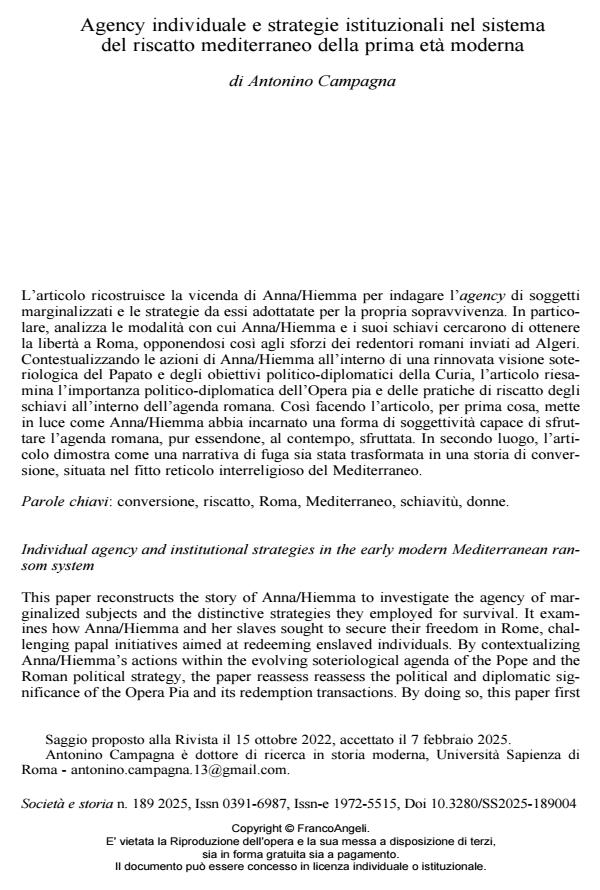
This paper reconstructs the story of Anna/Hiemma to investigate the agency of marginalized subjects and the distinctive strategies they employed for survival. It examines how Anna/Hiemma and her slaves sought to secure their freedom in Rome, challenging papal initiatives aimed at redeeming enslaved individuals. By contextualizing Anna/Hiemma’s actions within the evolving soteriological agenda of the Pope and the Roman political strategy, the paper reassess reassess the political and diplomatic significance of the Opera Pia and its redemption transactions. By doing so, this paper first unearths how Anna/Hiemma came to embody a a new form of subjectivity that both leveraged the Roman agenda, and was, in turn, shaped by it. Second, it demonstrates how the narrative of her escape was reframed as a conversion story, deeply embedded within the cross-religious networks of the Mediterranean.

Keywords: Conversion, Ransom, Rome, Mediterranean, Slavery, Women.

  1. Baskins C. (2023), The “Queen of Algiers”. An enterprising renegade in the Rome of Pope Sixtus V, in Non-Elite Women’s Networks across the Early Modern World, a cura di E.S. Cohen e M.J. Couling, Amsterdam, Amsterdam University Press, pp. 61-82.
  2. Benigno F. (2013), Parole nel tempo. Un lessico per pensare la storia, Roma, Viella.
  3. Bennassar B. e Bennassar L. (1991), I cristiani di Allah. La straordinaria epopea dei convertiti all’Islamismo nei secoli XVI e XVII, Milano, Rizzoli.
  4. Bennassar B. e Bennassar L. (2009), L’esclavage des femmes en Europe à l’époque moderne, in «Storia Delle Donne», 5, pp. 131-146.
  5. Bernard A. (2001), Le logiche del profitto. Schiavi e società a Siviglia nel Seicento, in «Quaderni storici», 2, pp. 379-389.
  6. Boccadamo G. (1985), La redenzione dei cattivi, Napoli, D’Auria.
  7. Boccadamo G. (2010), Napoli e l’islam. Storie di musulmani, schiavi e rinnegati in età moderna, Napoli, D’Auria.
  8. Bono S. (1955), La missione dei Cappuccini ad Algeri per il riscatto degli schiavi cristiani nel 1585, in «Collectanea Franciscana», 25, pp. 149-163, 279-304.
  9. Bono S. (1999), Schiavi musulmani nell’Italia moderna. Galeotti, vu’compra, domestici, Napoli, Edizioni Scientifiche Italiane.
  10. Bono S. (2006), Malta e Venezia tra corsari e schiavi (secc. XVI-XVIII), in «Mediterranea. Ricerche storiche», 7, pp. 213-222.
  11. Bono S. (2015), Da Salamanca a Varsavia: processioni di schiavi europei riscattati (1508-1830), in «Mediterranea. Ricerche storiche», 34, pp. 285-300.
  12. Bono S. (2016), Schiavi. Una storia mediterranea (XVI-XIX secolo), Bologna, il Mulino.
  13. Bono S. (2019), Una “regina d’Algeri” nella Roma di Sisto V, in Oltreconfine. Temi e fonti per lo studio dell’Africa, a cura di A. Baldinetti, M. Cassarino, G. Maimone e
  14. D. Melfa, Roma, Aracne, pp. 75-90.
  15. Boubaker S. (2008), Réseaux et techniques de Rachat des captifs de la course à Tunis au XVIIe siecle, in Le commerce des captifs: les intermédiaires dans l’échange et le rachat des prisonniers en méditerranée, XVe-XVIIIe siècle, a cura di Kaiser W., Rome, Ecole française de Rome, pp. 25-46.
  16. Buttigieg E. (2018), Corpi e anime in schiavitù: schiavi musulmani nella Malta dei Cavalieri di San Giovanni (1530-1798), in Schiavitù del corpo e schiavitù dell’anima. Chiesa, potere politico e schiavitù tra Atlantico e Mediterraneo (sec. XVIXVIII), a cura di E. Colombo, M. Massimi, A. Rocca e A. Zerone, Milano, Editore ITL – Studia Borromaica.
  17. Caffiero M. (2004), Battesimi forzati. Storie di ebrei, cristiani e convertiti nella Roma dei papi, Roma, Viella.
  18. Caffiero M. (2007), Battesimi, libertà e frontiere. Conversioni di musulmani e ebrei a Roma in età moderna, in «Quaderni storici», 126, pp. 821-841.
  19. Caffiero M. (2013), Incontrarsi a Roma. Schiavitù, conversioni e apostasie di musulmani tra Inquisizione e Casa dei catecumeni, in «Dimensioni e problemi della ricerca storica», 2, pp. 81-106.
  20. Caffiero M. (2022), Gli schiavi del papa. Conversioni e libertà dei musulmani a Roma in età Moderna, Brescia, Morcelliana.
  21. Calafat G. e Kaiser W. (2014), The Economic of Ransoming in the Early Modern Mediterranean. A form of cross-cultural trade between southern Europe and Maghreb (16th to 18th centuries), in Religion and Trade. Cross-cultural Exchanges in World History (1000-1900), a cura di F. Trivellato, L. Halevi e C. Antunes, Oxford, Oxford University Press, pp. 108-130.
  22. Colombo E. (2018), Ancora altre Indie: gesuiti, schiavi musulmani e conversioni nell’Europa del Seicento, in Schiavitù del corpo e schiavitù dell’anima. Chiesa, potere politico e schiavitù tra Atlantico e Mediterraneo (sec. XVI-XVIII), a cura di E. Colombo, M. Massimi, A. Rocca e C. Zerone, Milano, Editore ITL – Studia Borromaica, pp. 247-270.
  23. Davis R.C. (2002), Christian Slaves, Muslim Masters. White Slavery in the Mediterranean, the Barbary Coast and Italy, 1500-1800, New York, Houndsmills.
  24. De Vries J. (2019), Playing with Scales: The Global and the Micro, the Macro and the Nano, in «Past & Present», 14, pp. 23-36.
  25. Di Nepi S. (2013), Le Restitutiones ad libertatem di schiavi a Roma in età moderna: una ricerca su un fenomeno trascurato (1516-1645), in «Dimensioni e problemi della ricerca storica», 2, pp. 25-52.
  26. Kaiser W. (2007), L’économie de la rançon en Méditerranée occidentale (XVIe-XVIIe siècle), in «Hypothèses», 10, pp. 359-368.
  27. Di Nepi S. (2019), I “turchi”, la guerra e le conversioni. Per una riflessione su schiavitù e battesimo negli anni della Riforma, in Riforma/riforme: continuità o discontinuità? Sacramenti, pratiche spirituali e liturgia fra il 1450 e il 1600, a cura di F. Ferrario, E. Lòpez-Tello García e E. Prinzivalli, in «Quaderni di SMSR», 22, Roma, Morcelliana, pp. 350-364.
  28. Di Nepi S. (2022), I confini della salvezza. Schiavitù, conversione e libertà nella Roma di età moderna, Roma, Viella.
  29. Dursteler E.R. (2011), Renegade Women. Gender, Identity and boundaries in the early modern Mediterranean, Baltimore, John Hopkins University Press.
  30. Fabris A. (1997), Hasan “il Veneziano” tra Algeri e Costantinopoli, in «Quaderni di Studi Arabi», 15, pp. 51-66.
  31. Filioli Uranio F. e Sabatini G. (2017), Identità, valore, prezzo: nuove proposte di analisi e comparazione sul mercato degli schiavi a Napoli in Età Moderna, in «Mediterranea. Ricerche storiche», 41, pp. 677-694.
  32. Fiorani L. (1998), Verso la nuova città. Conversione e conversionismo a Roma nel Cinque-Seicento, in «Ricerche per la storia religiosa di Roma», 57, n. 1, pp. 85132.
  33. Fiume G. (2001), La schiavitù nel Mediterraneo, in «Quaderni Storici», 107, pp. 323474.
  34. Fiume G. (2009), Schiavitù mediterranee. Corsari, rinnegati e santi di età moderna, Milano, Mondadori.
  35. Fiume G. (2015), La schiavitù mediterranea tra Medioevo ed età moderna. Una proposta bibliografica, in «Estudis. Revista de Historia Moderna», 41, pp. 267-318.
  36. Fiume G. (2016a), La controversa eredità di Braudel e le forzature dei Mediterranean Studies. Un falso bel tema, in «Segnali – Storia. L’indice dei libri del mese», 2, p. 12. Fiume G. (2016b), Rinnegati. Le imbricazioni delle relazioni mediterranee, in Identidades cuestionadas. Coexistencia y conflictos interreligiosos en el Meiterràneo (ss.
  37. XIV-XVIII), a cura di B.F. Llopis, B. Pomara Saverino, M.L. Cortés e B.R. Bejarano, València, Publicacions de la Universitat de València, pp. 39-62.
  38. Fontenay M. (2008), Esclaves et/ou captifs: preciser les concepts, in Le commerce des captifs: les intermédiaires dans l’échange et le rachat des prisonniers en méditerranée, XVe-XVIIIe siècle, a cura di W. Kaiser, Rome, Ecole française de Rome, pp. 15-24.
  39. García-Arenal M. (2001), Conversions islamiques: identités religieuses en Islam méditerranéen, Paris, Maisonneuve et Larose.
  40. García-Arenal M. e Wiegers G. (2013), L’uomo dei tre mondi. Storia di Samuel Pallache, ebreo marocchino nell’Europa del Seicento, Roma, Viella.
  41. Ginzburg C. (1994), Microstoria. Due o tre cose che so di lei, in «Quaderni storici», 29, pp. 511-539.
  42. Greene M. (2002), A Shared World. Christians and Muslims in the Early Modern Mediterranean, Princeton, Princeton University Press.
  43. Hershenzon D. (2013), Plaintes et menaces: captivité et violences religieuses en Méditerranée au XVIIe siècle, in Les musulmans dans l’histoire de l’Europe, vol. 2, Passages et contacts en Méditerranée, a cura di J. Dakhlia e W. Kaiser, pp. 441-460. Hershenzon D. (2018), The Captive Sea Slavery. Communication, and Commerce in Early Modern Spain and the Mediterranean, Philadelphia, University of Pennsylvania Press.
  44. Hess A.C. (1978), The Forgotten Frontier. A History of the Sixteenth-Century IberoAfrican Frontier, Chicago-London, University of Chicago Press.
  45. Kaiser W. (2006), Frictions profitables. L’économie de la rançon en Méditerranée occidentale (XVIe-XVIIe siècles), in Ricchezza del mare. Ricchezza dal mare. Secc. XIII-XVIII, a cura di S. Cavaciocchi, Firenze, Le Monnier, pp. 689-701.
  46. Kaiser W. (2008a), La excepciòn permanente. Actores, visibilidad y asimetrias en los intercambios comerciales entre los paìses europeos y el Magreb (siglos XVI-XVII), in Circulaciòn de personas e intercambios en el Mediterràneo y en el Atlàntico (siglos XVI, XVII, XVIII), a cura di J.A. Martìnez Torres, Madrid, Consejo Superior de Investigaciones Cientìficas, pp. 171-189.
  47. Kaiser W. (2008b), Les «hommes de crédit» dans les rachats de captifs proven aux (XVIe-XVIIe siècles), in Le commerce des captifs: les intermédiaires dans l’échange et le rachat des prisonniers en Méditerranée, XVe-XVIIIe siècle, a cura di W. Kaiser, Rome, École fran aise de Rome, pp. 291-319.
  48. Lavenia V., Pavone S. e Petrolini C. (2023), Sacre metamorfosi. Racconti di conversione tra Roma e il mondo in età moderna, Roma, Viella.
  49. Loualich F. (2010), In the Regency of Algiers. The Human Side of Algerine Corso, in Trade and Cultural exchange in the Early Modern Mediterranean, a cura di M. Fusaro, C. Heywood e M.-S. Omri, London-New York, I.B. Tauris, pp. 69-96.
  50. Manca C. (1975), Un decano d’Ales redentore di schiavi cristiani in Barberia sul finire del Cinquecento, in La Diocesi di Ales-Usellus-Terralba, Cagliari, Editrice sarda Fossataro, pp. 287-300.
  51. Messana M. (2007), La «resistenza» musulmana e i «martiri» dell’Islam. Moriscos, schiavi e cristiani rinnegati di fronte all’Inquisizione spagnola di Sicilia, in «Quaderni Storici», 126, pp. 743-772.
  52. Morin E. (2000), La testa ben fatta. Riforma dell’insegnamento e riforma del pensiero, Milano, Raffaello Cortina [ed. or., Paris, Seuil, 1999].
  53. Pagano S. (1990), L’archivio dell’Arciconfraternita del Gonfalone. Cenni storici ed inventario, Città del Vaticano, Archivio Segreto Vaticano – Collectanea Archivi Vaticani.
  54. Pagano S. e Barone G. (1985), Arciconfraternita del Gonfalone, in «Ricerche per la storia religiosa di Roma», 6, pp. 215-219.
  55. Pedani M.P. (2002), Dalla frontiera al confine, Venezia, Herder.
  56. Pelizza A. (2012), «Restituirsi in libertà et alla patria». Riscatti di schiavi a Venezia tra XVI e XVIII secolo, in «Quaderni storici», 2, pp. 341-384.
  57. Pétré-Grenouilleau O. (2010), La tratta degli schiavi. Saggio di storia globale, Bologna, il Mulino, [ed. or., Paris, Gallimard, 2004].
  58. Planas N. (2015), Diplomacy from Below or Cross-Confessional Loyalty? The “Christians of Algiers” between the Lord of Kuko and the King of Spain in the Early 1600s, in «Journal of Early Modern History», 19, pp. 153-173.
  59. Rostagno L. (1983), Mi faccio turco. Esperienze e immagini dell’Islam nell’Italia moderna, Roma, Istituto per l’Oriente C.A. Nallino.
  60. Rothman E.N. (2006), Becoming Venetians. Conversions and Transformations in the Seventeenth Century Mediterranean, in «Mediterranean Historical Review», 21, pp. 39-75.
  61. Rothman E.N. (2011), Brokering Empire. Trans-Imperial Subjects between Venice and Istanbul, Ithaca, Cornell University Press.
  62. Scaraffia L. (1993), Rinnegati. Per una storia dell’identità occidentale, Roma-Bari, Laterza.
  63. Shuval T. (2000), The Ottoman algerian elite and its ideology, in «International Journal of Middle East Studies», 32, 3, pp. 323-344.
  64. Terpstra N. (2019), Purezza e fede. Esuli religiosi nell’Europa moderna, Bologna, il Mulino, [ed. or., New York, Cambridge University Press, 2015].
  65. Varriale G. (2014), Un covo di spie: il quartiere greco di Napoli, in Identità e frontiere. Politica, economia e società nel Mediterraneo (secc XIV-XVIII), a cura di L.J.Guia Marìn, M.G.R. Mele e G. Tore, Milano, FrancoAngeli, pp. 47-62.
  66. Walden J.A. (2021), Muslim Slaves in Early Modern Rome. The Development and Visibility of a Labouring Class, in A Companion to Religious Minorities in Early Modern Rome, a cura di M.C. Wainwright e E. Michelson, Leiden, Brill, pp. 298323.

Antonino Campagna, Agency individuale e strategie istituzionali nel sistema del riscatto mediterraneo della prima età moderna in "SOCIETÀ E STORIA " 189/2025, pp 593-618, DOI: 10.3280/SS2025-189004