Between the Shadows of Us: Reflections on the Partner and the Couple as Tools in the Treatment of Eating Disorders

Journal title TERAPIA FAMILIARE
Author/s Gabriele Scapellato, Emilia Rota
Publishing Year 2025 Issue 2025/138
Language Italian Pages 19 P. 37-55 File size 158 KB
DOI 10.3280/TF2025-138004
DOI is like a bar code for intellectual property: to have more infomation click here

Below, you can see the article first page

If you want to buy this article in PDF format, you can do it, following the instructions to buy download credits
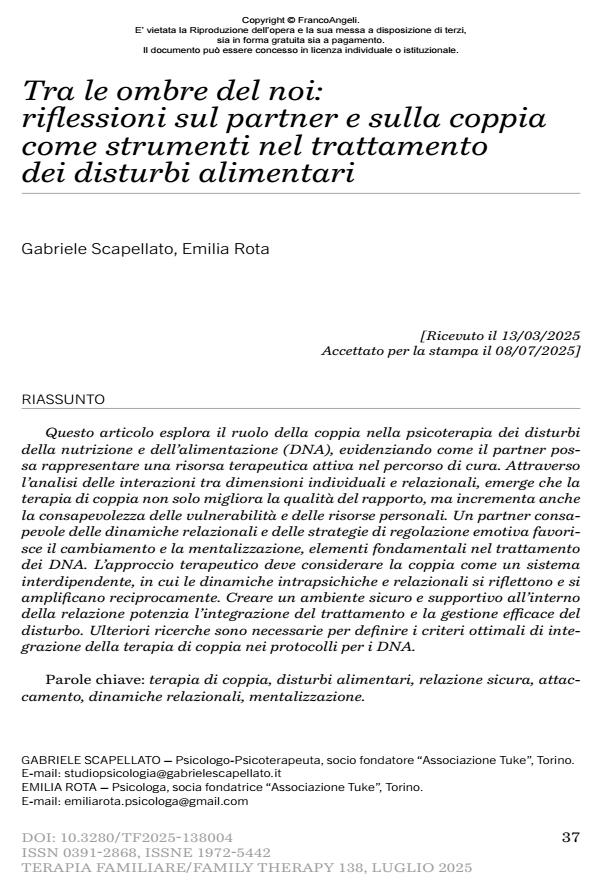
Article preview

FrancoAngeli is member of Publishers International Linking Association, Inc (PILA), a not-for-profit association which run the CrossRef service enabling links to and from online scholarly content.

This article explores the role of the couple in psychotherapy of eating disorders (DNA), highlighting how the partner can serve as an active therapeutic resource throughout the treatment process. By analyzing the interactions between individual and relational dimensions, it becomes clear that couples therapy not only enhances the quality of the relationship but also increases awareness of personal vulnerabilities and strengths. A partner who is mindful of relational dynamics and emotional regulation strategies facilitates change and mentalization, which are critical in treating eating disorders. The therapeutic approach must view the couple as an interdependent system, where intrapsychic and relational dynamics mutually reflect and amplify one another. Establishing a safe and supportive environment within the relationship enhances treatment integration and effective disorder management. Further research is needed to determine the optimal criteria for incorporating couples therapy into protocols for eating disorders.

Keywords: couple therapy, eating disorders, secure relationship, attachment, relational dynamics, mentalization.

  1. Allen J.g. & Fonagy P. (eds.) (2006). Mentalization-based Treatment. Chichester: Wiley (trad. it.: La mentalizzazione. Psicopatologia e trattamento. Bologna: il Mulino, 2008).
  2. Baldoni F. (2014). Mentalizzazione e integrazione psicosomatica del Sé. In: Northoff g., Farinelli M., Chattat R. & Baldoni F. (a cura di), La plasticità del Sé. un approccio neuro psicodinamico (pp. 93-130). Bologna: il Mulino.
  3. Beebe B. & Lachmann F.M. (2003). Infant research e trattamento degli adulti: un modello sistemico-diadico delle interazioni. Milano: Raffaello Cortina.
  4. Beebe B. & Lachmann F.M. (2015). Le origini dell’attaccamento: infant research e trattamento degli adulti. Milano: Raffaello Cortina.
  5. Berscheid E. (2006). Seasons of the heart. In: Sternberg R.J. & Weis K. (eds.), The new psychology of love (pp. 404-422). Yale university Press.
  6. Bulik C.M., Baucom D.H. & Kirby J.S. (2012a). Couples therapy for anorexia nervosa. In: Alexander J. & Treasure J. (eds.), A collaborative approach to eating disorders (pp. 189-200). New York: Routledge/Taylor & Francis group.
  7. Castellano R., Velotti P. & Zavattini g.C. (2010). Cosa ci fa restare insieme?
  8. L’attaccamento e gli esiti nella relazione di coppia. Bologna: il Mulino.
  9. Fraley R.C. (2002). Introduction to the special issue: The psychodynamics of adult attachments. Bridging the gap between disparate research traditions. Attachment e Human Development, 4: 131-132. DOI: 10.1080/14616730210154180
  10. gergely g. & Watson J.S. (1996). The social biofeedback theory of parental affect-mirroring: the development of emotional self-awareness and self-control in infancy. International Journal of Psychoanalysis, 77: 1181-212.
  11. Govind N. (2020). Couple Therapy for Depression. Issues in Mental Health Nursing, 41(7): 658-659. DOI: 10.1080/01612840.2019.1688439
  12. Jewell T., Blessitt E., Steward C., Simic M. & Eisler I. (2016). Family therapy for child and adolescent eating disorders: a critical review. Family Process, 55(3): 577-594.
  13. Johnson S.M. (2003). Attachment theory: A guide for couples therapy. In: Johnson
  14. S.M. & Whiffen V. (eds.), Attachment processes in couples and families (pp. 103123). New York: Guilford Press.
  15. Norsa N. & Zavattini g.C. (1997). Intimità e collusione. Teoria e tecnica della psicoterapia psicoanalitica di coppia. Milano: Raffaello Cortina.
  16. Orange D.M. (2001). La comprensione emotiva. Roma: Astrolabio.
  17. Robinson P., Skarderud F., Sommerfeldt B., Fonagy P. & Sambo B. (2022). Fame.
  18. Trattare i disturbi alimentari con la mentalizzazione. Roma: Astrolabio.
  19. Santona A. & Zavattini g.C. (2009). Intimità, vicinanza e disregolazione. In: Carli L., Cavanna D. & Zavattini g.C. (a cura di), Le relazioni di coppia. Modelli teorici e intervento clinico (pp. 153-192). Bologna: il Mulino.
  20. Scapellato g. (2024). L’emozione condivisa. Narrazione e metafora nella terapia di coppia. INTERAZIONI, 2: 144-156. DOI: 10.3280/INT2024-002012
  21. Shaver P.R. & Mikulincer M. (2002). Attachment-related psychodynamics. Attachment e Human Development. Special Issue: The Psychodynamics of Adult Attachment-Bridging the Gap between Disparate Research Traditions, 4(2): pp. 133-161. DOI: 10.1080/14616730210154171
  22. Siegel D.J. (1999). The Developing Mind. New York-London: Guilford Press (trad. it.: La mente relazionale. Neurobiologia dell’esperienza interpersonale. Milano: Cortina, 2001).
  23. Thompson-Brenner H. (ed.) (2015). Casebook of evidence-based therapy for eating disorders. New York: Guilford Press.
  24. Zachrisson H.D. & Skarderud F. (2010). Feelings of insecurity: Review of attachment and eating disorders. European Eating Disorders Review, 18(2): 97-106.

Gabriele Scapellato, Emilia Rota, Tra le ombre del noi: riflessioni sul partner e sulla coppia come strumenti nel trattamento dei disturbi alimentari in "TERAPIA FAMILIARE" 138/2025, pp 37-55, DOI: 10.3280/TF2025-138004