Saving businesses or market? Crony capitalism in the writings of Luigi Zingales
Journal title HISTORY OF ECONOMIC THOUGHT AND POLICY
Author/s Francesco Alfani
Publishing Year 2025 Issue 2025/2
Language English Pages 27 P. 5-31 File size 124 KB
DOI 10.3280/SPE2025-002001
DOI is like a bar code for intellectual property: to have more infomation
click here
Below, you can see the article first page
If you want to buy this article in PDF format, you can do it, following the instructions to buy download credits
FrancoAngeli is member of Publishers International Linking Association, Inc (PILA), a not-for-profit association which run the CrossRef service enabling links to and from online scholarly content.
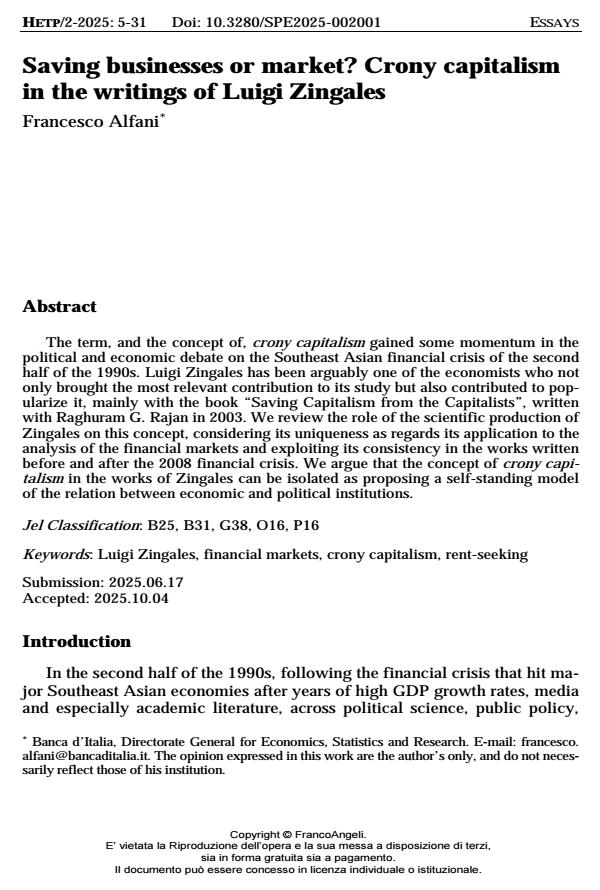
The term, and the concept of, crony capitalism gained some momentum in the political and economic debate on the Southeast Asian financial crisis of the second half of the 1990s. Luigi Zingales has been arguably one of the economists who not only brought the most relevant contribution to its study but also contributed to popularize it, mainly with the book “Saving Capitalism from the Capitalists”, written with Raghuram G. Rajan in 2003. We review the role of the scientific production of Zingales on this concept, considering its uniqueness as regards its application to the analysis of the financial markets and exploiting its consistency in the works written before and after the 2008 financial crisis. We argue that the concept of crony capitalism in the works of Zingales can be isolated as proposing a self-standing model of the relation between economic and political institutions.
Keywords: Luigi Zingales, financial markets, crony capitalism, rent-seeking
Jel codes: B25, B31, G38, O16, P16
- Acemoglu D., Johnson S. and Robinson J. 2001. The Colonial Origins of Comparative Development: An Empirical Study. American Economic Review, 91, 1369-1401.
- Aligica P. and Tarko V. 2014. Crony Capitalism: Rent Seeking, Institutions and Ideology. Kyklos, 67(2), 156-176.
- Banerjee A. and Iyer L. 2002. History, Institutions, and Economic Performance: The Legacy of Colonial Land Tenure Systems in India. Unpublished working paper, Cambridge, Massachusetts, MIT. Published in 2005. The American Economic Review, 95(4), 1190-1213.
- Becker G. 1983. A Theory of the Competition among Pressure Groups for Political Influence. The Quarterly Journal of Economics, 98, 371-400.
- Buchanan J. (ed. by Buchanan S., Tollison R. and Tullock G.) 1980. Rent Seeking and Profit Seeking. Towards a theory of the rent-seeking society. College Station, Texas A&M University.
- Chang H. J., Park H. J. and Yoo C. G. 1998. Interpreting the Korean Crisis: Financial Liberalisation, Industrial Policy and Corporate Governance. Cambridge Journal of Economics, 1998(22), 735-746.
- Faccio M. 2006. Politically Connected Firms. The American Economic Review, 96(1), 369-386.
- Fisman R. 2001. Estimating the Value of Political Connections. The American Economic Review, 91(4), 1095-1102.
- Haber S. 2002. Crony Capitalism and Economic Growth in Latin America: Theory and Evidence. Hoover Press.
- Henderson D. 2012. The Economics and History of Cronyism. Mercatus Center, George Mason University.
- Holcombe R. G. 2013. Crony Capitalism: By-Product of Big Government. The Independent Review, 17 (4), 541-559.
- Hunter W. C., Kaufman G. K. and Krueger T. H. (eds.) 1998. The Asian Financial Crisis. Norwell, Massachusetts: Kluwer Academic Publishers.
- Kang D. C. 2002. Crony Capitalism: Corruption and Development in South Korea and the Philippines. Cambridge, U.K.: Cambridge University Press.
- Khatri N. and Tsang E. 2003. Antecedents and Consequences of Cronyism in Organizations. Journal of Business Ethics, 43(4), 289-303.
- Khatri N., Tsang E. and Begley T. 2006. Cronyism: Across-Cultural Analysis. Journal of International Business Studies, 37(1), 61-75.
- King R. and Levine R. 1993. Finance and Growth: Schumpeter Might Be Right. Quarterly Journal of Economics, 108(3), 717-737.
- Krueger A. O. 1974. The Political Economy of the Rent-Seeking Society. The American Economic Review, 64(3), 291-303.
- Krueger A. (ed. By Haber S.) 2002. Why Crony Capitalism Is Bad for Growth. Crony Capitalism and Economic Growth in Latin America. Hoover Press, 1-23.
- Krugman P. 1998. What Happened to Asia? -- Website (http://web.mit.edu/
- krugman/www/#fortune), January 12, 1998.
- Krugman P. 1998. Asia: What Went Wrong. Fortune Magazine -- (https://money.
- cnn.com/magazines/fortune), March 2, 1998.
- Laffont J. and Tirole, J. 1991. The Politics of Government Decision-Making: A Theory of Regulatory Capture. Quarterly Journal of Economics, 106(4), 1089-1127.
- Laffont J. and Tirole, J. 1993. A Theory of Incentives in Regulation and Procurement. Cambridge, Massachusetts: MIT Press.
- La Porta R., Lopez-De-Silanes F., Shleifer A. and Vishny R. W. 1997. Legal Determinants of External Finance. The Journal of Finance, 52(3), 1131-1150.
- La Porta R., Lopez-de-Silanes F., Shleifer A. and Vishny R. 1998. Law and Finance. Journal of Political Economy, 106, 1113-1155.
- La Porta R., Lopez-de-Silanes F., Shleifer A. and Vishny R. 1999a. The Quality of Government. Journal of Law, Economics, and Organization, 15, 222-279.
- La Porta R., Lopez-de-Silanes F., Shleifer A. and Vishny R. 1999b. Investor Protection: Origins, Consequences, and Reform. Unpublished working paper 7428. NBER, Cambridge.
- La Porta R., Lopez-de-Silanes F. and Shleifer A. 2008. The Economic Consequences of Legal Origins. Journal of Economics Literature, 46, 285-332.
- Lamoreaux N. 1994. Insider Lending: Banks, Personal Connections and Economic Development in Industrial New England. Cambridge, U.K.: Cambridge University Press.
- Li W., Roland G. and Xie Y. 2022. Crony Capitalism, the Party-state, and the Political Boundaries of Corruption. Journal of Comparative Economics, 50, 652–667.
- Mazumdar S. 2008. Crony Capitalism and India. Before and After Liberalization. Working paper 2008/04, Institute for Studies in Industrial Development, New Delhi.
- Meltzer A. 2012. Why Capitalism. Oxford University Press.
- Mitchell M. 2012. The Pathology of Privilege: The Economic Consequences of Government Favoritism. Mercatus Center, George Mason University.
- Mitchell M. 2013. Luigi Zingales, A Capitalism for the People: Recapturing the Lost Genius of American Prosperity. Review of Austrian Economics, 26(3), 359-362.
- Munger M.C. and Villarreal-Diaz M. 2019. The Road to Crony Capitalism. The Independent Review, 23 (3), 331-344.
- Radelet S. and Sachs J. 1998. The Onset of the East Asian Financial Crisis. Harvard University Working Paper.
- Rajan R. G. 1992. Insiders and Outsiders: The Choice between Informed and Arm’s Length Debt. Journal of Finance, 47, 1367-1400.
- Rajan R. G. and Zingales L. 1998. Financial Dependence and Growth. The American Economic Review, 88, 559-586.
- Rajan R. G. and Zingales L. 1999. The Politics of Financial Development. Unpublished working paper: University of Chicago, Chicago.
- Rajan R. G. and Zingales L. 2003a. The Great Reversals: The Politics of Financial Development in the Twentieth Century. Journal of Financial Economics, 69(1), 5-50.
- Rajan R. G. and Zingales L. 2003b. Saving Capitalism from the Capitalists. New York: Crown Business Division of Random House.
- Reinsberg B., Kentikelenis A. and Stubbs T. 2021. Creating Crony Capitalism: Neoliberal Globalization and the Fueling of Corruption. Socio-Economic Review, 19(2), 607-634.
- Rochet J. and Tirole J. 2003. Platform Competition in Two-Sided Markets. Journal of the European Economic Association, 1(4), 990-1029.
- Roubini N., Corsetti G. and Pesenti P. 1998. What Caused the Asian Currency and Financial Crisis? New York University Working paper.
- Rubin P. 2015. Crony Capitalism. Supreme Court Economic Review, 23, 105-120.
- Schoenherr D. 2019. Political Connections and Allocative Distortions. The Journal of Finance, 74(2), 543-586.
- Shafer M. 1994. Winners and Losers: How Sectors Shape the Development Prospects of States. Ithaca: Cornell University Press.
- Shapiro C. 2018. Antitrust in a Time of Populism. International Journal of Industrial Organization, 61, 714-748.
- Shleifer A. and Vishny R. 1993. Corruption. Quarterly Journal of Economics, 108, 599-618.
- Shleifer A. and Vishny R. 1994. Politicians and Firms. Quarterly Journal of Economics, 109, 995-1025.
- Smith A. 1776. Wealth of Nations. Wordsworth Editions.
- Stigler G. 1971. The Theory of Economic Regulation. Bell Journal of Economics and Management Science 2, 3-21.
- Wade R. 1998. From ‘Miracle’ to ‘Cronyism’: Explaining the Great Asian Slump. Cambridge Journal of Economics 22(6), 693-706.
- Wang Z., Liu X., Kong X. and Zhou J. 2025. Corporate Political Connection, Rent Seeking and Government. International Review of Economics and Finance 103, 104354.
- Wei Y., Jia N. and Bonardi J. 2023. Corporate Political Connections: A Multidisciplinary Review. Journal of Management, 49(6), 1870-1910.
- Zingales L. 2009. Capitalism After the Crisis. National Affairs, 1, 22-35.
Francesco Alfani, Saving businesses or market? Crony capitalism in the writings of Luigi Zingales in "HISTORY OF ECONOMIC THOUGHT AND POLICY" 2/2025, pp 5-31, DOI: 10.3280/SPE2025-002001