Saving Masud Khan

Journal title PSICOTERAPIA E SCIENZE UMANE
Author/s Wynne Godley
Publishing Year 2025 Issue 2025/4
Language Italian Pages 21 P. 579-599 File size 364 KB
DOI 10.3280/PU2025-004001
DOI is like a bar code for intellectual property: to have more infomation click here

Below, you can see the article first page

If you want to buy this article in PDF format, you can do it, following the instructions to buy download credits
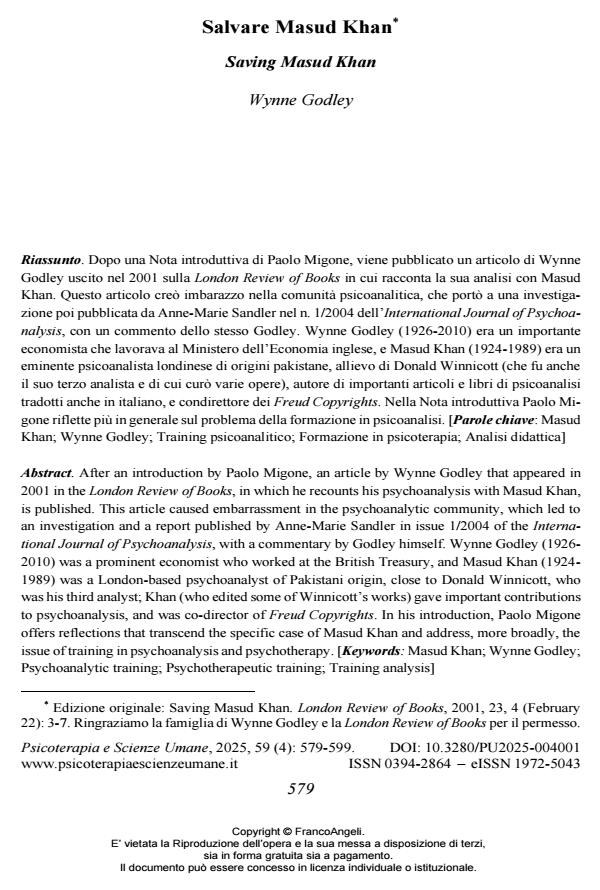
Article preview

FrancoAngeli is member of Publishers International Linking Association, Inc (PILA), a not-for-profit association which run the CrossRef service enabling links to and from online scholarly content.

After an introduction by Paolo Migone, an article by Wynne Godley that appeared in 2001 in the London Review of Books, in which he recounts his psychoanalysis with Masud Khan, is published. This article caused embarrassment in the psychoanalytic community, which led to an investigation and a report published by Anne-Marie Sandler in issue 1/2004 of the International Journal of Psychoanalysis, with a commentary by Godley himself. Wynne Godley (1926-2010) was a prominent economist who worked at the British Treasury, and Masud Khan (1924-1989) was a London-based psychoanalyst of Pakistani origin, close to Donald Winnicott, who was his third analyst; Khan (who edited some of Winnicott’s works) gave important contributions to psychoanalysis, and was co-director of Freud Copyrights. In his introduction, Paolo Migone offers reflections that transcend the specific case of Masud Khan and address, more broadly, the issue of training in psychoanalysis and psychotherapy.

Keywords: Masud Khan; Wynne Godley; Psychoanalytic training; Psychotherapeutic training; Training analysis

  1. Balint M. (1974). L’analisi didattica. Chi psicoanalizzerà gli psicoanalisti? Rimini: Guaraldi (vedi anche: L’amore primario. Rimini: Guaraldi, 1973; Milano: Raffaello Cortina, 1991).
  2. Berman E. (2004). Impossible Training: A Relational View of Psychoanalytic Education. Hillsdale, NJ: Analytic Press (trad. it.: Il training impossibile. Un punto di vista relazionale sulla formazione degli psicoanalisti. Roè Volciano [BS]: Arpa, 2019).
  3. Bolko M. & Rothschild B. (2006). Una “pulce nell’orecchio”. Cronaca del controcongresso dell’International Psychoanalytic Association di Roma del 1969. Psicoterapia e Scienze Umane, 40, 3: 703-718. Ristampa: 2015, 49, 3: 431-446.
  4. Boynton R.S. (2002). Return of the Repressed. The strange case of Masud Khan. The Boston Review, 27, 6: 23-29 (www.bostonreview.net/articles/robert-s-boynton-return-repressed).
  5. Castiello d’Antonio A. (2008). Sulla selezione degli psicoanalisti. Psicoterapia e Scienze Umane, 41, 3: 357-394.
  6. Cooper J. (1993). Speak of Me as I Am: The Life and Work of Masud Khan. London: Routledge.
  7. Cremerius J. (1986). Spurensicherung: Die “Psychoanalytische Bewegung” und das Elend der psychoanalytischen Institution. Psyche, 40, 12: 1063-1091 (trad. it.: Alla ricerca di tracce perdute. Il “movimento psicoanalitico” e la miseria della istituzione psicoanalitica. Psicoterapia e Scienze Umane, 1987, 21, 3: 3-34).
  8. Cremerius J. (1987a). L’istituzione, tra il 1923 e il 1926, del sistema di selezione come strumento della politica di potere del “movimento psicoanalitico”. Psicoterapia e Scienze Umane, 1990, 24, 4: 28-44.
  9. Cremerius J. (1987b). Wenn wir als Psychoanalytiker die psychoanalytische Ausbildung organisieren, müssen wir sie psychoanalytisch organisieren! Psyche, 41, 12: 1067-1096 (trad. it.: Quando noi, psicoanalisti, organizziamo il training psicoanalitico, dobbiamo farlo in maniera psicoanalitica! Quaderni. Associazione di Studi Psicoanalitici, 1991, II, 3: 5-23 [I e II parte], 4: 24-35 [III parte]).
  10. Cremerius J. (1988). Analisi didattica e potere. La trasformazione di un metodo di insegnamento-apprendimento in strumento di potere della psicoanalisi istituzionalizzata. Psicoterapia e Scienze Umane, 1989, 23, 3: 3-27 (https://priory.com/ital/riviste/psicouman/cremer89.htm). Ristampa: 2021, 55, 3: 487-508. DOI: 10.3280/PU2021-003005
  11. Daniel P. (2001). Masud Khan and Winnicott. Bulletin of the British Psychoanalytical Society, 37: 30-33.
  12. Freud A. (1938). Probleme der Lehranalyse. In: Max Eitingon in Memoriam. Jerusalem: Israel Psychoanalytic Society, 1950, pp. 80-94 (trad. it.: Problemi dell’analisi didattica. In: Opere, 1: 1922-1943. Torino: Boringhieri, 1978, pp. 267-280).
  13. Freud A. (1966). The ideal psychoanalytic institute: A utopia. Bulletin of the Menninger Clinic, 1971, 35, 4: 225-239 (trad. it.: L’istituto psicoanalitico ideale: un’utopia. In: Opere, 3: 1965-1975. Torino: Boringhieri, 1979, pp. 963-980).
  14. Freud S. (1937). Analisi terminabile e interminabile. Opere, 11: 497-535. Torino: Boringhieri, 1979.
  15. Galli P.F. (2013). From Basle to Milan to Zurich: On psychoanalytic training. International Journal of Psychoanalysis, 94, 6: 1209-1214.
  16. Gazzillo F. & Silvestri M. (2008). Sua maestà Masud Khan. Vita e opere di uno psicoanalista pakistano a Londra. Milano: Raffaello Cortina.
  17. Gitelson M. (1973). Psychoanalysis: Science and Profession. New York: International Universities Press (trad. it.: Psicoanalisi: scienza e professione. Torino: Boringhieri, 1980).
  18. Godley W. (2004). Commentary. International Journal of Psychoanalysis, 85, 1: 42-43.
  19. Hopkins L. (2006). False Self: The Life of Masud Khan. New York: Other Press.
  20. Hopkins L. & Kuchuck S. (2022). Diary of a Fallen Psychoanalyst: The Work Books of Masud Khan 1967-1972. London: Karnac.
  21. Kernberg O.F. (1986). Institutional problems of psychoanalytic education. Journal of the American Psychoanalytic Associaton, 34, 4: 799-834.
  22. Kernberg O.F. (1996). Thirty methods to destroy the creativity of psychoanalytic candidates. International Journal of Psychoanalysis, 77, 5: 1031-1040 (trad. it.: Trenta metodi per distruggere la creatività dei candidati in psicoanalisi. Gli Argonauti, 1998, 76: 1-14. Anche in: Kernberg, 1998, cap. 14, pp. 238-249 (trad. it.: pp. 259-270); Kernberg, 2016, pp. 75-88 (trad. it.: pp. 79-91) (www.psychomedia.it/pm/modther/probpsiter/kernberg-1.htm).
  23. Kernberg O.F. (1998). Ideology, Conflict, and Leadership in Groups and Organizations. New Haven, CT: Yale University Press (trad. it.: Le relazioni nei gruppi. Ideologia, conflitto, leadership. Milano: Raffaello Cortina, 1999).
  24. Kernberg O.F. (2001). Some thoughts regarding innovations in psychoanalytic education (Presented at the International Psychoanalytic Association [IPA] Executive Council Meeting in Puerto Vallarta, Mexico, January 7, 2001). IPA Newsletter, 10: 6-9 (trad. it.: Alcuni pensieri sulle innovazioni nella formazione psicoanalitica. Psicoterapia e Scienze Umane, 2003, 37, 2: 35-49).
  25. Kernberg O.F. (2011a). La formazione in psicoanalisi e psicoterapia dinamica oggi: conflitti e sfide. Psicoterapia e Scienze Umane, 45, 4: 460-471.
  26. Kernberg O.F. (2011b). Psychoanalysis and the university: A difficult relationship. International Journal of Psychoanalysis, 92, 3: 609-622.
  27. Kernberg O.F. (2012). Suicide prevention for psychoanalytic institutes and societies. Journal of the American Psychoanalytic Association, 60, 4: 707-719.
  28. Kernberg O.F. (2013). Twilight of the training analyst system. Psychoanalytic Review, 2014, 101, 2: 151-174.
  29. Kernberg O.F. (2016). Psychoanalytic Education at the Crossroads. London: Routledge (trad. it.: Psicoanalisi e formazione: cambiamenti e prospettive del training psicoanalitico. Milano: FrancoAngeli, 2018).
  30. Khan M.M.R. (1974). The Privacy of the Self. London: Hogarth (trad. it.: Lo spazio privato del Sé. Torino: Boringhieri, 1979).
  31. Khan M.M.R. (1979). Alienation in Perversions. London: Hogarth Press (trad. it.: Le figure della perversione. Torino: Boringhieri, 1982).
  32. Khan M.M.R. (1983). Hidden Selves: Between Theory and Practice in Psychoanalysis. New York: International Universities Press (trad. it.: I Sé nascosti: teoria e pratica psicoanalitica. Torino: Bollati Boringhieri, 1990).
  33. Khan M.M.R. (1988). When Spring Comes. Awakenings in Clinical Psychoanalysis. London: Chatto and Windus. Edizione USA: The Long Wait, and Other Psychoanalytic Narratives. New York: Summit Books, 1989 (trad. it.: Trasgressioni. Torino: Bollati Boringhieri, 1992).
  34. Kirsner D. (2001). The future of psychoanalytic institutes. Psychoanalytic Psychology, 18, 2: 195-212.
  35. Migone P. (1984). Cronache psicoanalitiche: il caso Masson. Con una nota di Jeffrey M. Masson. Psicoterapia e Scienze Umane, 18, 4: 32-62. Anche in: Terapia psicoanalitica. Seminari. Milano: FrancoAngeli, 1995, 2010, cap. 14. Una versione ampliata su Internet del 2002: www.psychomedia.it/pm/modther/probpsiter/ruoloter/rt2002.htm.
  36. Perlman F.T. (2021). Cronache psicoanalitiche: il dibattito sull’analisi didattica all’interno dell’American Psychoanalytic Association. Psicoterapia e Scienze Umane, 55, 3: 363-424. DOI: 10.3280/PU2021-003001
  37. Reeder J. (2004). Hate and Love in Psychoanalytic Institutions. The Dilemma of a Profession. New York: Other Press.
  38. Sandler A.-M. (2004). Institutional responses to boundary violations: The case of Masud Khan. International Journal of Psychoanalysis, 85, 1: 27-42. DOI: 10.1516/LP8G-5A70-9FFR-U62Q
  39. Willoughby R. (2005). Masud Khan: The Myth and the Reality. London: Free Association Books.

Wynne Godley, Salvare Masud Khan in "PSICOTERAPIA E SCIENZE UMANE" 4/2025, pp 579-599, DOI: 10.3280/PU2025-004001