The psychoanalyst’s toolbox for dealing with couple and family relationships
Journal title INTERAZIONI
Author/s Diana Norsa
Publishing Year 2025 Issue 2025/2
Language Italian Pages 17 P. 115-131 File size 89 KB
DOI 10.3280/INT2025-002012
DOI is like a bar code for intellectual property: to have more infomation
click here
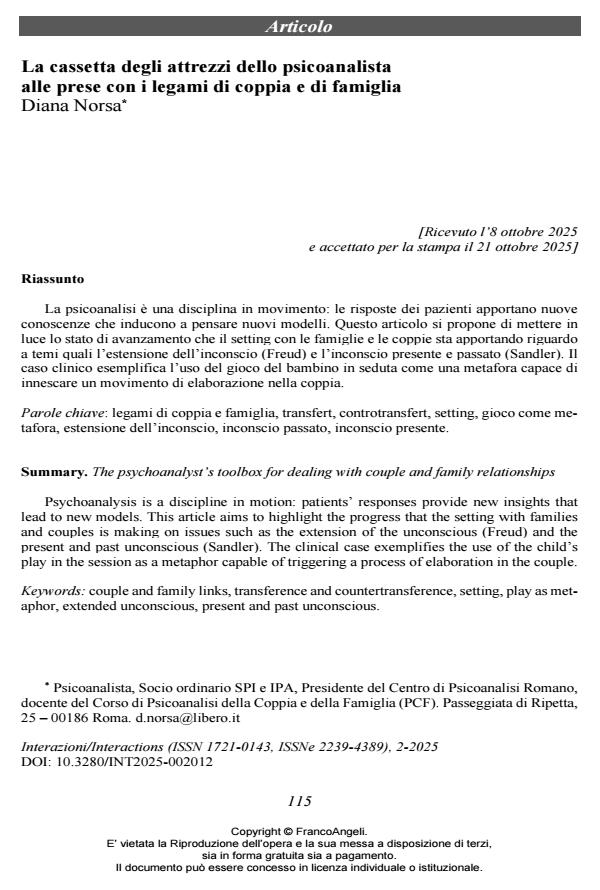
Below, you can see the article first page
If you want to buy this article in PDF format, you can do it, following the instructions to buy download credits
FrancoAngeli is member of Publishers International Linking Association, Inc (PILA), a not-for-profit association which run the CrossRef service enabling links to and from online scholarly content.
Psychoanalysis is a discipline in motion: patients’ responses provide new insights that lead to new models. This article aims to highlight the progress that the setting with families and couples is making on issues such as the extension of the unconscious (Freud) and the present and past unconscious (Sandler). The clinical case exemplifies the use of the child’s play in the session as a metaphor capable of triggering a process of elaboration in the couple.
Keywords: couple and family links, transference and countertransference, setting, play as metaphor, extended unconscious, present and past unconscious.
- Bastianini T., Ferruta A. (a cura di) (2018). La cura psicoanalitica contemporanea: l’estensione della psicoanalisi. Roma: Giovanni Fioriti.
- Bion W.R. (1961). Esperienze nei gruppi. Roma: Armando.
- Bollas C. (1995). Craking Up. London: Rutledge (tr. it. Craking Up. Milano: Raffaello Cortina).
- Bromberg P.M. (1992). The difficult patient or the difficult dyad? Some basic issues. Contemporary Psychoanalysis, 28, 3: 495-502.
- Etchegoyen R.H. (1986). I fondamenti della tecnica psicoanalitica. Roma: Astrolabio, 1990.
- Falci A. (2024). Il perturbante spettro del sessuale. Interazioni, 1, 59: 34-56. DOI: 10.3280/INT2024-00100
- Freud S. (1912). Consigli al medico nel trattamento psicoanalitico. OSF, vol. 6. Torino: Bollati Boringhieri.
- Freud S. (1938). Risultati, idee, problemi. OSF, vol. 11. Torino: Bollati Boringhieri.
- Joseph B. (1985). Tranference: the total situation. International Journal of Psychoanalysis, 66, 4: 447-454.
- Kaës R. (2007) Un singulier pluriel. Paris: Dunod (tr. it. Un singolare plurale. Roma: Borla).
- Meltzer D. (1992). The Claustrum. Perthshire: Clunie Press (tr. it., Claustrum. Milano: Raffaello Cortina, 1993).
- Nicolò A.M., Norsa D. (2017). The italian approach to family and couple therapy. In Scharff D., Palacios E. (eds.), Family and couple psychoanalysis. London: Karnac.
- Norsa D., Zavattini G.C. Il Chiasma narcisistico nella coppia: fra intimità sessuale e depotenziamento dell’altro. In stampa
- Ogden T.H., Di Donna L. (2013). Thomas H. Ogden in conversation with Luca Di Donna. Rivista di Psicoanalisi, 59, 3: 625-641.
- Rosenfeld H. (1987). Impasse and interpretation. Therapeutic and anti-therapeutic factors in the psychoanalytic treatment of psychotic, borderline, and neurotic patients. London: Rutledge (tr. it. Comunicazione e interpretazione. Torino: Bollati Boringhieri, 1989).
- Sandler J., Sandler A.M. (1987). The past unconscious, the present unconscious and the vicissitudes of guilt. The International Journal of Psychoanalysis, 68: 331-341.
- Sauvayre P., Vegas M. (2016). An even hover-reading of Freud: The work of metaphor. The International Journal of Psychoanalysis, 97, 5: 1343-1367.
- Strachey J. (1934). La natura dell’azione terapeutica della psicoanalisi. Rivista di Psicoanalisi, 1, 20 (1974): 92-126.
- Vivier-Vacheret C. (2005). Configurations of link, group associative chain and diffraction of transference. Revue de Psychothérapie Psychanalytic de Groupe, 2, 45: 109-116.
Diana Norsa, La cassetta degli attrezzi dello psicoanalista alle prese con i legami di coppia e di famiglia in "INTERAZIONI" 2/2025, pp 115-131, DOI: 10.3280/INT2025-002012