Antropocene e decentramento dell’umano Un confronto tra Chakrabarty e Descola
Journal title SOCIETÀ DEGLI INDIVIDUI (LA)
Author/s Alessandro Mancuso
Publishing Year 2025 Issue 2025/83
Language Italian Pages 18 P. 55-72 File size 117 KB
DOI 10.3280/LAS2025-083005
DOI is like a bar code for intellectual property: to have more infomation
click here
Below, you can see the article first page
If you want to buy this article in PDF format, you can do it, following the instructions to buy download credits
FrancoAngeli is member of Publishers International Linking Association, Inc (PILA), a not-for-profit association which run the CrossRef service enabling links to and from online scholarly content.
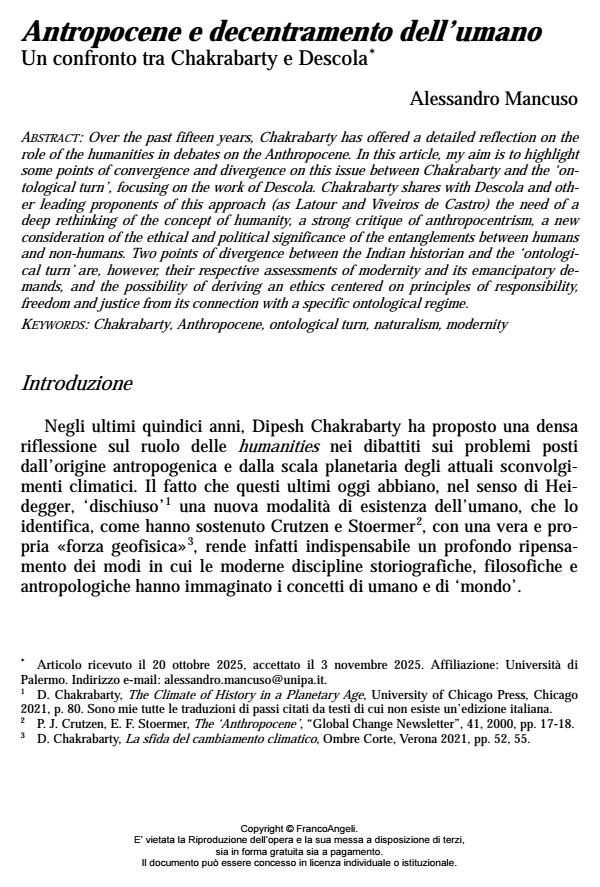
Over the past fifteen years, Chakrabarty has offered a detailed reflection on the role of the humanities in debates on the Anthropocene. In this article, my aim is to highlight some points of convergence and divergence on this issue between Chakrabarty and the ‘ontological turn’, focusing on the work of Descola. Chakrabarty shares with Descola and other leading proponents of this approach (as Latour and Viveiros de Castro) the need of a deep rethinking of the concept of humanity, a strong critique of anthropocentrism, a new consideration of the ethical and political significance of the entanglements between humans and non-humans. Two points of divergence between the Indian historian and the ‘ontological turn’ are, however, their respective assessments of modernity and its emancipatory demands, and the possibility of deriving an ethics centered on principles of responsibility, freedom and justice from its connection with a specific ontological regime.
Keywords: Chakrabarty, Anthropocene, ontological turn, naturalism, modernity
Alessandro Mancuso, Antropocene e decentramento dell’umano Un confronto tra Chakrabarty e Descola in "SOCIETÀ DEGLI INDIVIDUI (LA)" 83/2025, pp 55-72, DOI: 10.3280/LAS2025-083005