Mountain therapy and pathological addictions
Journal title RIVISTA SPERIMENTALE DI FRENIATRIA
Author/s Livio Picchetto, Francesca Sireci, Gloria Bizzarri4, Valentina Moretti, Paolo Di Benedetto
Publishing Year 2025 Issue 2025/3
Language Italian Pages 15 P. 27-41 File size 669 KB
DOI 10.3280/RSF2025-003003
DOI is like a bar code for intellectual property: to have more infomation
click here
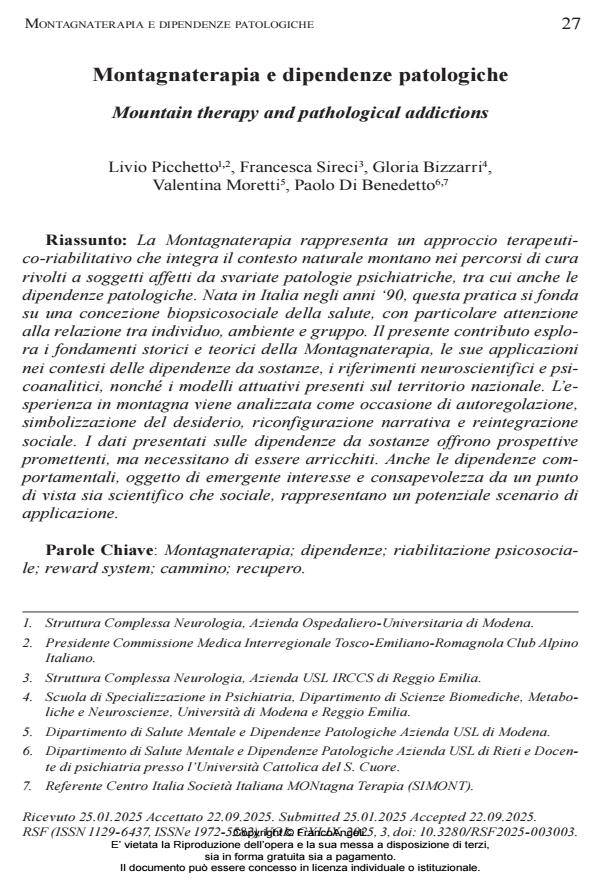
Below, you can see the article first page
If you want to buy this article in PDF format, you can do it, following the instructions to buy download credits
FrancoAngeli is member of Publishers International Linking Association, Inc (PILA), a not-for-profit association which run the CrossRef service enabling links to and from online scholarly content.
Mountain Therapy is a therapeutic and rehabilitative approach that integrates the natural mountain environment into care pathways for individuals affected by different psychiatric disorders, among which pathological addictions. Originating in Italy in the 1990s, this practice is grounded in a biopsychosocial concept of health, with particular attention to the relationship between the individual, the environment, and the group. This contribution explores the historical and theoretical foundations of Mountain Therapy, its applications in the treatment of substance use disorders, its neuroscientific and psychoanalytic underpinnings, as well as the implementation models currently active across the national territory. The mountain experience is analyzed as an opportunity for emotional selfregulation, symbolization of desire, narrative reconfiguration, and social reintegration. The available data on substance use disorders suggest promising perspectives, although further research is needed. Behavioral addictions, which are gaining increasing scientific and social attention, also represent a potential field of application currently under exploration.
Keywords: Mountain therapy; addictions; psychosocial rehabilitation; reward system; walking; recovery
Livio Picchetto, Francesca Sireci, Gloria Bizzarri4, Valentina Moretti, Paolo Di Benedetto, Montagnaterapia e dipendenze patologiche in "RIVISTA SPERIMENTALE DI FRENIATRIA" 3/2025, pp 27-41, DOI: 10.3280/RSF2025-003003