The impact of long-distance walking on mental health: The Case Study of Via Vandelli
Journal title RIVISTA SPERIMENTALE DI FRENIATRIA
Author/s Giorgio Mattei
Publishing Year 2025 Issue 2025/3
Language Italian Pages 20 P. 155-174 File size 701 KB
DOI 10.3280/RSF2025-003008
DOI is like a bar code for intellectual property: to have more infomation
click here
Below, you can see the article first page
If you want to buy this article in PDF format, you can do it, following the instructions to buy download credits
FrancoAngeli is member of Publishers International Linking Association, Inc (PILA), a not-for-profit association which run the CrossRef service enabling links to and from online scholarly content.
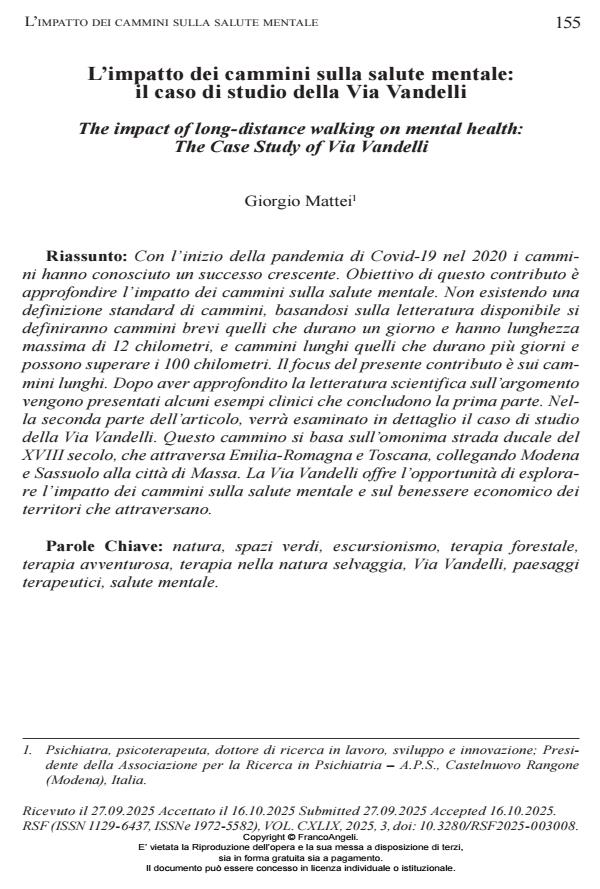
With the onset of the Covid19 pandemic in 2020, longdistance walks experienced growing popularity. The aim of this contribution is to explore the impact of longdistance walks on mental health. Since there is no standard definition of longdistance walks, building on available literature a distinction will be made between short longdistance walks, i.e. those lasting one day and with a maximum length of 12 kilometers, and long longdistance walks, i.e. those lasting several days and potentially exceeding 100 kilometers. This paper focuses on long longdistance walks. After reviewing the scientific literature on the subject, some clinical vignettes are presented, which conclude the first part of the contribution. In the second part of the article, the case study of the Via Vandelli longdistance walk will be examined in depth. This route is based on the eponymous eighteenthcentury ducal road, which crosses EmiliaRomagna and Tuscany, connecting Modena and Sassuolo to the city of Massa. The Via Vandelli offers the opportunity to explore the impact of longdistance walks on mental health and the economic health of the territories they traverse.
Keywords: nature, green spaces, hiking, forest therapy, adventure therapy, wilderness therapy, Via Vandelli, therapeutic landascapes, mental health
Giorgio Mattei, L’impatto dei cammini sulla salute mentale: il caso di studio della Via Vandelli in "RIVISTA SPERIMENTALE DI FRENIATRIA" 3/2025, pp 155-174, DOI: 10.3280/RSF2025-003008