Dealing with the crimes of colonialism in recent international agreements
Journal title SOCIETÀ E STORIA
Author/s Alessandro Bufalini
Publishing Year 2025 Issue 2025/190
Language Italian Pages 23 P. 831-853 File size 217 KB
DOI 10.3280/SS2025-190004
DOI is like a bar code for intellectual property: to have more infomation
click here
Below, you can see the article first page
If you want to buy this article in PDF format, you can do it, following the instructions to buy download credits
FrancoAngeli is member of Publishers International Linking Association, Inc (PILA), a not-for-profit association which run the CrossRef service enabling links to and from online scholarly content.
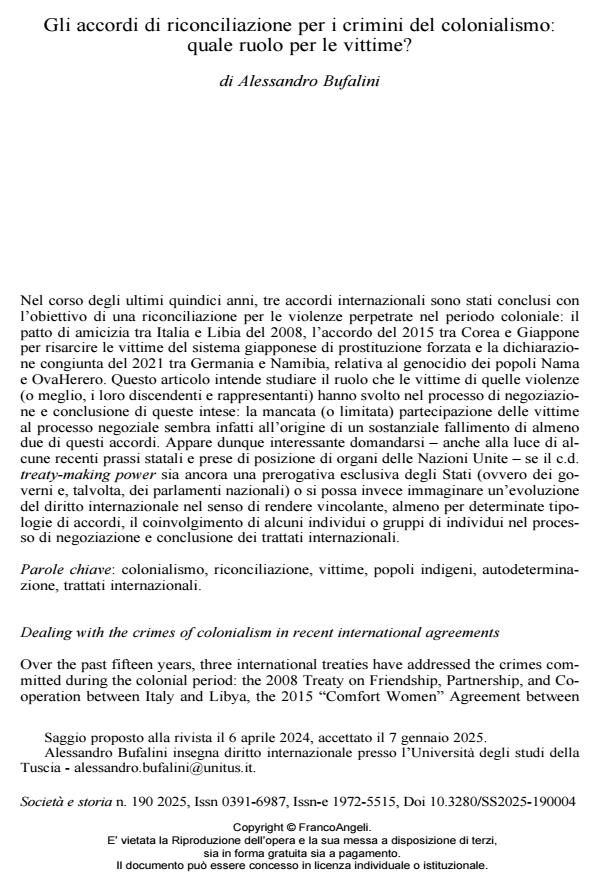
Over the past fifteen years, three international treaties have addressed the crimes committed during the colonial period: the 2008 Treaty on Friendship, Partnership, and Cooperation between Italy and Libya, the 2015 “Comfort Women” Agreement between Korea and Japan, and the 2021 Joint Declaration between Germany and Namibia concerning the genocide of the Nama and OvaHerero peoples. This paper aims to examine the involvement, or lack thereof, of the victims (or their heirs and representatives) in the negotiation processes of these agreements. The limited participation of victims in treaty negotiations probablly contributed to significant shortcomings in at least two of these cases. Therefore, it is important to investigate whether treatymaking power solely resides with States or if there is a potential role for specific groups of individuals in the treatymaking process.
Keywords: colonialism, reconciliation, victims, indigenous peoples, selfdetermination, treaties.
Alessandro Bufalini, Gli accordi di riconciliazione per i crimini del colonialismo: quale ruolo per le vittime? in "SOCIETÀ E STORIA " 190/2025, pp 831-853, DOI: 10.3280/SS2025-190004