Rethinking the pre-­capitalist economies of the Mediterranean. Economic models in Chris Wickham’s L’asino e il battello

Journal title SOCIETÀ E STORIA
Author/s Paolo Grillo, Luigi Provero, Michele Campopiano
Publishing Year 2025 Issue 2025/190
Language Italian Pages 41 P. 855-895 File size 524 KB
DOI 10.3280/SS2025-190005
DOI is like a bar code for intellectual property: to have more infomation click here

Below, you can see the article first page

If you want to buy this article in PDF format, you can do it, following the instructions to buy download credits
Article preview

FrancoAngeli is member of Publishers International Linking Association, Inc (PILA), a not-for-profit association which run the CrossRef service enabling links to and from online scholarly content.

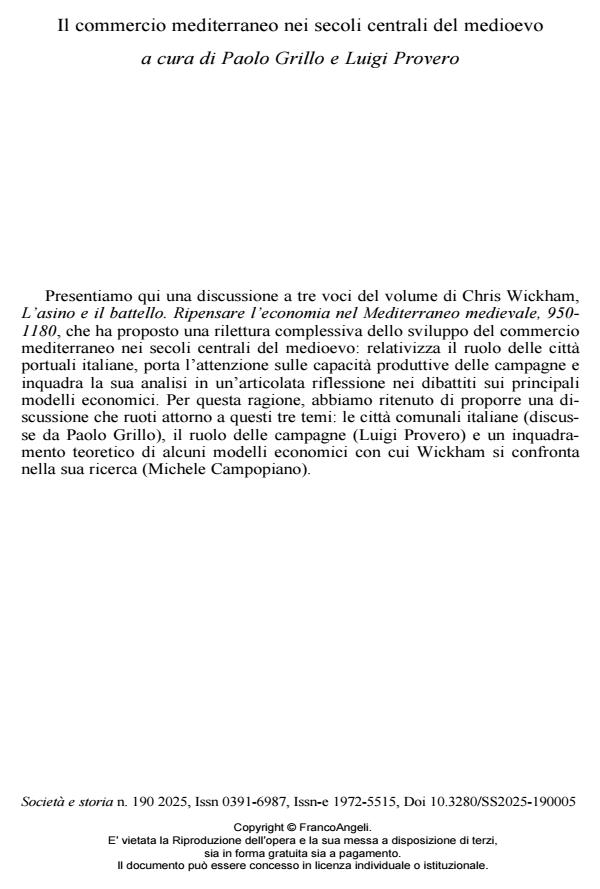
This article highlights the historiographical and theoretical foundations of Chris Wickham’s critique of economic historiography that assesses the “prosperity” of an economy based on the participation of certain regions or countries in longdistance trade, as well as his criticism of Roberto Sabatino Lopez’s notion of a “commercial revolution” in the Middle Ages. Wickham’s critique is part of broader debates in economic history inspired by British Marxist historiography, particularly the social history studies associated with the journal Past & Present and the Dobb–Sweezy debate on the transition from feudalism to capitalism. Following the ideas of Maurice Dobb and Rodney Hilton, Wickham emphasizes the role of small producers and, consequently, regional trade in the development of economic complexity, linking economic transformations to class struggle between lords and producers. This approach makes it possible to identify the internal logic of the feudal mode of production and to understand the primary driving force behind Mediterranean economies in the Middle Ages.

Keywords: commercial revolution, mode of production, regional exchange, class struggle, economic transition.

  1. Amin S. (1973), Le développement inégal. Essai sur les formations sociales du capitalisme périphérique, Paris, Les Editions de minuit.
  2. Amin S. (1974), Modes of Production and Social Formations, in «Ufahamu: A Journal of African Studies», 4, 3, pp. 5785.
  3. Amin S. (2009), Eurocentrism, New York, Monthly Review Press.
  4. Banaji J. (2010), Theory as History. Essays on Modes of Productiona and Exploitation, Leiden, Brill.
  5. Bavel B. J.P. van (2016), The Invisible Hand? How Market Economies Have Emerged and Declined since AD 500, Oxford, Oxford University Press.
  6. Campopiano M. (2022), Il capitalismo commerciale. Nuove riflessioni su un vecchio tema a partire dal recente libro di Jairus Banaji, in «Rivista Storica Italiana», 134, pp. 249258.
  7. Dobb M. (1974), Problemi di storia del capitalismo, Roma, Editori Riuniti.
  8. Dobb M. (1978a), A reply, in The Transition from Feudalism to Capitalism, a cura di Rodney Hilton, London, Verso, pp. 5767.
  9. Dobb M. (1978b), A further comment, in The Transition from Feudalism to Capitalism, a cura di Rodney Hilton, London, Verso, pp. 98101.
  10. Duby G. (1973), Guerriers et paysans, VIIIeXIIe siècles. Premier essor de l’économie européenne, Paris, Gallimard
  11. Epstein S. R. (2007), Rodney Hilton, Marxism and the transition from feudalism to capitalism, in Rodney Hilton’s Middle Ages: An Exploration of Historical Themes, a cura di Ch. Dyer, P. Coss e Ch. Wickham, «Past and present», 195, 2, pp. 248–269..
  12. Greif A. (2006), Institutions and the path to the modern economy: lessons from medieval trade, Cambridge, Cambridge University Press.
  13. Haldon J. (1993), The State and the Tributary Mode of Production, LondonNew York, Verso.
  14. Hill Ch. (1961), The Century of Revolution, 16031714, Edinburgh, Nelson.
  15. Hilton R. (1990), Class conflict and the crisis of feudalism, LondonNew York, Verso. Kula W. (1970), Teoria economica del Sistema feudale. Proposta di un modello, Tori no, Einaudi.
  16. Lopez R. S. (1976), The Commercial Revolution of the Middle Ages, 9501350, Englewood Cliffs, New Jersey, Prentice Hall.
  17. Pirenne H. (1937), Mahomet et Charlemagne, Bruxelles, Alcan, Paris.
  18. Polanyi K. (1948), Review of M.H. Dobb, Studies in the development of capitalism, New York 1947, in «Journal of Economic History», 8, pp. 206207.
  19. Polanyi K. (1957), The Economy as Instituted Process, in Trade and Market in the Early Empires. Economies in History and Theory, a cura di K. Polanyi, C.M. Arensberg e H.W. Pearson, Glencoe, Illinois, The Free Press, pp. 243270.
  20. Polanyi K. (2024), The Great Transformation. The Political and Economic Origins of Our Time, London, Penguin.
  21. Sofri G. (1969), Il modo di produzione asiatico. Storia di una controversa marxista, Torino, Einaudi.
  22. Sweezy P. (1978a), A Critique, in The Transition from Feudalism to Capitalism, a cura di Rodney Hilton, London, Verso, pp. 3356.
  23. Sweezy P. (1978b), A Rejoinder, in The Transition from Feudalism to Capitalism, a cura di Rodney Hilton, London, Verso, pp. 102108.
  24. Tangheroni M. (1996), Commercio e navigazione nel Medioevo, RomaBari, Laterza.
  25. Tedesco P. (2022), How Marxists View the Middle Ages, in «Jacobin»;; disponibile al seguente URL: https://jacobin.com/2022/04/marxismmiddleagesmedievalantiquityeconomictheoryhistorycapitalism (ultima consultazione: 13/10/2024), ora anche in: Tedesco P. (2024), Writings on the Tributary State and Commercial Capitalism, Napoli, Edizioni Scientifiche Italiane, pp. 6579.
  26. Wallerstein I. (1974), The Modern World System: Capitalist Agriculture and the Origins of the European World Economy in the Sixteenth Century, New York, Academic Press.
  27. Wallerstein I. (2004), WorldSystems Analysis: An Introduction, Durham, NC, Duke University Press.
  28. Wickham Ch. (1984), The other Transition: from the Ancient World to Feudalism, in «Past and Present», 103, pp. 336.
  29. Wickham Ch. (2005), Framing the Early Middle Ages: Europe and the Mediterranean 400–800, Oxford, Oxford University Press.
  30. Wickham Ch. (2007), Conclusions, in Rodney Hilton’s Middle Ages: An Exploration of Historical Themes, a cura di Ch. Dyer, P. Coss e Ch. Wickham, «Past and present», 195, 2, pp. 304316.
  31. Wickham Ch. (2008), Productive Forces and the Economic Logic of the Feudal Mode of Production, in «Historical Materialism», 16, 2, pp. 322.
  32. Wickham Ch. (2009), Le società dell’alto medioevo. Europa e Mediterraneo, secoli VVIII, a cura di Alessio Fiore e Luigi Provero, Roma, Viella
  33. Wickham Ch. (2013), Roma medievale. Crisi e stabilità di una città, 9001150, Roma, Viella.
  34. Wickham Ch. (2024), L’asino e il battello. Ripensare l’economia del Mediterraneo medievale, 9501180, Roma, Viella.

Paolo Grillo, Luigi Provero, Michele Campopiano, Il commercio mediterraneo nei secoli centrali del medioevo / Ripensare le economie precapitalistiche del Mediterraneo. Modelli economici nell’Asino e il battello di Chris Wickham in "SOCIETÀ E STORIA " 190/2025, pp 855-895, DOI: 10.3280/SS2025-190005