La formazione di una nuova generazione di psicoterapeuti come priorità per la sanità pubblica

Journal title TERAPIA FAMILIARE
Author/s Angelo Barbato
Publishing Year 2026 Issue 2025/139
Language Italian Pages 9 P. 29-37 File size 114 KB
DOI 10.3280/TF2025-139002
DOI is like a bar code for intellectual property: to have more infomation click here

Below, you can see the article first page

If you want to buy this article in PDF format, you can do it, following the instructions to buy download credits
Article preview

FrancoAngeli is member of Publishers International Linking Association, Inc (PILA), a not-for-profit association which run the CrossRef service enabling links to and from online scholarly content.

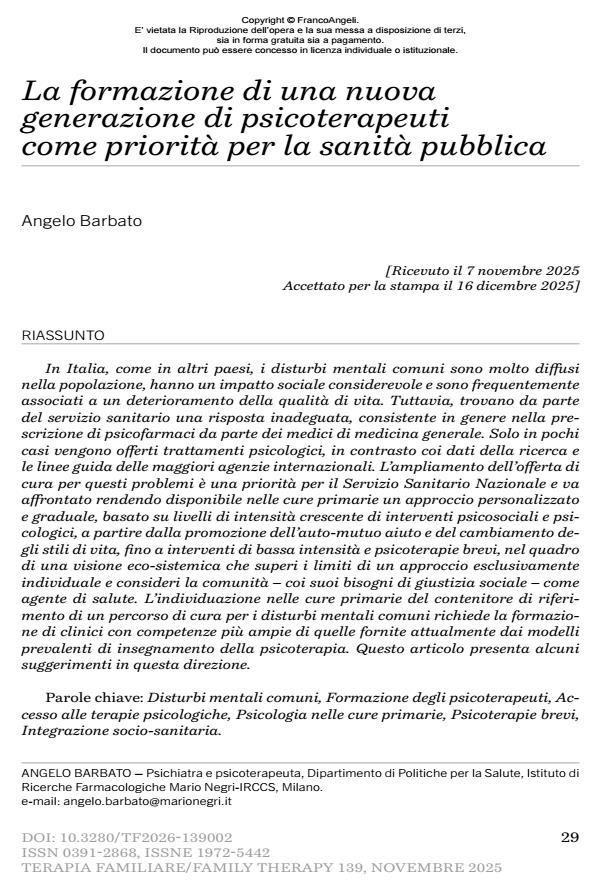
In Italy and elsewhere the common mental disorders are widespread in the population and are often associated with heavy social burden and low quality of life. However, the response of the health system is inadequate, inasmuch as is mainly based on prescription of psychotropic drugs by general practitioners. In few cases psychological treatments are offered, despite the research findings and the guidelines of most international agencies. Widening the healthcare offer for such problems is a public health priority. It requires the availability in primary care of a personalized and stepped approach based on a growing intensity of psychosocial and psychological interventions, ranging from selfhelp to lifestyle changes up to low intensity treatment and brief psychotherapies. Care should be delivered in the framework of an ecosystemic view, overcoming a narrow individual approach by considering the needs for social justice of communities as change agents. The focus on primary care as the setting for a care pathway aimed to common mental disorders, asks for the training of clinicians with broad skills not provided by current prevailing models of training in psychotherapy. This paper will present some suggestions in this direction.

Keywords: Common mental disorders, Training in psychotherapy, Access to psychological treatments, Psychology in primary care, Brief psychotherapies, Social and health care integration.

  1. Barbato A. & D’Avanzo B. (2020). The findings of a Cochrane metaanalysis of couple therapy in adult depression: Implications for research and clinical practice. Family Process, 59(2): 361375.
  2. Barbui C., Dua T., Harper M., Tablante E.C., Thornicroft G. & Saxena S. (2015).
  3. Using GRADE to update WHO recommendations for MNS. Lancet Psychiatry, 2(12): 10541056. DOI: 10.1016/S22150366(15)004563
  4. Caregnato Tosetto F. (2025). Ottimizzare la rete di sostegno come risorsa personale. Terapia Familiare, 48(137): 520. DOI: 10.3280/TF2025137001
  5. Carr A. (2025). Couple therapy and systemic interventions for adultfocused problems: The evidence base. Journal of Family Therapy, 47(1): e12481. DOI: 10.1111/14676427.12225
  6. Çitak S., Avci S.H. & Kahraman B.B. (2021). The effectiveness of shortterm psychodynamic psychotherapy in depression and anxiety disorders. Psychodynamic Practice, 27(4): 372383.
  7. Cuijpers P., de Wit L., Kleiboer A., Karyotaki E. & Ebert D.D. (2018). Problemsolving therapy for adult depression: an updated metaanalysis. European Psychiatry, 48(1): 2737.
  8. Cuijpers P., Miguel C., Harrer M., Plessen C.Y., Ciharova M., Ebert D. & Karyotaki
  9. E. (2023). Cognitive behavior therapy vs. control conditions, other psychotherapies, pharmacotherapies and combined treatment for depression: A comprehensive metaanalysis including 409 trials with 52,702 patients. World Psychiatry, 22(1): 105115.
  10. Darwiche J., Carneiro C., Vaudan C., Imesch C., Eira Nunes C., Favez N., de Roten Y. (2022). Parents in couple therapy: An intervention targeting marital and coparenting relationships. Family Process, 61(2): 490506.
  11. GBD 2019 Mental Disorders Collaborators. (2022). Global, regional, and national burden of 12 mental disorders in 204 countries and territories, 19902019: a systematic analysis for the Global Burden of Disease Study 2019. Lancet Psychiatry, 9(2): 137150. DOI: 10.1016/S22150366(21)003953
  12. Gigantesco A. (2021). Prospettiva di accesso alle cure per i disturbi mentali comuni. Rivista di Psichiatria, 56(3): 167170. DOI: 10.1708/3635.36158
  13. Gruppo di lavoro “Consensus sulle terapie psicologiche per ansia e depressione” (2022). Consensus Conference sulle terapie psicologiche per ansia e depressione. Roma: Istituto Superiore di Sanità, Consensus ISS 1/2022.
  14. Leichsenring F., Steinert C., Rabung S. & Ioannidis J.P. (2022). The efficacy of psychotherapies and pharmacotherapies for mental disorders in adults: an umbrella review and metaanalytic evaluation of recent metaanalyses. World Psychiatry, 21(1): 133145.
  15. Mariotti S., Simon G. & Francescutti C. (2003). Il Global Burden of Disease. Analisi di una metodologia per valutare lo stato di salute delle popolazioni. Tendenze Nuove, 3(2): 203. DOI: 10.1450/8788
  16. McHugh R.K., Whitton S.W., Peckham A.D., Welge J.A. & Otto M.W. (2013). Patient preference for psychological vs pharmacologic treatment of psychiatric disorders: a metaanalytic review. Journal of Clinical Psychiatry, 74(6): 13979.
  17. Menear M., Girard A., Dugas M., Gervais M., Gilbert M. & Gagnon M.P. (2022). Personalized care planning and shared decision making in collaborative care programs for depression and anxiety disorders: A systematic review. PLoS One, 17(6): e0268649.
  18. Monzio Compagnoni M., Caggiu G., Allevi L., Barbato A., Carle F., D’Avanzo B., Di Fiandra T., Ferrara L., Gaddini A., Giordani C., Sanza M., Saponaro A., Scondotto S., Tozzi V.D., Corrao G. & Lora A. (2023). Assessment and monitoring of the quality of clinical pathways in patients with depressive disorders: results from a Multiregional Italian Investigation on Mental Health Care Quality (the QUADIM Project). Journal of Clinical Medicine, 12(9): 3297.
  19. Naghavi M., GBD 2021 Italy Subnational Burden of Disease Collaborators (2025). State of health and inequalities among Italian regions from 2000 to 2021: a systematic analysis based on the Global Burden of Disease Study 2021. Lancet Public Health, 10(4): e309e320. DOI: 10.1016/S24682667(25)000453
  20. Palacios J., Adegoke A., Wogan R., Duffy D., Earley C., Eilert N., Enrique A., Sollesse S., Chapman J., & Richards D. (2023). Comparison of outcomes across lowintensity psychological interventions for depression and anxiety within a steppedcare setting: A naturalistic cohort study using propensity score modelling. British Journal of Psychology, 114(2): 299314.
  21. Pauling N. (2023). Addressing social determinants of mental health in therapy: A thematic synthesis. Counselling and Psychotherapy Research, 23: 982994.
  22. Russo P.L. (2025). L’uso degli psicofarmaci in Italia: focus sui dati del Rapporto OSMED. Roma: Agenzia Italiana del Farmaco.
  23. Sass S.M., Early L.M., Long L., Burke A., Gwinn D. & Miller P. (2019). A brief mindfulness intervention reduces depression, increases nonjudgment, and speeds processing of emotional and neutral stimuli. Mental Health & Prevention, 13: 5867.
  24. Wakefield S., Kellett S., SimmondsBuckley M., Stockton D., Bradbury A. & Delgadillo J. (2021). Improving Access to Psychological Therapies (IAPT) in the United Kingdom: A systematic review and metaanalysis of 10years of practicebased evidence. British Journal of Clinical Psychology, 60(1): 137.

Angelo Barbato, La formazione di una nuova generazione di psicoterapeuti come priorità per la sanità pubblica in "TERAPIA FAMILIARE" 139/2025, pp 29-37, DOI: 10.3280/TF2025-139002