“When a chair is empty”. The complexity of assessing parenting skills in the absence of the child

Journal title TERAPIA FAMILIARE
Author/s Ilaria Di Vecchio, Franco Della Maggiora, Daniela Merciadri, Ilaria Genovesi
Publishing Year 2026 Issue 2025/139
Language Italian Pages 19 P. 63-81 File size 144 KB
DOI 10.3280/TF2025-139004
DOI is like a bar code for intellectual property: to have more infomation click here

Below, you can see the article first page

If you want to buy this article in PDF format, you can do it, following the instructions to buy download credits
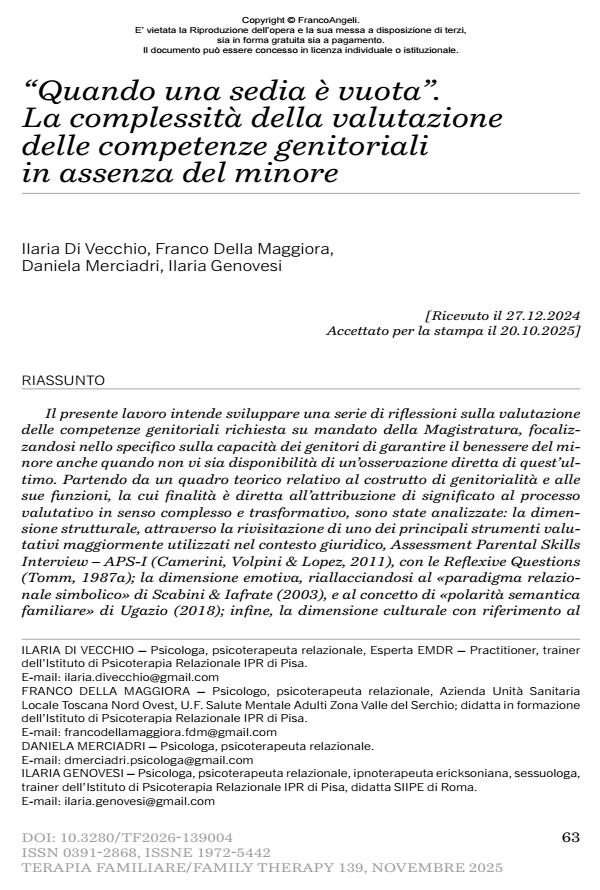
Article preview

FrancoAngeli is member of Publishers International Linking Association, Inc (PILA), a not-for-profit association which run the CrossRef service enabling links to and from online scholarly content.

This work aims to develop a series of reflections on the assessment of parental competence mandated by the Judiciary, specifically focusing on parents’ ability to ensure the wellbeing of the child even when direct observation of the child is not possible. Starting from a theoretical framework related to the concept of parenting and its functions – whose purpose is to give meaning to the evaluation process in a complex and transformative sense – the following dimensions have been analyzed: the structural dimension, through a review of one of the most widely used assessment tools in the legal context, the Assessment Parental Skills Interview (APSI) (Camerini, Volpini & Lopez, 2010), with Reflexive Questions (Tomm, 1987); the emotional dimension, drawing on the symbolic relational paradigm by Scabini and Iafrate (2003), and the concept of family semantic polarities by Ugazio (2018); finally, the cultural dimension, with reference to the model of cybernetics of prejudices (Cecchin, Lane & Ray, 1997), linked to the anthropological and ethnopsychiatric perspective.

Keywords: parenting, protection, culture, emotion, structure, complexity.

  1. Sameroff A.J. (2009). The transactional model of development: How children and contexts shape each other. Washington DC: American Psychological Association. DOI: 10.1037/11877000
  2. Abidin R.R. (1983). Parenting Stress IndexManual. Charlottesville: Pediatric Psychology Press.
  3. Abidin R.R. & Konold T.R. (1999). Parenting Alliance Measure (PAM). Odessa: Psychological Assessment Resources.
  4. Ammaniti M. (2016). La famiglia adolescente. RomaBari: Laterza.
  5. Arnold D.S., O’Leary S.G., Wol L.S. & Acker M.M. (1993). The Parenting Scale: A measure of dysfunctional parenting and discipline situations. Psychological Assessment, 5: 132144. DOI: 10.1037/10403590.5.2.13
  6. BoszormenyiNagy I. & Spark G.M. (1973). Invisibile Loyalties. Reciprocity in Intergenerational Family Therapy. New York: Harper & Row (trad. it.: Lealtà invisibili. La reciprocità nella terapia familiare intergenerazionale. Roma: Astrolabio, 1988).
  7. ByngHall J. (1998). Le trame della famiglia. Milano: Raffaello Cortina.
  8. Camerini G.B., Volpini L. & Lopez G. (2011). Manuale di valutazione delle capacità genitoriali, vol. 1. Santarcangelo di Romagna: Maggioli Editore.
  9. Cecchin G., Lane G. & Ray W.A. (1997). Verità e pregiudizi. Milano: Raffaello Cortina.
  10. Cigoli V. (1994). Fabula e intreccio. Transizione familiare e temporalità familiare. In: Scabini E. & Donati P. (a cura di), Tempo e transizioni familiari (pp. 3146) Milano: Vita e Pensiero.
  11. Coppo P. (2003). Tra psiche e culture: elementi di etnopsichiatria. Torino: Bollati Boringhieri.
  12. Coppo P. (2006). Attaccamenti, identità, dipendenze. I fogli di Oriss, 26: 89100.
  13. Coppo P. (2013). Le ragioni degli altri. Etnopsichiatria, etnopsicoterapie. Milano: Raffaello Cortina.
  14. Coppo P. (2015). Gli altri, noi, la pace necessaria. Disponibile su: itempinuovi.wordpress.com/2015/06/01/pierocoppoglialtrinoilapacenecessaria/.
  15. Davies B. & Harré R. (1990). Positionings: The discursive production of selves. Journal for the Theory of Social Behaviour, 20(1): 4363.
  16. Devereux G. (1973). Essais d’ethnopsychiatrie générale. Paris: Gallimard.
  17. Di Blasio P. (2005). Tra rischio e protezione. La valutazione delle competenze parentali. Milano: Unicopli Edizioni.
  18. Frick P.J. (1991). The Alabama Parenting Questionnaire. Unpublished rating scale. Tuscaloosa: University of Alabama.
  19. Gardon M. (2022). La valutazione della recuperabilità delle competenze genitoriali. Maltrattamento e abuso all’infanzia, 1: 87103.
  20. Angeles: Western psychological services.
  21. Harré R. & Van Langenhove L. (1999). Positioning theory. Moral contexts of intentional action. Oxford: Blackwell Publishers.
  22. Hermans H.J.M. (2001). The construction of a personal position repertoire: method and practice. Culture & Psychology, 7: 323366. DOI: 10.1177/1354067X0173005
  23. Hollway W. (1994). Beyond sex differences: a project for femminist psychology. Femminism & Psychology, 4(4): 538546. DOI: 10.1177/0959353594044008
  24. Hurley K.D., HuscroftD’Angelo J., Trout A., Griffith A. & Epstein M. (2014). Assessing parenting skills and attitudes: a review of psychometrics of parenting measures. Journal of Child Family Studies, 23: 812823.
  25. Ielpo F. (2015). La genitorialità come momento di riorganizzazione della narrativa familiare. Psicoterapeuti informazione, 15: 5085. Disponibile su: www.psicoterapeutiinformazione.it/.
  26. Latour B. (2000). Factures/fracture. De la notion de réseau à celle d’attachment. In: Micoud A., Pironi M. (a cura di), Ce qui nous relie (pp. 4366). La Tour d’Aigues (trad. it. In: I fogli di Oriss, 2006, pp. 1131).
  27. LuciusHoene G. & Deppermann A. (2000). Narrative Identity Empiricized: a dialogical and positioning approach to autobiographical research interviews. Narrative Inquiry, 10(1): 199222.
  28. McHale J.P. (2010). La sfida della cogenitorialità. Milano: Raffaello Cortina. Milner J. (1986). The child abuse potential inventory manual. Dekalb: Psytec Inc. Moro M.R. (1994). Parents en exil. Psychopathologie et migrations. Paris: Press Universitaires de France.
  29. Nathan T. (1993). Principes d’ethnopsychanalyse. Grenoble: La Pensée sauvage.
  30. Nathan T. (2001). Nous ne sommes pas seuls au monde. Paris: Les Empêcheurs de penser en rond.
  31. Pedrocco Biancardi M.T. & Talevi A. (2011). La voce dei bambini nel percorso di tutela: aspetti psicologici, sociali giuridici. Milano: FrancoAngeli.
  32. Pisani L. (2020). Pratiques de médiation ethnoclinique en Toscane. L’Autre, 1: 63 72.
  33. Reder D.P. & Lucey C. (1995). Assessment of parenting: psychiatric and psychological contributions. London: Routledge.
  34. Scabini E. & Cigoli V. (2012). Alla ricerca del famigliare. Il modello relazionalesimbolico. Milano: Raffaello Cortina.
  35. Scabini E. & Iafrate R. (2003). Psicologia dei legami familiari. Bologna: il Mulino. Seikkula J. & Arnkil T.E. (2013). Metodi dialogici nel lavoro di rete. Per la psicotera pia di gruppo, il servizio sociale e la didattica. Trento: Erickson.
  36. Sironi F. (2007). Psychopathologie des violences collectives. Essai de psychologie géopolitique clinique. Paris: Odile Jacob.
  37. Stern P., Dietz T. & Kalof L. (1993). Value orientations, gender, and environmental concern. Environment and Behavior, 25. DOI: 10.1177/0013916593255002
  38. Tafà E., Malagoli Togliatti M. (1998). L’attaccamento oltre l’infanzia: Continuità intergenerazionale e potenzialità evolutive del legame di coppia. Rassegna di Psicologia, 15(3): 528.
  39. Taliani S. (2014a). Il perito, il giudice e la bambinachenonmorirà. Minorigiustizia, 4: 158164. DOI: 10.3280/MG2014004018
  40. Taliani S. (2014b). Non esistono culture innocenti. Gli antropologi, le famiglie spossessate e i bambini adottabili. L’uomo, 2: 4565.
  41. Ugazio V. (1998). Storie permesse, storie proibite. Polarità semantiche familiari e psicopatologie. Milano: Raffaello Cortina.
  42. Ugazio V. (2012). Storie permesse, storie proibite. Polarità semantiche familiari e psicopatologie (nuova edizione ampliata, aggiornata e rivista). Milano: Raffaello Cortina.
  43. Ugazio V. (2018). Storie permesse, storie proibite. Polarità semantiche familiari e psicopatologie (edizione ampliata e aggiornata, con glossario e bibliografia 19912018). Torino: Bollati Boringhieri.
  44. Westh F. (2003). Parents Preference Test – PPT. Westh Development & Psykologisk (trad. it: La valutazione del Parenting. Il Parents Preference Test (PPT): Manuale d’uso, traduzione di R. Baiocco, F. Laghi & M. D’Alessio. Milano: LED Edizioni Universitarie, 2011).
  45. Wortham S. (2000). Interactional positioning and narrative selfconstruction. Narrative Inquiry, 10(1): 157184.

Ilaria Di Vecchio, Franco Della Maggiora, Daniela Merciadri, Ilaria Genovesi, “Quando una sedia è vuota”. La complessità della valutazione delle competenze genitoriali in assenza del minore in "TERAPIA FAMILIARE" 139/2025, pp 63-81, DOI: 10.3280/TF2025-139004