The phenomenological approach of Milton Erickson
Journal title IPNOSI
Author/s Mauro Lavalle
Publishing Year 2026 Issue 2025/2
Language Italian Pages 10 P. 49-58 File size 67 KB
DOI 10.3280/IPN2025-002004
DOI is like a bar code for intellectual property: to have more infomation
click here
Below, you can see the article first page
If you want to buy this article in PDF format, you can do it, following the instructions to buy download credits
FrancoAngeli is member of Publishers International Linking Association, Inc (PILA), a not-for-profit association which run the CrossRef service enabling links to and from online scholarly content.
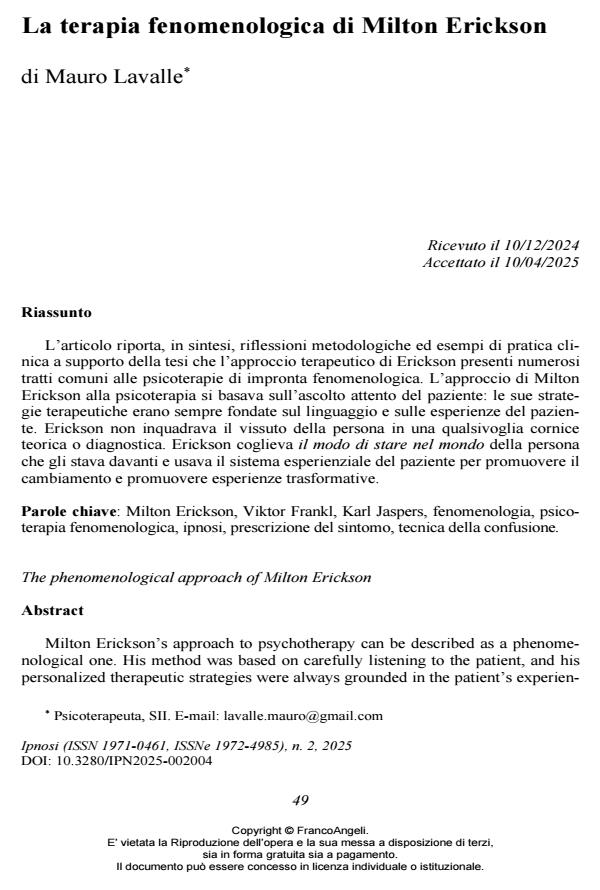
Milton Erickson’s approach to psychotherapy can be described as a phenomenological one. His method was based on carefully listening to the patient, and his personalized therapeutic strategies were always grounded in the patient’s experiential language. His humanity was evident in his ability to understand the individual’s existential reality, going beyond words to grasp the way the person in front of him existed in the world. Erickson used the patient’s experiential system to induce trance and promote change, viewing symptoms as part of the language the person used to navigate reality. His aim was to facilitate transformative experiences without framing the individual’s experience within any theoretical or diagnostic framework. Erickson can rightfully be considered one of the founders of phenomenological psychotherapy, on par with Karl Jaspers and other representatives of the European phenomenological school.
Keywords: Milton Erickson, Viktor Frankl, Karl Jaspers, Ludwig Binswanger, phenomenology, phenomenological psychotherapy, hypnosis, symptom prescription, confusion technique.
- Arciero G., Bondolfi G., Mazzola V. (2018). The Foundation of Phenomenological Psychotherapy. New York: Springer.
- Balogh L., Tanaka M, Török N., Vécsei L., TaguchiL. (2021). Crosstalk between Existential Phenomenological Psychotherapy and Neurological Sciences in Mood and Anxiety Disorders, Biomedicines, 9(4): 340.
- Binswanger L. (1970). La concezione freudiana dell’uomo alla luce dell’antro-pologia. In Binswanger L., a cura di, Per un’antropologia fenomenologica. Milano: Feltrinelli.
- Binswanger L. (1970). Sulla Fenomenologia. In Binswanger L., a cura di, Per un’antropologia fenomenologica. Milano: Feltrinelli.
- Erickson M.H., Rossi E.L., Ryan M.O., Sharp F.A. (1983). Guarire con l’ipnosi. Roma: Astrolabio.
- Erickson M.H., Rossi E.L. (1989). The February man. Evolving consciousness and identity in hypnotherapy. Canada: Brunner Mazel Publishers.
- Erickson M.H., Rossi E. (1980). Opere. Vol. IV. Roma: Astrolabio.
- Galimberti U. (2018). Nuovo Dizionario di Psicologia, Psichiatria, Psicoanalisi, Neuroscienze. Milano: Feltrinelli.
- Haley J. (2013). On Milton Erickson. London: Routledge.
- Haley J. (1976). Terapie non comuni. Roma: Astrolabio.
- Jaspers K. (2014). La cura della mente. Roma: Castelvecchi.
- Mecacci L. (2019). Storia della Psicologia dal Novecento ad oggi. Roma: Laterza.
- Megli D. (1998). Psicoterapie brevi. Milano: Red Edizioni.
- Rosen S. (1982). My voice will go with you. The teaching tales of Milton H. Erickson. New York: Norton & Company.
Mauro Lavalle, La terapia fenomenologica di Milton Erickson in "IPNOSI" 2/2025, pp 49-58, DOI: 10.3280/IPN2025-002004