The organization of local markets for news: the case of lombardy in italy

Journal title ECONOMIA E SOCIETÀ REGIONALE
Author/s Marco Gambaro
Publishing Year 2026 Issue 2025/3
Language Italian Pages 28 P. 139-166 File size 405 KB
DOI 10.3280/ES2025-003009
DOI is like a bar code for intellectual property: to have more infomation click here

Below, you can see the article first page

If you want to buy this article in PDF format, you can do it, following the instructions to buy download credits
Article preview

FrancoAngeli is member of Publishers International Linking Association, Inc (PILA), a not-for-profit association which run the CrossRef service enabling links to and from online scholarly content.

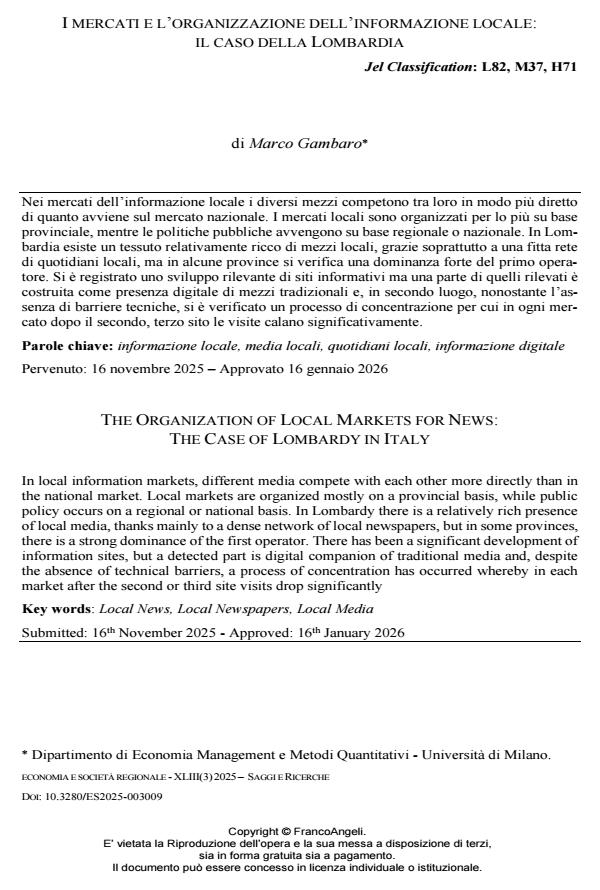
In local information markets, different media compete with each other more directly than in the national market. Local markets are organized mostly on a provincial basis, while public policy occurs on a regional or national basis. In Lombardy there is a relatively rich presence of local media, thanks mainly to a dense network of local newspapers, but in some provinces, there is a strong dominance of the first operator. There has been a significant development of information sites, but a detected part is digital companion of traditional media and, despite the absence of technical barriers, a process of concentration has occurred whereby in each market after the second or third site visits drop significantly

Keywords: Local News, Local Newspapers, Local Media

Jel codes: L82, M37, H71

  1. Passarelli G. (2012). Le tv locali dopo lo switch off. il Mulino. Rivista di cultura e di politica, 3: 548554.
  2. Pew Research Center (2016). Civic engagement strongly tied to local news habits. Report, November 3.
  3. Abernaty P.M. (2019). News Desert and Ghost Newspapers: Will Local News Survive?. Chapel Hill: University of North Carolina Hussman School of Journalism.
  4. Agcom (2018). Indagine conoscitiva sull’informazione locale. Allegato alla delibera n. 570/18/CONS.
  5. Ali C., Radcliffe D., Schmidt T., Donald R. (2020). Searching for Sheboygans: On the future of small market newspapers. Journalism, 2(4): 453471. DOI: 10.1177/1464884917749667
  6. Angelucci C., Cagé J., Sinkinson M. (2021). Media Competition and News Diets. WP 26782. Cambridge (MA): National Bureau of Economic Research <http://www.nber.org/papers/w26782>.
  7. Baker C.E. (2002). Media, Markets, and Democracy. Cambridge: Cambridge University Press.
  8. Balmer R. (2013). Entry and Competition in Local Newspaper Retail Markets. MPRA Paper n. 54079 <https://mpra.ub.unimuenchen.de/54079/>.
  9. Matherly T., Greenwood B. (2024). No news is bad news: Political corruption, news deserts, and the fourth estate. MIS Quarterly 48(2): 699714. DOI: 10.25300/MISQ/2023/17869
  10. Besley T., Burgess R. (2002). The Political Economy of Government Responsiveness: Theory and Evidence from India. The Quarterly Journal of Economics, 117(4): 14151451. DOI: 10.1162/003355302320935061
  11. Bush A. (2002). On the Substitutability of Local Newspapers, Radio, and Television Advertising in Local Business Sales. Media Bureau Staff Research Papers n.10. Washington, DC: Federal Communications Commission <Microsoft Word 21723.doc>.
  12. Capisani M.A. (2026). Giornali, dal 2026 al 2050 il loro futuro tra quotidiani locali e newsletter. Italia Oggi, 2 gennaio.
  13. Coyne C.J., Leeson P.T. (2004). Read all about it! Understanding the role of media in economic development. Kyklos, 57(1): 2144.
  14. Djourelova M., Durante R., Marti R. (2025). The Impact of Online Competition on Local Newspaper: Evidence from the Introduction of Crainglist. Review of Economic Studies, 92(3): 17381772.
  15. Drago F., Nannicini T., Sobbrio F. (2014). Meet the Press: How Voters and Politicians Respond to Newspaper Entry and Exit. American Economic Journal: Applied Economics, 6(3): 15988.
  16. Evans D.S. (2009). Twosided market definition. Journal of Competition Law & Economics, 3(1): 135.
  17. Fabbri L. (2004). Locale, locale, locale. Gli editori riscoprono le news locali, ma quella dimensione non è ancora percepita come business. Quali strategie per lo sviluppo editoriale. Problemi dell’informazione, XXIX(1): 74108. DOI: 10.1445/13155
  18. Ferrandi P. (2011). La via stretta dei quotidiani locali. Informazione e comunità nella provincia italiana. Problemi dell’informazione, XXXVI(1): 5260. DOI: 10.1445/34930
  19. Fu W.W. (2003). Multimarket contact of US newspaper chains: circulation competition and market coordination. Information Economics and Policy, 15(4): 501519. DOI: 10.1016/S01676245(03)000258
  20. Gao P., Lee C., Murphy D. (2020). Financing dies in darkness? The impact of newspaper closures on public finance. Journal of Financial Economics, 135(2): 445467.
  21. Gambaro M. (2009). La radio tra multimedialità e dimensione locale. Roma: Carocci Editore.
  22. Gennaioli N., La Porta R., LopezdeSilanes F., Shleifer A. (2014). Growth in Regions. Journal of Economic Growth, 19(3): 259309.
  23. Gentzkow M., Shapiro J., Sinkinson M. (2011). The Effect of Newspaper Entry and Exit on Electoral Politics. American Economic Review 101(7): 29803018.
  24. Goldfarb A. (2014). What is Different about Online Advertising?. Review of Industrial Organization, 44(2): 115129.
  25. Hayes D., Lawless J.L. (2015). As local news goes, so goes citizen engagement: Media, knowledge, and participation in US House elections. Journal of Politics, 77(2): 447462. DOI: 10.1086/679749
  26. Heese J., PérezCavazos G., Peter C.D. (2022). When the local newspaper leaves town: The effects of local newspaper closures on corporate misconduct. Journal of Financial Economics, 145(2): 445463.
  27. Kübler D., Goodman C. 2019). Newspaper markets and municipal politics: how audience and congruence increase turnout in local elections. Journal of Elections Public Opinion and Parties, 29(1): 120. DOI: 10.1080/17457289.2018.1442344
  28. Leone S., Della Mura M. (2022) L’informazione locale social e il reader engagement. Problemi dell’informazione, XLVII(2): 199224.
  29. Marrazzo F., (2020). Giornalismo locale market oriented. Identità professionali e culture organizzative tra informazione e comunicazione. Problemi dell’Informazione, XLV(3): 423449.
  30. Martin G.J., McCraig J. (2019). Local News and National Politics, American Political Science Review, 113(2): 372384. DOI: 10.1017/S0003055418000965
  31. Pickard V. (2020). Journalism’s Market Failure Is a Crisis for Democracy. Harvard Business Review, March 12 <https://hbr.org/2020/03/journalismsmarketfailureisacrisisfordemocracy>.
  32. Snyder J.M., Strömberg D. (2010). Press Coverage and Political Accountability. Journal of Political Economy, 118(2): 355408. DOI: 10.1086/652903
  33. Sorrentino C. (2002). Riflessioni intorno a un giornalismo mai nato. Informazione locale e società italiana. Problemi dell’informazione, XXVII(4): 504515. DOI: 10.1445/8037
  34. Tabellini G. (2010). Culture and Institutions: Economic Development in the Regions of Europe. Journal of the European Economic Association, 8(4): 677716.
  35. WahlJorgesen K. (2019). The challenge of local news provision. Journalism, 20(1): 163166. DOI: 10.1177/1464884918809281
  36. Weber M.S., Andringa P., Napoli P. (2019). Local News on Facebook. News Measure Research Project. Minneapolis: University of Minnesota Hubbard School of Journalism.

Marco Gambaro, Mercati e l’organizzazione dell’informazione locale: il caso della lombardia in "ECONOMIA E SOCIETÀ REGIONALE " 3/2025, pp 139-166, DOI: 10.3280/ES2025-003009