Parenting challenged by a child’s disability
Journal title SETTING
Author/s Albert Ciccone
Publishing Year 2026 Issue 2025/49
Language Italian Pages 21 P. 19-39 File size 104 KB
DOI 10.3280/SET2025-049002
DOI is like a bar code for intellectual property: to have more infomation
click here
Below, you can see the article first page
If you want to buy this article in PDF format, you can do it, following the instructions to buy download credits
FrancoAngeli is member of Publishers International Linking Association, Inc (PILA), a not-for-profit association which run the CrossRef service enabling links to and from online scholarly content.
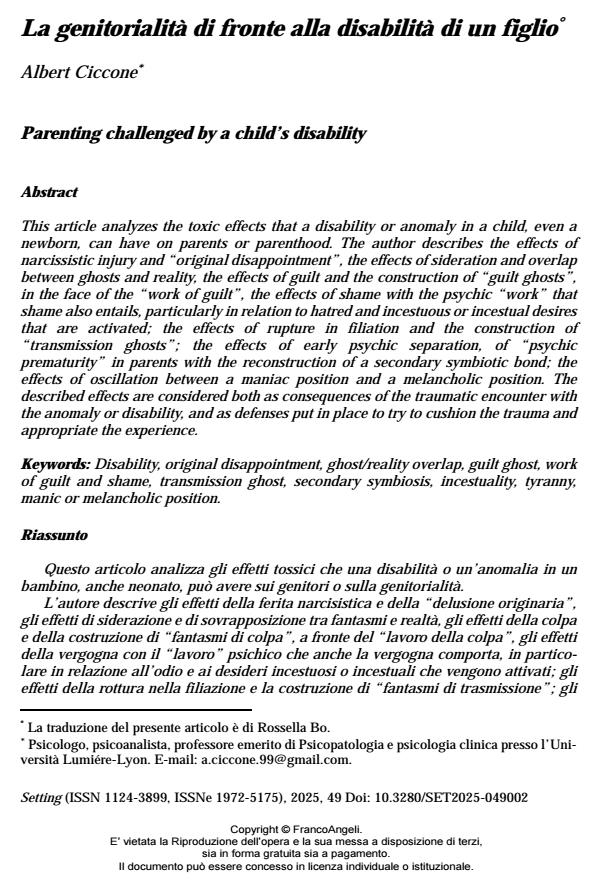
This article analyzes the toxic effects that a disability or anomaly in a child, even a newborn, can have on parents or parenthood. The author describes the effects of narcissistic injury and “original disappointment”, the effects of sideration and overlap between ghosts and reality, the effects of guilt and the construction of “guilt ghosts”, in the face of the “work of guilt”, the effects of shame with the psychic “work” that shame also entails, particularly in relation to hatred and incestuous or incestual desires that are activated; the effects of rupture in filiation and the construction of “transmission ghosts”; the effects of early psychic separation, of “psychic prematurity” in parents with the reconstruction of a secondary symbiotic bond; the effects of oscillation between a maniac position and a melancholic position. The described effects are considered both as consequences of the traumatic encounter with the anomaly or disability, and as defenses put in place to try to cushion the trauma and appropriate the experience.
Keywords: Disability, original disappointment, ghost/reality overlap, guilt ghost, work of guilt and shame, transmission ghost, secondary symbiosis, incestuality, tyranny, manic or melancholic position.
- Aulagnier P. (1975). La Violence de l’interprétation. Paris: PUF.
- Carel A. (2002). Le processus d’autorité – Approche clinique et métapsychologique. Groupal, 10: 7-38.
- Ciccone A. (1997). Empiétement imagoïque et fantasme de transmission. In: A. Eiguer (dir.). Le Générationnel. Approche en thérapie familiale psychanalytique. Paris: Dunod, pp. 151-185.
- Ciccone A. (2000). Travail du traumatisme et fantasme de transmission dans la rencontre avec le handicap. Le Divan familial, 5: 177-186.
- Ciccone A. (2003). Les enfants qui “poussent à bout”: logiques du lien tyrannique. In: A. Ciccone (dir.). Psychanalyse du lien tyrannique. Paris: Dunod, pp. 11-45.
- Ciccone A. (2007a). La transmission psychique à l’épreuve du handicap. In: A. Ciccone, S. Korff-Sausse, S. Missonnier et R. Scelles (dir.). Cliniques du sujet handicapé. Actualités des pratiques et des recherches. Toulouse: Éres, pp. 75-92.
- Ciccone A. (2007b). La tyrannie chez l’enfant porteur de handicap. Champ psychosomatique, 45: 35-51.
- Ciccone A. (2009a). Handicap du bébé et travail de la honte dans la famille. In: N. Presme, P. Delion et S. Missonnier (dir.). Les professionnels de la périnatalité accueillent le handicap. Toulouse: Érès, pp. 99-124.
- Ciccone A. (2009b). Potentialités incestuelles et mise en histoire générationnelle dans les contextes de handicap. Le Divan familial, 22: 67-80.
- Ciccone A. (2010). Le handicap, l’altérité et le sexuel. In: A. Ciccone (dir.). Handicap, Identité sexuée et Vie sexuelle. Toulouse: Érès, pp. 7-24.
- Ciccone A. (2012). La Transmission psychique inconsciente. Paris: Dunod, nouvelle édition refondue, augmentée et mise à jour.
- Ciccone A. (2013). Fantasme de culpabilité et culture familiale. In: R. Scelles (dir.). Famille, Culture et Handicap. Toulouse: Érès, pp. 61-70.
- Ciccone A. (2014). Violence du handicap et violence dans le soin. In: A. Ciccone (dir.). Handicap et Violence. Toulouse: Érès, pp. 15-25.
- Ciccone A. (2016). Effets sur la parentalité d’une anomalie, un handicap ou une psychopathologie précoce chez un enfant. In: A. Ciccone (dir.). Violences dans la parentalité. Paris: Dunod, pp. 91-106.
- Ciccone A. (2017). The traumatic effects of encountering disability. The bond and psychic transmission put to the test. In: S. Korff-Sausse et R. Scelles (dir.). The Clinic of disability. Psychoanalytical approaches. London: Karnac Books, pp. 17-47.
- Ciccone A. (2022). Peut-on penser une incestualité “ordinaire” au service du développement?. Le Divan familial, 49: 209-227.
- Ciccone A., Ferrant A. (2015). Honte, Culpabilité et Traumatisme, nouvelle édition augmentée, Paris: Dunod.
- Freud S. (1914). Pour introduire le narcissisme. Trad. fr., in La Vie sexuelle. Paris: PUF, 1985, pp. 81-105.
- Freud S. (1916). Quelques types de caractères dégagés par la psychanalyse. Trad. fr., in L’Inquiétante Étrangeté et autres essais. Paris: Gallimard, 1985, pp. 134-171.
- Guyotat J. (1980). Mort/Naissance et Filiation. Paris: Masson.
- Racamier P.-C. (1995). L’Inceste et l’Incestuel. Paris: Éditions du Collège de Psychanalyse Groupale et Familiale.
- Rouchy J.-C. (1995). Secret intergénérationnel : transfusion, gardien, résurgence. In: Tisseron et al. Le Psychisme à l’épreuve des générations. Paris: Dunod, pp. 145-174.
- Tustin F. (1981). Les États autistiques chez l’enfant. Trad. fr., Paris: Le Seuil, 1986.
- Winnicott D.W. (1956). La tendance antisociale. Trad. fr., in De la pédiatrie à la psychanalyse. Paris: Payot, 1969, pp. 175-184.
Albert Ciccone, La genitorialità di fronte alla disabilità di un figlio in "SETTING" 49/2025, pp 19-39, DOI: 10.3280/SET2025-049002