The old Brussels Markets, Tools for the Regeneration of the City Center?
Journal title STORIA URBANA
Author/s Claire Billen
Publishing Year 2026 Issue 2025/180
Language French Pages 16 P. 135-150 File size 698 KB
DOI 10.3280/SU2025-180009
DOI is like a bar code for intellectual property: to have more infomation
click here
Below, you can see the article first page
If you want to buy this article in PDF format, you can do it, following the instructions to buy download credits
FrancoAngeli is member of Publishers International Linking Association, Inc (PILA), a not-for-profit association which run the CrossRef service enabling links to and from online scholarly content.
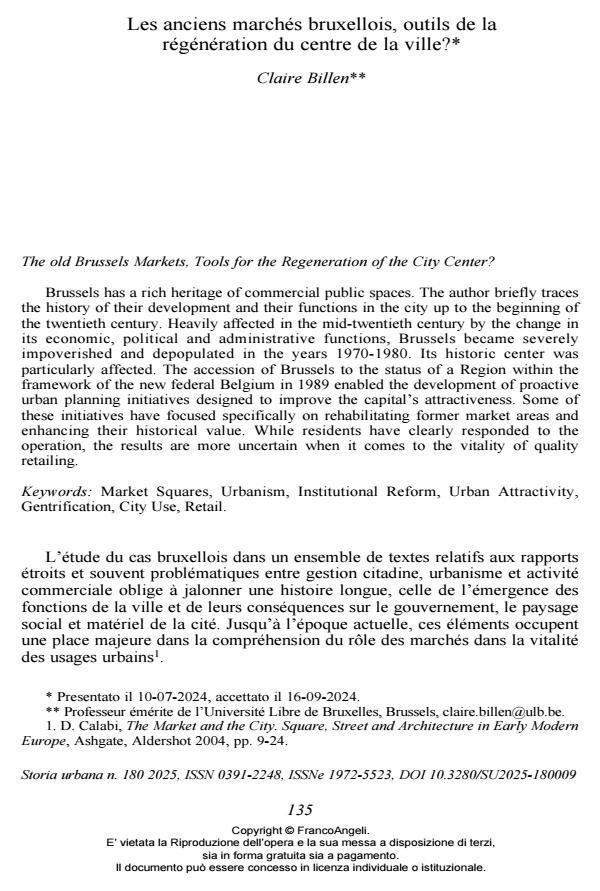
Brussels has a rich heritage of commercial public spaces. The author briefly traces the history of their development and their functions in the city up to the beginning of the twentieth century. Heavily affected in the mid-twentieth century by the change in its economic, political and administrative functions, Brussels became severely impoverished and depopulated in the years 1970-1980. Its historic center was particularly affected. The accession of Brussels to the status of a Region within the framework of the new federal Belgium in 1989 enabled the development of proactive urban planning initiatives designed to improve the capital’s attractiveness. Some of these initiatives have focused specifically on rehabilitating former market areas and enhancing their historical value. While residents have clearly responded to the operation, the results are more uncertain when it comes to the vitality of quality retailing.
Fortemente colpita, a metà del XX secolo, dal cambiamento delle sue funzioni economiche, politiche e amministrative, Bruxelles si impoverì gravemente e si spopolò nel corso degli anni ’70’80. Il suo centro storico fu particolarmente devastato. L’adesione di Bruxelles allo status di Regione nel quadro del Belgio federalizzato nel 1989 ha consentito lo sviluppo di azioni proattive di pianificazione urbana destinate a migliorare l’attrattività della capitale. Tra queste azioni, alcune si sono concentrate specificamente sulla riabilitazione dei vecchi spazi del mercato e sulla loro valorizzazione storica. Se il ritorno dei residenti ha risposto in modo chiaro all’operazione, più incerti sono i suoi risultati per la vitalità del commercio di qualità.
Keywords: Market Squares, Urbanism, Institutional Reform, Urban Attractivity, Gentrification, City Use, Retail.
Claire Billen, Les anciens marchés bruxellois, outils de la régénération du centre de la ville? in "STORIA URBANA " 180/2025, pp 135-150, DOI: 10.3280/SU2025-180009