The Black Swan: Kant, Beauvoir, and Friendship as a Relationship of Free- dom, Equality, and Reciprocity.
Journal title RIVISTA DI STORIA DELLA FILOSOFIA
Author/s Matilde Ciolli
Publishing Year 2026 Issue 2025/4
Language Italian Pages 16 P. 675-690 File size 213 KB
DOI 10.3280/SF2025-004009
DOI is like a bar code for intellectual property: to have more infomation
click here
Below, you can see the article first page
If you want to buy this article in PDF format, you can do it, following the instructions to buy download credits
FrancoAngeli is member of Publishers International Linking Association, Inc (PILA), a not-for-profit association which run the CrossRef service enabling links to and from online scholarly content.
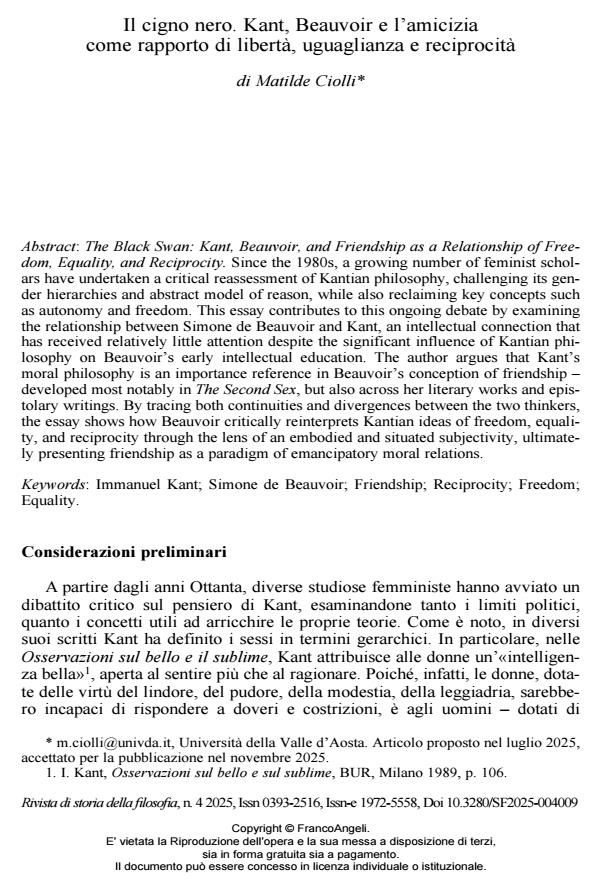
Since the 1980s, a growing number of feminist schol- ars have undertaken a critical reassessment of Kantian philosophy, challenging its gen- der hierarchies and abstract model of reason, while also reclaiming key concepts such as autonomy and freedom. This essay contributes to this ongoing debate by examining the relationship between Simone de Beauvoir and Kant, an intellectual connection that has received relatively little attention despite the significant influence of Kantian phi- losophy on Beauvoir’s early intellectual education. The author argues that Kant’s moral philosophy is an importance reference in Beauvoir’s conception of friendship – developed most notably in The Second Sex, but also across her literary works and epis- tolary writings. By tracing both continuities and divergences between the two thinkers, the essay shows how Beauvoir critically reinterprets Kantian ideas of freedom, equali- ty, and reciprocity through the lens of an embodied and situated subjectivity, ultimate- ly presenting friendship as a paradigm of emancipatory moral relations.
Keywords: Keywords: Immanuel Kant;; Simone de Beauvoir;; Friendship;; Reciprocity;; Freedom;;Equality.
Matilde Ciolli, Il cigno nero. Kant, Beauvoir e l’amicizia come rapporto di libertà, uguaglianza e reciprocità in "RIVISTA DI STORIA DELLA FILOSOFIA" 4/2025, pp 675-690, DOI: 10.3280/SF2025-004009