Communities of Commoner Communication in the Edo Period
Journal title STORIA URBANA
Author/s Yuko Tanaka
Publishing Year 2026 Issue 2025/181
Language English Pages 22 P. 21-42 File size 975 KB
DOI 10.3280/SU2025-181002
DOI is like a bar code for intellectual property: to have more infomation
click here
Below, you can see the article first page
If you want to buy this article in PDF format, you can do it, following the instructions to buy download credits
FrancoAngeli is member of Publishers International Linking Association, Inc (PILA), a not-for-profit association which run the CrossRef service enabling links to and from online scholarly content.
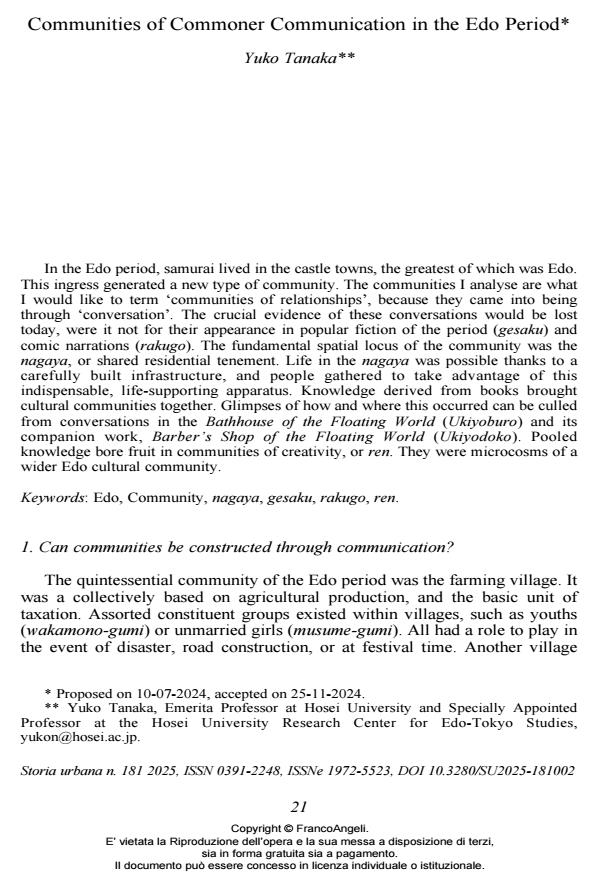
In the Edo period, samurai lived in the castle towns, the greatest of which was Edo. This ingress generated a new type of community. The communities I analyse are what I would like to term ‘communities of relationships’, because they came into being through ‘conversation’. The crucial evidence of these conversations would be lost today, were it not for their appearance in popular fiction of the period (gesaku) and comic narrations (rakugo). The fundamental spatial locus of the community was the nagaya, or shared residential tenement. Life in the nagaya was possible thanks to a carefully built infrastructure, and people gathered to take advantage of this indispensable, life-supporting apparatus. Knowledge derived from books brought cultural communities together. Glimpses of how and where this occurred can be culled from conversations in the Bathhouse of the Floating World (Ukiyoburo) and its companion work, Barber’s Shop of the Floating World (Ukiyodoko). Pooled knowledge bore fruit in communities of creativity, or ren. They were microcosms of a wider Edo cultural community.
Keywords: Edo, Community, nagaya, gesaku, rakugo, ren.
Yuko Tanaka, Communities of Commoner Communication in the Edo Period in "STORIA URBANA " 181/2025, pp 21-42, DOI: 10.3280/SU2025-181002